


The healthcare industry faces a paradigm shift in its workflows with the inception of new and advanced technologies in AI. Leveraging AI tools and technologies, improved medical outcomes can be acquired with higher healthcare efficiency. Traditional manual data management in healthcare is often time consuming and error prone, leading to inefficiencies and increased risk of mistakes. OCR helps to address these challenges.
OCR, or Optical Character Recognition, is an essential healthcare technology becoming hugely prevalent today. OCR technology helps manage the medical data of patients and hospitals and aims to streamline medical processes for better outcomes. By providing accurate data extraction, OCR reduces the risk of errors in healthcare documentation.
Let us learn about OCR in-depth and understand its various perks and limitations..
What is OCR in healthcare?
Optical Character Recognition is a technology used in healthcare to digitize data and improve data accuracy to obtain higher medical efficiency. OCR scans and converts printed and handwritten documents like patient forms, doctor’s notes, prescription labels, lab results, etc., into digital data.
This process allows healthcare information to be stored and managed in electronic form, which is essential for modern healthcare operations. This makes storing and managing healthcare information easier and creates suitable databases for the existing data. This data stored in databases is more easily accessible and can be used to generate valuable insights from a patient’s medical history..
A Quick Look Into the Working of OCR
Though OCR is getting a lot of attention lately, it is not as young as it seems. OCR was developed in 1974 in the USA for digitally recognizing and printing all font types. Fortunately, now with improved technologies, OCR, too, has become more refined and efficient. Here is how the OCR technology works:
- Primarily, the text in the image is scanned, and individual characters are segregated using an advanced program.
- Next, each character is matched to the known characters in a separate database. The program identifies and separately stores all the identified characters from the image.
- The characters are then clubbed again together as it was there in the offline format.
- Lastly, a new digital file containing the same information as in the offline medical documents is generated.
[Also Read: Learn About the Process of OCR in Detail!]
Healthcare Data Management Challenges
Managing healthcare data in today’s healthcare industry is a complex and demanding task. Healthcare providers must ensure that patient data is handled with the utmost care, not only to deliver quality healthcare services but also to comply with a web of federal civil rights laws and regulations. The Office for Civil Rights (OCR) is instrumental in enforcing these laws, including the Health Insurance Portability and Accountability Act (HIPAA), which sets the standard for protecting sensitive patient information.
With the expansion of the Affordable Care Act, more healthcare organizations now receive federal financial assistance, making them subject to even greater oversight by the OCR. This means that healthcare data management is not just about storing information—it’s about ensuring the confidentiality, integrity, and availability of patient data while adhering to strict compliance requirements. Failure to comply can result in hefty fines and jeopardize the ability to provide quality care.
Healthcare organizations must navigate these regulations while managing vast amounts of data, from medical records to insurance claims. Effective healthcare data management is essential for reducing costs, minimizing errors, and maintaining the trust of patients. By prioritizing compliance and leveraging the guidance of the Office for Civil Rights, healthcare providers can better protect patient data and deliver high-quality healthcare services.
OCR Technology and Compliance
OCR technology has become a vital asset for healthcare organizations striving to meet the rigorous demands of federal regulations. By automating the extraction of relevant information from healthcare documents, OCR solutions help healthcare providers reduce the risk of human error and improve the accuracy of healthcare data management. This is especially important for compliance with laws such as HIPAA and the Civil Rights Act.
Implementing OCR technology enables healthcare organizations to offer alternative formats and auxiliary aids, ensuring that individuals with disabilities have equal access to healthcare services. This not only supports compliance with federal civil rights laws but also enhances the overall patient experience. The Department of Health and Human Services (HHS) Office for Civil Rights provides valuable guidance and resources to help organizations understand and comply with these complex regulations.
By reducing the need for manual data entry, OCR solutions also help healthcare organizations lower operational costs and streamline processes. This leads to more efficient healthcare data management, improved accuracy, and better compliance with federal laws. Ultimately, OCR technology empowers healthcare providers to deliver high-quality care while meeting their legal and ethical obligations.
What are the Benefits and Drawbacks of OCR in Healthcare?
Similar to every technology, OCR, too, has its set of advantages and limitations. Let us discuss both of them so that you can fairly analyze the efficiency of OCR technology.
Benefits of OCR
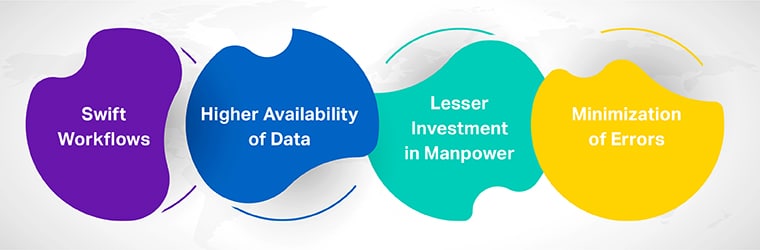
- Swift Workflows: OCR results in the automation of various medical processes, including accessing information from EHR, storing and managing healthcare data, healthcare analytics, etc. This automation in the healthcare processes significantly improves the processing time and helps save time for patients and physicians.
- Higher Availability of Data: The best perk of OCR technology is that it makes data 24*7 available to the users. As the data is digitally stored, the data extraction process becomes straightforward, and patients can eliminate delays in their treatment.
- Lesser Investment in Manpower: The healthcare industry comprises various repetitive and tedious tasks that require a substantial workforce. However, with OCR, processes get automated, and the need for a healthcare workforce significantly lowers.
- Minimization of Errors: Humans are prone to errors, especially during complicated and demanding healthcare processes. Fortunately, with OCR, human intervention gets limited, and mistakes can be pretty minimized.
Drawbacks of OCR
- OCR Requires Significant Storage Capabilities: The crux of OCR technology is to digitalize all the medical data for patients and doctors for improved outcomes. However, this may require enormous storage capabilities to store and access large volumes of data.
- Vulnerability to data breaches: Data security is a major concern for healthcare institutions, and OCR technology is still not as optimized to provide adequate security to its users and is vulnerable to data breaches.
- Difficulty in Obtaining Accuracy: The most difficult part of OCR is to accurately understand complex medical terms and jargon. Wrong or improper identification of characters might lead to transcription errors or report inaccuracies.
- More Prone to Errors: The OCR technology has not reached its ultimate potential and is still prone to errors in identifying document handwriting and images.

