The biggest stress in the market is coming to mid-priced offerings. In grocery, this means national CPGs are feeling the stress with their legacy brands. In foodservice, full-service is beginning to buckle.
The new value standard dictates that budget and unique, experiential offerings will continue to grow.
“The traditional model, where brands achieved ‘staple’ status through long on-shelf presence and blockbuster marketing budgets, has been completely disrupted,” Guy White, CEO and founder of Catalyx, told FI.
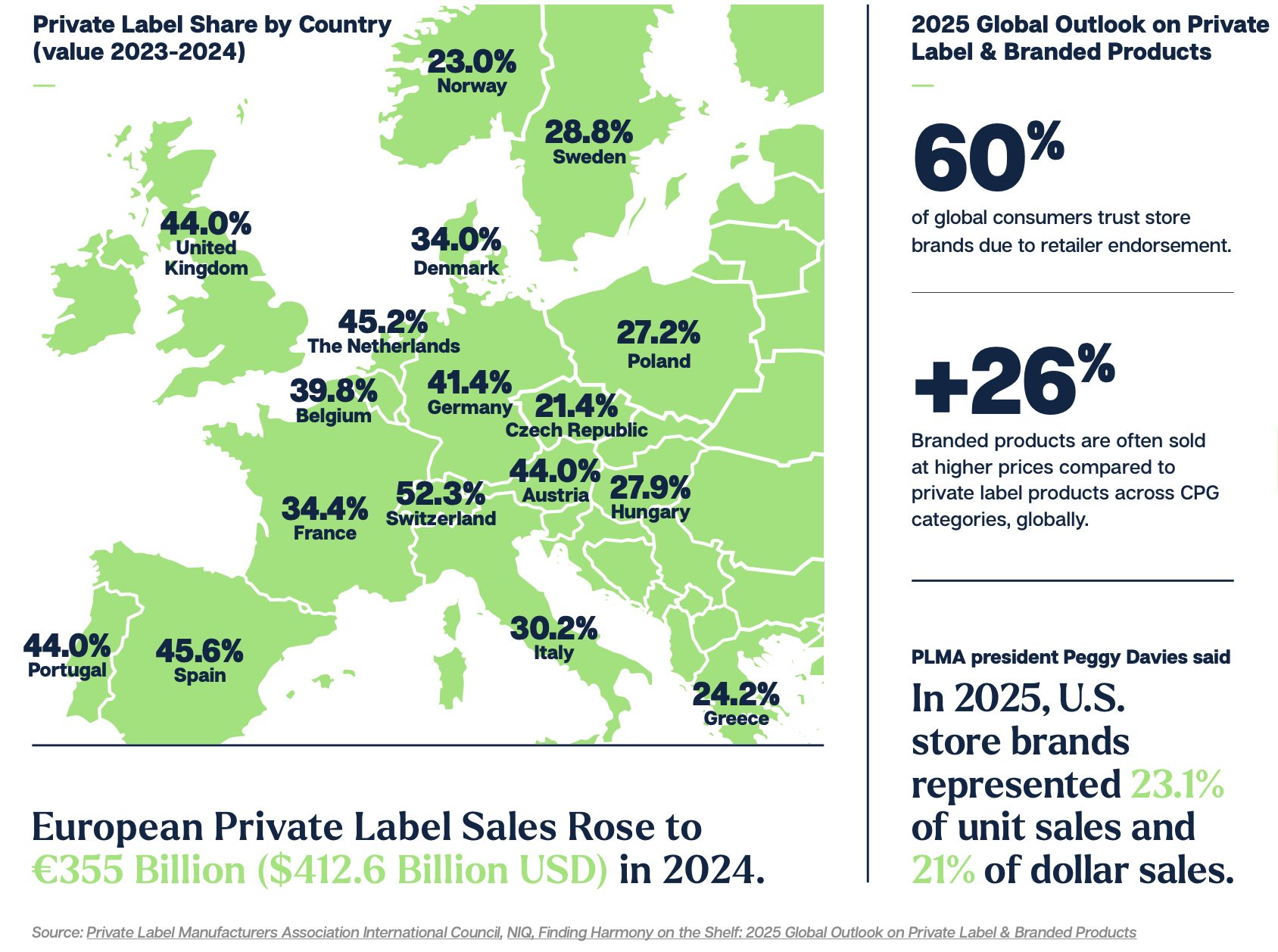
 For private label, this dominance has been gradual. These products have simply gotten better: now, 74% of shoppers say private label is just as good as their name-brand analogs.
“Private label has evolved from a trade-down to a trade-smart decision,” said Curious Plot’s Alison Buckneberg.
Coinciding with the fall of the old model is a new format that will define the future of the grocery shopping experience, in line with today’s European market.
Every year, private labels’ overall market share in the U.S. Innovation pipelines are gradually aligning to the European model, with true innovation coming from challenger brands that can better meet consumer niches. These aisles also feature fewer national brands, with private label filling out the gaps and offering lower prices.
NIQ notes that retailers are already shifting toward a “tiered assortment strategy” that features value, mid-tier, and premium private label lines poised alongside those staple national and challenger brands. This model effectively attracts different shopper segments and inspires more diverse baskets with a curated mix of offerings.
Forvis Mazars US’s Kristen Walters noted the impact that private label has had on domestic CPG brands.
“We have…seen companies that are traditionally only focused on the growth of their own brands shift towards private label customers,” she said.
On the premium end, challenger brands have excelled through their market positioning. They are well-equipped to continue delivering attractive value propositions for their core consumers, who are willing to pay a price premium for experiential, indulgent, functional, and/or artisanal offerings.
“These brands are finding creative ways to compete with legacy players by positioning themselves as affordable, yet elevated alternatives as inflation persists,” said Guy Yehiav, president at SmartSense by Digi.
He noted that frozen and ready-to-eat categories have been especially fruitful for challenger makers as they boast a premium, high-quality product that can elevate an experience while also providing attractive unit economics.
Both ultra-savings offerings and premium delights have an opening in today’s market to better connect with consumers across income levels with authenticity, transparency, and a compelling story.
The Rise of Premium Private Label
What a few years ago may have seemed like an oxymoron, FI CEO Brian Choi now calls a “bright spot” in the industry.
“Just like diners can still go to a Chili’s and get a restaurant experience at a cheaper price point, consumers can still have a heightened experience with premium private label,” he explained.
At its core is the concept of “purposeful luxury” that resonates with today’s savvy shopper.
The premium portfolio is supported by an approach that lets other players test the market. Private Label Manufacturers Association president Peggy Davies described the relationship between private label and name brands as symbiotic in an FI webinar on the topic late last year.
“We need [name brands],” Davies said. “They sometimes have a way to invest that our [private label] manufacturers don’t have. They bring some innovation to the market, and we are fast followers.”
This approach has been the subject of recent controversy as legacy brands lose market share and turn to taking legal action to recoup some of their losses. J.M. Smucker Co. is embroiled in a lawsuit with Trader Joe’s over a crustless peanut butter and jelly sandwich that allegedly resembles its Uncrustables product line.
Technological advancements in Generative AI have also enabled retailers to better innovate in the aisle, but the to-market strategy is still in its early stages.
For now, premium private label complicates the market.
“In some categories, the real competition is now between premium private label and mid-tier challenger brands. Consumers are asking themselves, ‘Why pay more for a name I don’t know, when the retailer brand already feels trustworthy?’ explained PRS IN VIVO’s Patrick Young.
This means that challengers and national brands need to work harder to offer differentiation by leveraging their respective competitive advantages: for legacy brands, it’s scale and household penetration, for challengers, it’s agility and community personalization.