


by Susan Flantzer
© Unofficial Royalty 2025

Eric VI, King of Denmark, detail from his tomb; Credit – Wikipedia
Eric VI, King of Denmark, reigned from 1286 to 1319. Born in 1274, Eric VI was the second of the seven children and the eldest of the three sons of Eric V, King of Denmark, and Agnes of Brandenburg. His paternal grandparents were Christopher I, King of Denmark, and Margrethe Sambiria. Johann I, Margrave of Brandenburg, and his second wife, Brigitte of Saxony, were Eric VI’s maternal grandparents.
Eric VI had six siblings, but three died in childhood:
- Richeza of Denmark (circa 1272 – 1308), married Nicholas II, Lord of Werle, had two children
- Christopher II, King of Denmark (1276 – 1332), married Euphemia of Pomerania, had six children
- Martha of Denmark (born between 1277 and 1282 – 1341), married Birger, King of Sweden, had six children
- Katharine of Denmark (circa 1281 – 1283), died in childhood
- Valdemar of Denmark (? – 1304), died in childhood
- Elisabeth of Denmark (1280 – 1283), died in childhood
Through his widowed mother’s second marriage to Gerhard II, Count of Holstein-Plön, Eric had one half-brother:
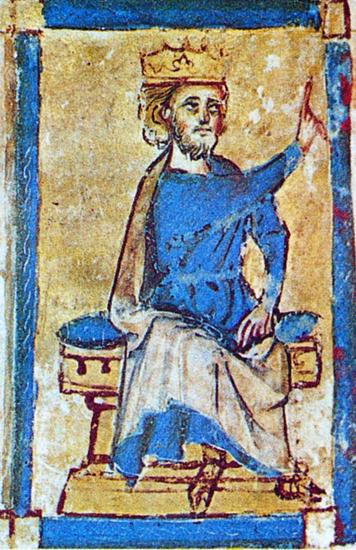
King Eric V of Denmark, Erik VI’s father; Credit – Wikipedia
Eric VI’s father, King Eric V, tried to enforce control over the church and nobility. In 1272, King Eriv V’s conflict with the church was brought to a resolution with the help of Pope Gregory X. However, by 1282, King Eric V had so offended the Danish nobles that he was forced to accept a charter, a kind of Danish Magna Carta, which limited his authority and guaranteed the rights and customs that preserved the nobles’ power. Despite the progress with the nobles’ power, several nobles swore an oath to murder King Eric V in revenge for personal slights or unpopular policies. After a long hunt on November 22, 1286, led by Rane Jonsen, King Eric V and his attendants could not find their way back to the king’s farm at Viborg. Rane suggested that they take shelter in the church barn in the village of Finderup. The assassins, dressed as Franciscan friars, were kept informed as to the king’s whereabouts and waited for everyone to settle down for the night. Once the king fell asleep, they rushed from their hiding places and stabbed and hacked the king to death.
Eric was only twelve years old when his father died. To secure the Danish throne for her son, Eric’s mother, now Dowager Queen Agnes, established a guardian government with Vitslav II, Prince of Rügen, Peder Nielsen Hoseøl, and other supporters of her late husband. Dowager Queen Agnes served as Regent of Denmark until 1294, when Eric VI, King of Denmark, reached his majority. Eric VI, King of Denmark, was crowned on Christmas Day in 1287 at Lund Cathedral.
Eric VI’s reign began in turmoil. At the Danehof in Nyborg, Denmark, in 1287, nine nobles were sentenced for the murder of King Eric V. Only one was accused of having killed the king. The others were accused of complicity. They all pleaded not guilty, but were condemned as outlaws, and they all fled to Norway, where they waited for a suitable opportunity to return. A few years later, the War of the Outlaws began when King Erik II of Norway and the convicted nobles carried out successful attacks on Danish coastal towns and took control of Northern Jutland. In 1293, the leader of the outlaws, Stig Andersen Hvide, died. The attacks subsided, and peace was made with Norway.

Ingeborg Magnusdotter of Sweden, detail from her tomb; Credit – Wikipedia
In June 1296, at Helsingborg, Sweden, Eric VI married Ingeborg Magnusdotter of Sweden, the daughter of King Magnus Ladulås of Sweden and Helvig of Holstein. The marriage was part of a dynastic marriage policy. In 1298, Ingeborg’s brother, King Birger of Sweden, married King Eric VI’s sister, Martha of Denmark. Eric VI and Ingeborg had between eight and fourteen children, but all died in infancy. In 1318, Ingeborg gave birth to a son who lived, which caused great celebrations. However, while Ingeborg and her infant son were riding in her carriage, the carriage suddenly broke and fell over, the infant fell from her grip, broke his neck, and died.
After the death of her son, Ingeborg entered St. Catherine’s Priory in Roskilde, Denmark, and there are several possible reasons. According to one version, she decided to voluntarily enter the priory, either out of grief over the death of her son or out of grief over the death of her younger brothers Erik Magnusson and Waldemar Magnusson, who died in the same year in the power struggle against older brother Birger. Another version says that Ingeborg was forcibly imprisoned in the priory by her husband, who blamed her for the death of her son.
Eric VI intervened in Sweden between 1306 and 1310 by supporting his brother-in-law, King Birger of Sweden, against his younger brothers Erik Magnusson and Valdemar. He also re-established Danish supremacy in northern Germany by relying on his other brother-in-law, Nicholas II, Lord of Werle, who surrendered Rostock to him in 1300. In 1304, Albrecht I, King of Germany, ruler of the Holy Roman Empire, gave Eric the lands north of the Elbe River and Elde River.
Eric VI and his wife, Ingeborg, both died in 1319, a year after the death of their son. Ingeborg died on April 5, 1319, or August 15, 1319, at St. Catherine’s Priory in Roskilde, Denmark. Eric VI died on November 13, 1319, in Roskilde, Denmark. Eric VI, King of Denmark and his wife, Queen Ingeborg, were buried at Saint Bendt’s Church in Ringsted, Denmark. Since Eric was childless, he was succeeded by his younger brother, Christopher II, King of Denmark.
This article is the intellectual property of Unofficial Royalty and is NOT TO BE COPIED, EDITED, OR POSTED IN ANY FORM ON ANOTHER WEBSITE under any circumstances. It is permissible to use a link that directs to Unofficial Royalty.
Works Cited
- Autoren der Wikimedia-Projekte. (2005). dänischer König (1286–1319). Wikipedia.org; Wikimedia Foundation, Inc. https://de.wikipedia.org/wiki/Erik_VI._(D%C3%A4nemark)
- Bidragsydere til Wikimedia-projekter. (2003). Konge af Danmark (1274-1319). Wikipedia.org; Wikimedia Foundation, Inc. https://da.wikipedia.org/wiki/Erik_Menved
- Flantzer, Susan. (2025). Eric V, King of Denmark. Unofficial Royalty. https://www.unofficialroyalty.com/eric-v-king-of-denmark/
- Wikipedia Contributors. (2025). Eric VI of Denmark. Wikipedia; Wikimedia Foundation.
- Wikipedia Contributors. (2025). Ingeborg Magnusdotter. Wikipedia; Wikimedia Foundation.

