


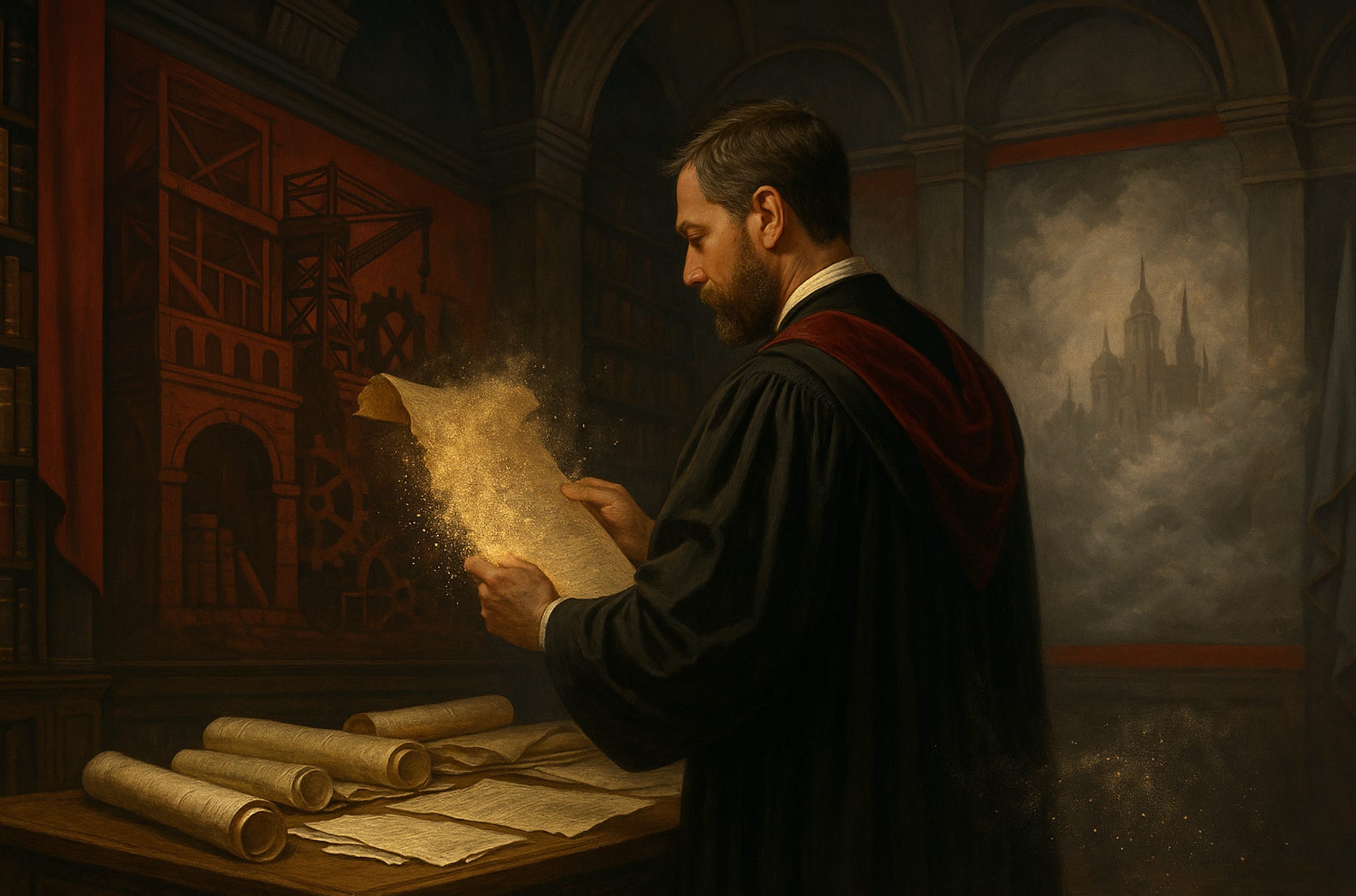
Can we “rediscover the freedoms that make us human” by rewriting the past into fake patterns? Or does such fact-unmoored idealism trap us in a cage of our own making? The case of Graeber and Wengrow’s The Dawn of Everything offers a cautionary tale for would-be utopians and their readers. It claims to be a bold reimagining of human history. But since the scaffolding of fact is too thin to support the Grand Narrative, they resort to fake facts, and so we leave us with more than faërie gold? “Speculative Nonfiction” is not, I think, a useful intellectual genre.
Indeed.
Walter Scheidel: Resetting History’s Dial? A Critique of David Graeber & David Wengrow, “The Dawn of Everything: A New History of Humanity” <https://escholarship.org/uc/item/9jj9j6z7>: ‘Graeber and Wengrow condemn “conventional narratives of world history, which present the planting of a single seed as a point of no return” (260). Yet as hyperbolic as this claim is made out to be, it is, in the end, true…. Farming had managed to spread almost everywhere 2,500 years ago and… unlocked terrestrial carrying capacity in ways that allowed our species to grow in number by three orders of magnitude between the end of the Holocene and today…. [Their] directing the spotlight at hybrid forager-farmers and at developmental lags, detours and hiatuses [in the process of the conquest of humanity by agriculture and our consequent enslavement in societies-of-domination] is… worthy…. Yet… a trap that was slow in closing was, in the end, a trap….
Strenuous mental gymnastics…. The authors advance the “speculative” claim that certain structures on the late fourth millennium BCE acropolis of Uruk may have been assembly halls (306)…. Yet this explicitly “speculative” take swiftly morphs into fact, turning into “at least seven centuries of collective self-rule” at Uruk (380)…. The presence of a citadel with monumental purification facilities in the city of Mohenjodaro (317–18)… [leads them to] envision… “a clear hierarchy between groups… [but] doesn’t necessarily mean that the groups themselves were hierarchical in their internal organization,” or, for that matter, that the higher caste called the shots in “matters of day-to-day governance” (319)…. “Necessarily” does a lot of heavy lifting… yet readers… harboring doubts are promptly chided for their lack of imagination (319)….
A single solid case of a large city without clear signs of highly centralized authority, Teotihuacan… 100,000 residents… has not left written records but lacks iconographic evidence of royalty, even as men hailing from there occupied positions of power in Mayan Tikal (331–36). Conventional beginnings… derailed…. Pyramid construction ceased, the fanciest temple was desecrated, and high-quality stone-built multi-household apartment compounds were erected to house the urban masses, arranged around 20-odd local temple complexes…. This situation prevailed for several centuries before things started falling apart, culminating in the abandonment of much of the site (341–45)…. [But] Teotihuacan was… without precedent and successor…. Something unusual was clearly going on, and a non-royal form of governance seems more likely than not. It is unclear how far beyond this we can push… Graeber and Wengrow infer from all that a “surprisingly common pattern” of scaling-up “with no resulting concentration of wealth or power in the hands of ruling elites” (322)….
Graeber and Wengrow’s extensive discussion of “why the state has no origin” is even more disappointing…. Their vaguely Weberian model of three different bases of social power— control of violence, control of information, and charismatic politics (365 and passim)—is a perfectly workable template…. [But] instead of acknowledging existing frameworks, Graeber and Wengrow prefer to invoke the most extraordinary strawpeople who are said to “assume that there is only one possible end point… that these various types of domination were somehow bound to come together, sooner or later, in something like the particular form taken by the modern nation states in America and France at the end of the eighteenth century” (369). Considering how strongly the study of state formation tends to be infused with notions of European or Western exceptionalism, nothing could be farther from the truth….
Graeber and Wengrow confuse space and people. Thus, their observation— intended to de-center state formation as a key feature of human history—that for “most” of the last 5,000 years, “cities, empires and kingdoms” were “exceptional islands of political hierarchy, surrounded by much larger territories whose inhabitants (…) systematically avoided fixed, overarching systems of authority” (382) is technically correct yet wildly misleading by prioritizing territory over population number. As far as we can guesstimate, the majority of our species has been claimed by polities with entrenched political hierarchies for several thousand years. Around the beginning of the Common Era, up to three quarters of all people on earth lived in just four Eurasian empires….
Much as in their discussion of agriculture, Graeber and Wengrow eventually revert to concessions. “Overall, one might be forgiven for thinking that history was progressing uniformly in an authoritarian direction. And in the long run it was” (323)…. [So] they decide to move the goalposts…. They muse, that… just as in the case of farming, state building took a long time but became a big success: once grain states grew, so did their populations, and they outcompeted other forms of organization (443–44). That, of course, is exactly what happened. But did it absolutely have to be that way? “How inevitable, really, were the type of governments we have today?… Was this really the necessary culmination of human history?” (446)…. Inevitability sets a pretty high bar…. Counterfactual reasoning might be an option, but that they dismiss as “at best an idle game” (449). Where are real-life alternatives to be found? Graeber and Wengrow… [claim] the Americas… “the one truly independent point of comparison” (451)…. [But] the emergence of the Aztec and Inca autocracies from more diverse beginnings effectively put Central and South America out of play as well (370–78).…
In the eleventh century… Cahokia… 15,000 residents, marked by monumental construction, social hierarchies, mass killings, and elite control over the city and its hinterland, plus extensive cultural influence elsewhere—in other words, the emergence of an incipient grain state. Yet Cahokia was abandoned…. Graeber and Wengrow… note that “populations were relatively sparse” (469, also 472), a condition essential in creating affordable exit options…. The absence of horses constrained the capacity of aspirants to project power…. Both of these factors sustained an unusual lack of circumscription…. [Moreover] collapses and hiatuses were common around the world, even in places where the deck was not as stacked against early states as it was for Cahokia and Cahokianism…. In view of… [a] familiar template of concentration and abatement, the lack of circumscription, the growing impact of European-induced attrition—it is not quite obvious how developments among Indigenous groups could represent a genuine alternative to conventional trends.
Yet Graeber and Wengrow, bereft of other candidates elsewhere, need it to be… a “backlash” against the Cahokian experience—a backlash that “was so severe that it set forth repercussions we are still feeling today” (482)…. Some might see a tangle of conjectures, others a scenario worth thinking with. Graeber and Wengrow are more confident: “Certainly, the overall direction, in the wake of Cahokia, was a broad movement away from overlords of any sort and towards constitutional structures carefully worked out to distribute power in such a way that they would never return” (491). And it was that “backlash” that allowed indigenous North Americans to “almost entirely sidestep the evolutionary trap that we assume must always lead, eventually, from agriculture to the rise of some all powerful state or empire.”…
7,000 years separated the earliest known traces of crop cultivation and the appearance of archaic states in Central America and the Andes. Lag times were similar in the Middle East and only somewhat shorter in East Asia, the Sahel and southern Africa…. In view of timelines elsewhere, the failure of sustainable state formation to catch on in North America prior to the European takeover can hardly count as anomalous. If the anti-Cahokia backlash scenario is the best Graeber and Wengrow can come up with to demonstrate alternative trajectories of social evolution, determinists can rest easy….
Only once does their charge against the present become concrete: “There is no doubt that something has gone terribly wrong with the world. A very small percentage of its population do control the fates of almost everyone else, and they are doing it in an increasingly disastrous fashion” (76). How this notion squares with the fact that the proportion of humankind living in liberal or electoral democracies has increased from next to nothing a couple centuries ago to about a third today is left unexplained. Nor does it account for the concurrent growth in prosperity, health, longevity and knowledge. No matter: while Graeber and Wengrow concede early on that it is hard to argue with the statistics of progress, they query whether “‘Western civilization’ really made life better for everyone” (18)—truly a high bar if taken literally.
However we define the flaws of the present, the authors seek redress. That, in the end, is what the book is for: an improved understanding of the past will help us improve our own future. To do so, we must first “rediscover the freedoms that make us human” (8); rediscover them, that is, in the historical record. Graeber and Wengrow are aware that their account might be seen as even more tragic than foreshortened teleological versions precisely because it highlights alternatives that once existed but are long gone. “But on the other hand it also suggests that, even now, the possibilities for human intervention are far greater than we’re inclined to think” (524). In the context of their own narrative, this “even now” comes out of the blue, even as they present it as axiomatic, as self-evident….
Is it at least plausible? As a particular way of life became dominant, earlier alternatives slowly but surely lost their relevance, both in terms of their legacy— their impact on our own world—and in terms of inspiration—what they can make us do today…. How much do these faded traditions have to offer to us today, how can they teach us to make different choices in the present?… Is it enough simply to remind us that it once existed? Do they who control the past really control the future?
Their idealist purism traps Graeber and Wengrow in a cage of their own making. Acknowledgment of materialist perspectives would have helped them draw more meaningful connections between past and present. If it was their mobile lifestyle and hybrid mode of subsistence that made it easier for Holocene foragers to step in and out of different forms of cooperation than it was for fullblown farmers who found themselves tied to their lands and crops, how do we compare? Do service economies, digital tools and globalization hold out the promise of a new dawn? Materialism is not the enemy of historical understanding: it is essential to it. Nor is it the enemy of social activism. It might even be its best friend…
Scheidel focuses on the main red thread of Grand Narrative argument in Graeber and Wengrove: that only malign contingency and bad luck landed humanity in agrarian-age societies-of-domination which left a legacy that still shadows us today, as opposed to a belief that the coming of “civilization” was we knew it in 1500 and know it today was the result of very strong pressures and trends. And he—convincingly and, I believe, completely accurately—points out that that argument makes absolutely no sense at all, relying entirely on rhetorical misdirection tricks with smoke and mirrors.
What Scheidel does not focus on is that, by my count, 1/3 or so of Graeber and Wengrove’s claims about how things went down in individual episodes in the past are wrong, 1/3 or so are extremely tortuous and Prokroustean misrepresentations, and only 1/3 or so are what any fair-minded observer would say are broadly right. This is a pattern I am familiar with from Graeber’s Debt, in which he claimed, falsely, that “it was all true” that the world’s gold reserves were stored in basement vaults beneath the World Trade Center on 9/11/2001.
To me that lack of factual mooring to reality makes G&W useless, even as “a tangle of conjectures… [evoking] scenario[s] worth thinking with…” And thus I have a bone to pick with Henry Farrell, who says his final view on David Graeber is a:
That seems to me to be unhelpful. Rely on something David Graeber wrote about how some historical episode went down and try to use it as payment as you construct an argument, and you are very likely to find that you have tried to buy something with faërie gold—enchanted temporarily, yes, but misled. And then comes the awakening on the cold hillside.

