


By Stephen Campbell
A common refrain among astute observers holds that the United States has in recent decades descended into a “New Gilded Age” that explicitly recalls the income inequality, class conflict, monopolization, and corporate malfeasance of the late-19th century epoch dominated by unscrupulous robber barons. Yet, as this article shows, fears of corporate money corrupting democratic elections predate the Civil War and may even go back to the country’s founding.
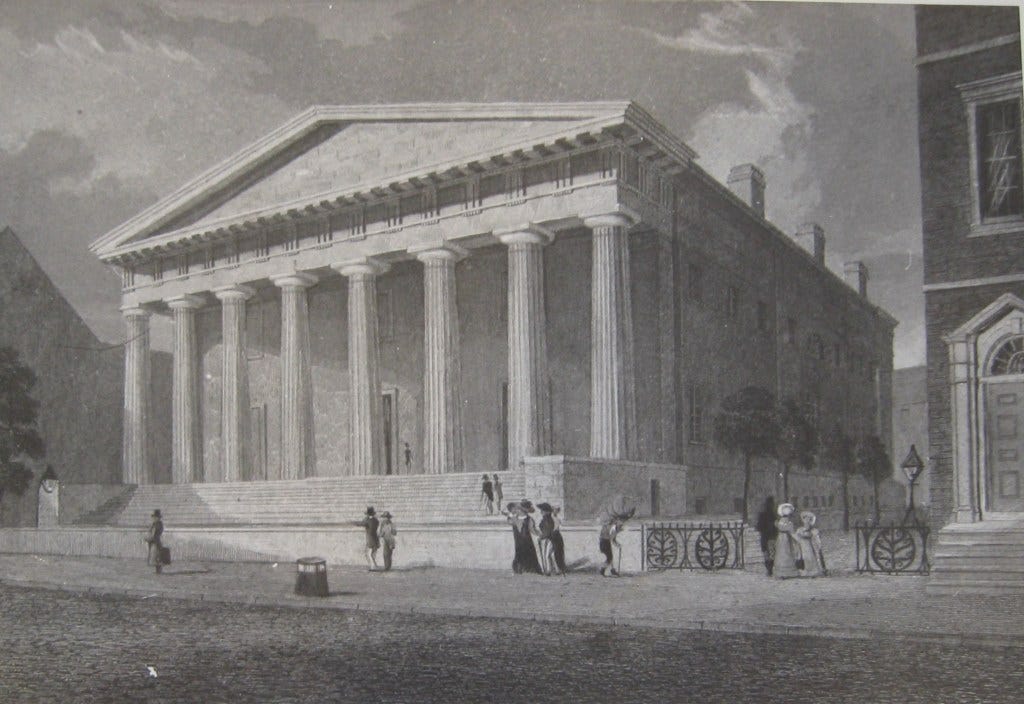
President Andrew Jackson’s political conflict with the Second Bank of the United States (BUS)—the “Bank War”—was a case in point. In an issue that both defined his presidency and contributed to the development of mass political parties, Jackson drew up a grocery list of objections to the BUS akin to Jefferson’s world-famous tirade against King George III.
According to Jackson and his followers, the Jacksonians (later, Democrats), the Bank was an unconstitutional state-sanctioned monopoly that violated states’ rights, widened class divisions, undermined equal opportunity, stimulated sectionalism, rewarded foreign stockholders, and privileged rapacious speculators and creditors at the expense of hard-working farmers and artisans. One of the most common indictments of the “Monster Bank” was that it could wield its formidable financial resources to interfere in the electoral process by bribing members of the press and Congress.
Even historians inclined toward a charitable treatment of the BUS and its stewardship under the Philadelphia patrician, Nicholas Biddle, recognize that Jackson’s fears on this point had at least some basis in reality. But how much money did the Bank spend in its ultimately futile attempt to prolong its existence and avoid the wrath of Andrew Jackson?
My book, The Bank War and the Partisan Press: Newspapers, Financial Institutions, and the Post Office in Jacksonian America, offers an updated and more detailed response to this question while characterizing Biddle’s efforts as one of the earliest interregional corporate lobbies in the nation’s history. Evidence from numerous manuscript collections, bank balance sheets, newspaper editorials, minutes of BUS board meetings, internal memoranda between bank officers, and records of legislative debates, sheds light on the ways in which the Second Bank propagated a positive message through space and time.
Biddle’s Campaign achieved a nationwide presence primarily because he deployed large sums of cash; because he mobilized an impressive array of branch officers, state bankers, lawmakers, intellectuals, voter counters, and confidential agents; because he communicated a relatively uniform message to disparate geographic locations; and because advancements in transportation and communication, in combination with the peculiar institutional structure of the Bank in the form of branch offices, enabled one man to reach scores of correspondents separated by hundreds of miles of distance.
In response to Jackson’s first public criticism of the Bank during his annual message to Congress in December 1829, Biddle authored an anonymous piece defending the Bank’s currency. A Senate Finance Committee report issued the following March replicated Biddle’s language in stating that the Bank provided “a currency as safe as silver; more convenient, and more valuable than silver, which…is eagerly sought in exchange for silver.” The House Ways and Means Committee followed suit a few weeks later. To ensure that these reports reached a wider audience, Biddle asked the Bank’s board of directors to appropriate some of the institution’s funds for printing and dissemination. The board, which was comprised of Biddle and like-minded colleagues, agreed.
In addition, the board approved funds for printing and distributing articles and pamphlets written by former treasury secretary Albert Gallatin and George Tucker, a professor of political economy at the University of Virginia. Using the Bank’s funds for self-promotion was risky because it threatened to confirm Jacksonians’ worst fears and cause political blowback. Yet because Bank defenders believed that Jacksonians manipulated public opinion through gross exaggerations and demagogic rhetoric, they were willing to take the risk.
The Bank’s business model, according to a little-known internal report circulated among the Bank’s stockholders and directors, “derive[d] much of its advantages from its credit, and its general reputation for solvency.” Too many unanswered attacks in partisan newspapers might erode borrowers’ trust in that reputation, triggering a devastating bank run.
In the early months of 1831, the contours of an interregional corporate lobby began to take shape. Biddle dispatched confidential agents with bank funds to state legislatures in Pennsylvania and New York in order to procure pro-BUS resolutions. One of Biddle’s agents, Jacksonian newspaper editor John Norvell, wrote in March that he was “very hospitable” to a number of legislators in Harrisburg, inviting them to dine at his place, “lending five, ten, and twenty dollars to them,” which he never expected to get back.
Norvell told Biddle, “your hundred dollars are pretty well exhausted,” and worried that their secret arrangement would invite scrutiny. The editor closed with a stern plea: “For Heaven’s Sake, throw this letter into the fire as soon as you have read it. It contains some things not to be disclosed to the world.”
The core of Biddle’s lobby was the financial assistance he extended to partisan newspaper editors for circulating Bank reports, internal documents, letters, balance sheets, and editorials. Duff Green of the United States Telegraph, James Watson Webb of the New York Courier and Enquirer, and Thomas Ritchie of the Richmond Enquirer were some of the most high-profile editors that received substantial loans from the Bank. The National Intelligencer, edited by Joseph Gales, Jr. and William Seaton, was Biddle’s preferred medium.
Such loans became the subject of acrimonious congressional hearings in the spring of 1832 that threatened to derail the Bank’s hope of a new charter. A special select House committee headed by the anti-BUS Representative Augustin Clayton of Georgia pummeled Biddle’s relationship with the press in a report issued in April 1832, claiming that the bank had abused its powers because it issued loans of unusually long duration to editors without adequate security.
A $15,000 loan to Webb, in particular, exposed Biddle to charges of bribery, especially because the latter had taken this sum out of his own personal funds without recording the transaction in the bank’s account books. Nor had Biddle presented Webb’s loan application before the bank’s board as required. Although Biddle retained support among a majority of representatives and senators in Congress, at least one of Biddle’s colleagues and closest allies, BUS director Thomas Cadwalader, disapproved of the unilateral and secretive manner in which Biddle propped up editors.
When Cadwalader left Philadelphia on business in early 1832, Biddle single-handedly expedited loans to some of his preferred editors, including “an accommodation to Gales and Seaton, of several years standing.” Cadwalader contemplated resignation. While he recognized that Biddle’s behavior stemmed from his “zeal for the interests of the Bank,” he emphasized to the BUS president in no uncertain terms, “do me the justice to acquit me of all knowledge of, or participation in [these] transactions.”
Historians have yet to systematically calculate Biddle’s spending and loans from January 1830 to July 1832, the period in which he was lobbying most intensely. When writing about the presidential election in the fall of 1832, famed Jackson biographer Robert V. Remini stated, “Although it can not be determined precisely…it is likely that something approximating $100,000 was spent by the institution to defeat Andrew Jackson.”
The unapologetically pro-Biddle historian, Thomas Payne Govan, wrote, “During 1831 and 1832 the Bank had spent a total of eighty thousand dollars for the preparation, printing, and circulation of documents.” Though Govan was generally detailed in his research, he only cited Henry Gilpin’s diary in this section. While his estimates for Bank expenditures on printing and circulation are roughly in-line with my own, Govan did not estimate the loans to members of Congress and editors.
It is possible to improve upon these estimates with greater clarity and detail, though not without recognizing significant challenges and demanding a careful analysis of sources. Financial statements are scattered and contain incomplete information. Antebellum era financiers and politicians had yet to develop a standardized terminology to describe credit instruments and Biddle did not record some of his more clandestine maneuvers in the bank’s account books.
Sorting out the difference between loans that clearly had a corrupt intent and those that were merely providing convenient credit facilities, moreover, can be more of an art form than science. A list of the Bank’s “advancements” to members of Congress in one government report led one political scientist to affirm the Jacksonian charge of bribery, but closer inspection shows that the advancements were more likely just standard payments to members of Congress for their salary. The BUS, as the Treasury Department’s fiscal agent, facilitated the collection and distribution of all public moneys, including payments to public officials.
To move beyond what previous historians have done, it is important to distinguish between loans and expenditures. Lending was often the sole function that enabled a bank’s continued profitability and existence. We do not gain much insight in terms of the Second Bank’s influence by adding up the total dollar amounts of various loans over time since a mere summation cannot tell us whether each loan was repaid, renewed, or defaulted.
Biddle’s secret loans to editors certainly warranted criticism and evinced bribery, but most loans to editors and members of Congress did not constitute a grievous threat to democratic institutions in the way that Jacksonians claimed. Our interpretation changes, however, when we consider the Bank’s spending, particularly since much of the spending was intended to influence voter behavior, the terms of debate, or the character of the public sphere. Even Biddle’s political allies in the Whig-led Senate of 1834 criticized the instances in which the Bank spent its own money to secure a new charter.
The best available evidence I have gathered indicates that the bank spent somewhere between $50,000 and $100,000 from the start of Jackson’s first term to the veto in July 1832. This sum included payments to various agents (confidential and otherwise) and orders for the printing and dissemination of sundry reports, articles, treatises, pamphlets, editorials, and other documents. In the same period, the bank loaned about $150,000 to $200,000 to members of Congress and perhaps $100,000 to editors.
One hundred thousand dollars in 1832 would be equivalent to several million dollars today, though there are many caveats to any estimate ranging over such a long period of time. For comparison, we might consider that the size of the U.S. economy in 1830, as measured in gross domestic product (GDP), was approximately $1 billion. The U.S. federal budget for 1832 was $34.6 million, which was about the same amount as the bank’s paid-in capital stock.
If Biddle spent and lent so much money in an effort to secure a new charter, why did he fail? For one, his chief media allies — Webb, Green, and Gales and Seaton — were poor businessmen and lacked the energy and enthusiasm of their anti-BUS rivals. And because of Jackson’s opposition, Biddle needed a two-thirds majority in both houses of Congress to obtain a new charter, an exceedingly tall order with a popular president and a nation increasingly polarizing along partisan lines.
As I’ve written elsewhere, the Jacksonians appropriated publicly-funded patronage networks in state and federal bureaucracies to counter the Bank’s prowess. An unnamed BUS officer at the branch office in Richmond, Virginia provided an additional reason: corporate lobbying could backfire. In his view, if Biddle sent pro-BUS material there, “certain demagogues in the district” would “indulge in the most shameless misrepresentations, and invectives against the Bank.” Not only was this a lesson that public relations campaigns could backfire, but that donations and favorable media coverage in and of themselves, whether in 1832 or in the twenty-first century, do not guarantee any particular outcome, even if they shape political behavior in powerful ways.
About the Author: Stephen W. Campbell is a historian, author, and lecturer who teaches in the history department at Cal Poly Pomona. He holds a master’s degree in history from CSU Sacramento and a doctorate in history from UC Santa Barbara. A California native and early-19th US scholar who specializes in political and economic history, Campbell has authored several peer reviewed articles and has been teaching college-level history courses since 2007. His book, The Bank War and the Partisan Press: Newspapers, Financial Institutions, and the Post Office, has recently been published by the University Press of Kansas. You can find him on Twitter at @Historian_Steve.

