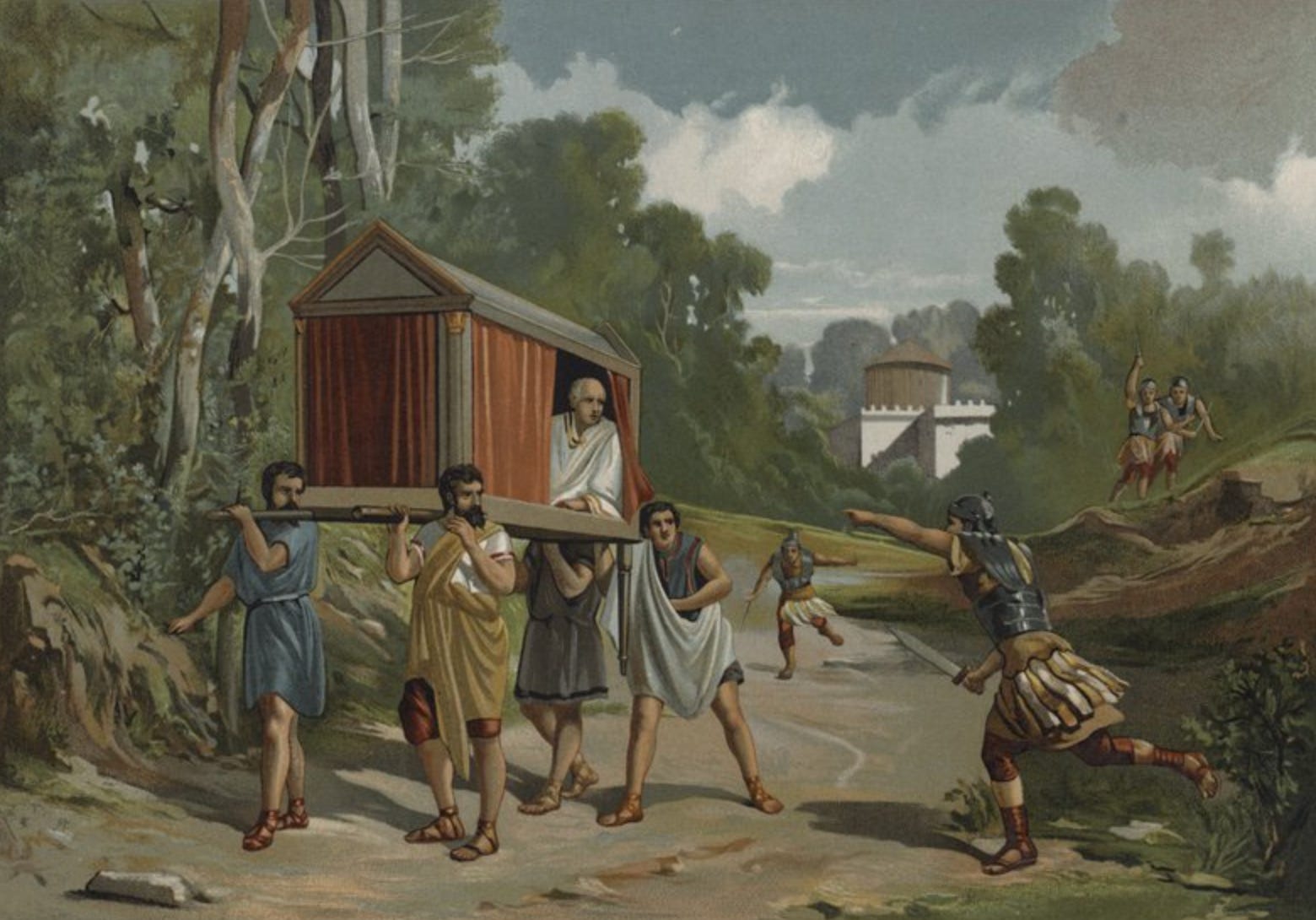
“Adolescentem: Laudandum, Ornandum, Tollendum”: “The Boy: Praise, Honor, Remove”: Cicero, Octavian, & the Politics of Necessary & Unnecessary Violence: gerundives & grim actions…
2067 years ago today the Roman Senator Marcus Tullius Cicero M. f. M. n. (hereafter “Cicero”), age 63, was murdered. On December 7, -43, 21 months after the assassination of the Dictator Gaius Julius Caesar G. f. G. n. (hereafter “Julius Caesar”), Cicero was killed by the soldiers commanded by the troop of Centurion Herennius and Military Tribune Gaius Popilius Laenas, acting on the orders of the Second Triumvirate of Marcus Antonius, Marcus Amelius Lepidus, and Gaius Julius Caesar Octavianus G. f. G. f. (hereafter “Caesar Octavianus”)—the future Emperor Augustus.
That was six and a half months after he had received this letter from Decimus Junius Brutus Albinus, Propraeter for Cisalpine Gaul:
D. Brutus: To M. Cicero, Eporedia, 24 May -43 <https://www.loebclassics.com/view/marcus_tullius_cicero-letters_friends/2001/pb_LCL230.307.xml>: ‘Greetings.
My affection for you and your services to me make me feel on your account what I do not feel on my own: fear.
Here is something I have often been told and have not thought negligible—my latest informant is Labeo Segulius (he never acts out of character), who tells me that he has been with Caesar [Octavianus} and that a good deal of talk about you took place. Caesar [Octavianus}, he says, made no complaints about you to be sure, except for a remark which he attributed to you: ‘the young man must be praised, honoured, and—removed.’
He added that he had no intention of letting himself get removed.
I believe that the remark was repeated to him (or invented) by Labeo, not produced by the young man. As for the veterans, Labeo would have me believe that they are grumbling viciously, and that you are in danger from them. He says they are particularly indignant that neither Caesar nor I have been put on the Commission of Ten,2 and that everything has been placed in the hands of you gentlemen.
When I heard all this, though I was already on the march, I thought it would be wrong for me to cross the Alps yet, before I knew what was going on in Rome. As for the danger to yourself, believe me, they are hoping to gain larger gratuities by talking at large and threatening trouble. They mean to terrorize you and instigate the young man. This whole rigmarole has one origin: they want to make as much profit for themselves as possible. At the same time I don’t want you to be other than circumspect…
The Latin for:
Caesar [Octavianus], he says, made no complaints about you to be sure, except for a remark which he attributed to you: ‘the young man must be praised, honoured, and—removed’ He added that he had no intention of letting himself get removed…
is:
Ipsum Caesarem nihil sane de te questum, nisi dictum quod diceret te dixisse: ‘adolescentem laudandum. ornandum, tollendum’. Se non esse commissurum, ut tolli posset…
The words are: “the boy: praise, adorn, remove”. The case endings say this is a matter of necessity, with these cases used for necessity: both in the sense that the planets must move in their orbits, and in the sense that this must happen if our purposes are to be accomplished. The verbs laudare and ornare are uncomplicated: praise, adorn. The verb tollere, on the other hand, has a primary meaning of elevate (in the sense of raise your eyes or raise your hands) and a secondary meaning—its meaning in this context—of lifting up some burden that is holding you down. The range of possible meanings back then in the minus-first century was, I think, something like: lift, elevate, raise; lift/take up/away; destroy; remove, steal.
Cicero’s Latin is very effective, rhetorically: adolescentem laudandum, ornandum, tollendum does stick in one’s mind. Translation is—as always (cf. George Steiner, After Babel, passim)—very difficult to attain something like the same set of connotations and penumbras in the mind of the reader. “must be praised, honoured, and—removed” does not do it. Neither do:
-
“The young man must get praises, honours, and—the push”
-
“The young man must be praised, honored, and set aside.”
-
“The young man must be praised, honored, and immortalized.”
-
“The young man must be praised, honored, and put aside.”
-
“The young man must be praised, honored, and got rid of.”
-
“The young man must be praised, honored, and get the push.”
-
“The young man must be praised, honored, and lifted up.”
-
“An excellent youth who must be praised and—sent to another place.”
And “lifted off” does not do it either.
Anyway, as of May 24, -43, it was fourteen months after the assassination of Julius Caesar. Caesar Octavianus had been adopted by Gaius Julius Caesar as his son and named his heir. Marcus Antonius had blocked him from gaining control over Julius Caesar’s fortune. And so he had borrowed on an enormous scale to pay out the 300HS that Julius Caesar had bequeathed to every citizen of Rome in his will, to hold the public Games of Caesar Victorious, and to raise an army of four legions. Caesar Octavianus had then joined the faction of Caesar’s assassins in a Civil War against Julius Caesar’s lieutenant Marcus Antonius and his forces.
But Caesar Octavianus was playing a double game, at least.
In November -43 he would switch sides, and ally with Marcus Antonius and Marcus Amelius Lepidus, And on December 7 Marcus Tullius Cicero would die.