


WASHINGTON — Most freshman lawmakers spend their first year, or even years, working on Capitol Hill in obscurity. Not Adelita Grijalva.
Before she even raised her hand to take the oath of office, the Arizona Democrat this fall was fortuitously thrown into the national spotlight and has become an unexpected but unwavering voice for sexual assault survivors.
For 50 days after Grijalva won a special election in a safely blue seat in Arizona, Speaker Mike Johnson, R-La., refused to seat her while the House was out.
Though the House was out, Grijalva and her would-be Democratic colleagues clashed with Johnson in the halls of the Capitol. Johnson, they argued, was keeping the House out of session to delay Grijalva from becoming the clinching 218th signature to force a vote to release the Jeffrey Epstein files. The speaker denied that was his intent, insisting she would be seated promptly once Democrats agreed to end the longest shutdown in U.S. history.
The seven-week standoff kept Grijalva and the Epstein story in the headlines and helped build momentum for the near-unanimous passage of a bill to force the Justice Department to release all of its files related to the late convicted sex offender.
The most junior of 535 members of Congress is now easily recognized by reporters and staffers alike in the Capitol. Colleagues refer to her by just her first name.
“Adelita showed courage and persistence in fighting to be sworn in and making it clear she stood with the survivors,” Rep. Ro Khanna, a California Democrat who co-authored the Epstein bill with Republican Rep. Thomas Massie, told NBC News. “She deserves a lot of credit for our success.”
Johnson finally administered the oath to her Nov. 12, and she formally took the seat of her father and liberal icon, Rep. Raul Grijlava, who died in March. The Epstein bill cleared both the House and the Senate six days later.
Short and stocky, the elder Grijlava had been a towering figure on Capitol Hill, serving as both chairman of the Natural Resources Committee and leading the Congressional Progressive Caucus for a decade. On the Hill, his daughter had expected to follow in his footsteps, focusing on the same issues he did: education, the environment and immigration.
But the confluence of the Epstein saga and her fight to be seated has added another issue to her portfolio: advocating for survivors.
In an interview in the Capitol, Grijalva downplayed her own role in the battle over the Epstein files, instead crediting the courageous survivors who’ve gone public in telling their personal stories of being sex trafficked and abused by Epstein when they were minors.
“When we look at the situation that I was put in, it’s easy to advocate for the survivors and justice for them,” Grijalva told NBC News. “That was not even something I had to say, ‘Let me think, do I want to do this?’ That absolutely was something that, morally, everybody should do. I’m happy to join many others who did a lot more work — especially the survivors.”
It’s a role Grijalva, 55, a mother of three teenagers, said she feels comfortable with, given her career. For more than 25 years, she worked at the Pima County Teen Court, where she ran a diversion program that gives youth an alternative to going through the formal court process. She served for 20 years on the Tucson Unified School District board and the past four years on the Pima County Board of Supervisors — the same path her father took to Washington.
In all of those roles, Grijalva said, she worked with homeless children, foster children, those living in poverty and with organizations like the Emerge Center Against Domestic Abuse in Tucson.
“Advocacy for people that feel like they don’t have a voice has always been something that I’m very comfortable with. I think that it is our responsibility. When people don’t feel like they have support or the ability … to raise their own voices, then it’s part of our responsibility to do that,” Grijalva said in the interview. “So, yeah, I can get loud.”
She and a dozen of her Democratic colleagues did get loud Oct. 14, as they marched arm-in-arm to the speaker’s office to demand that Johnson seat Grijalva. They repeatedly chanted “Swear her in!” and carried purple signs with the same message. Video showed them pushing past a Capitol Police officer and Johnson accused the Democrats of “storming” his suite, but they appeared to turn back once they were denied access.
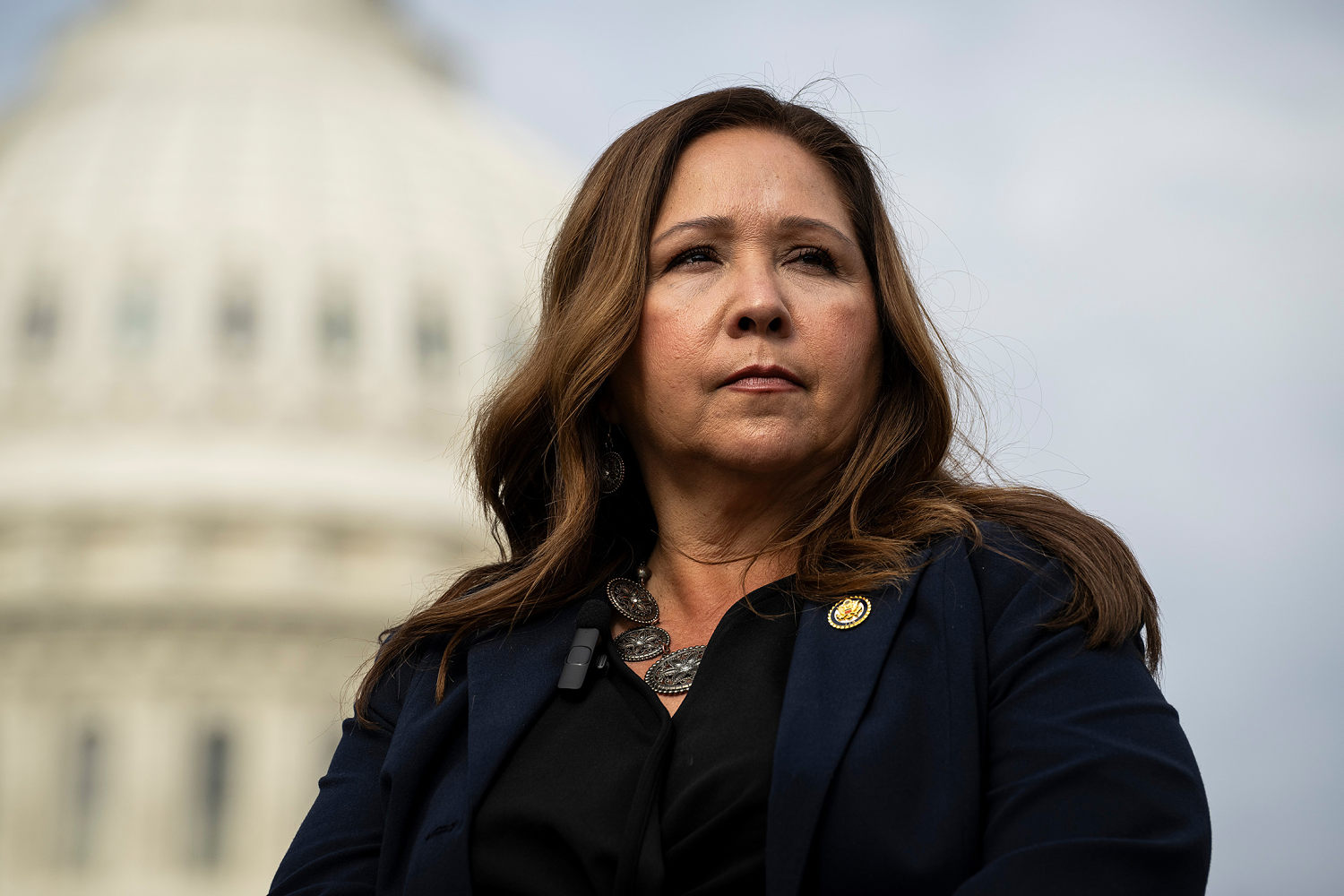
On Nov. 18, Grijlava stood before the Capitol dome with other Democratic lawmakers, sexual abuse survivors and survivor advocates to urge unanimous passage of the Epstein legislation in the House and the Senate. Later that day, it passed the House 427-1, then cleared the Senate by unanimous consent. Rep. Clay Higgins, R-La., was the only lawmaker in either chamber to vote no, arguing that it didn’t do enough to protect victims’ privacy.
“This felt very much like the advocacy work in protecting children,” Grijlava said of the push to release the files. “Because while they are women now, this happened to them when they were children and they needed somebody to stand up for them.”
She’ll continue her focus on education and climate advocacy as well, much as her father did. She’s been assigned to both the Education and Workforce Committee and the Natural Resources Committee, where her father was the top Democrat from 2015 until earlier this year.
Despite being the daughter of a longtime congressman, Grijlava said, she’s still learning her way around the building. “I’ve never been on the Hill before. I didn’t intern here. This is not my lived experience,” she said.
The day after Johnson swore her into office, Grijalva sat down for an interview alongside two Epstein survivors, Liz Stein and Jess Michaels. NBC News’ Hallie Jackson asked the survivors what it felt like to be in the House gallery witnessing Grijalva finally taking the oath of office.
“Not just because of how historic a moment it was for us as a country, but also the validation and the representative’s fierceness, her courage, is just so contagious to all of us,” Stein said.
“To have her validate us in front of the entire House, and for Jess and I to get a standing ovation from the members when we have felt at times so unheard by the people in our government, was absolutely transformative for me.”

