Agglomeration locks in advantage; weaponized tariffs unlock dysfunction. Macro self‑sufficiency hides micro choke points—and China sits at the hub. The U.S. lost trust; China gained leverage; decoupling shrank to slogans…
Share
Big economies look nearly self‑sufficient—until a single input fails. China’s hub advantage, the U.S.’s trust deficit, and Brexit’s self‑inflicted friction show why weaponized trade weakens coalitions more than China. Global supply chains are an omelette—entangled, efficient, and hard to reverse. The macro story (large domestic shares) masks micro fragility: specialized intermediates, scaled clusters, and dense spillovers that make agglomeration self‑perpetuating. China’s role as dominant supplier of intermediates creates asymmetric leverage; the U.S., Japan, and Germany are more exposed to China than vice versa. Tariffs, deployed unpredictably, erode allied coordination and deepen reliance on precautionary stockpiles rather than capacity. Brexit exemplifies how added friction shreds regional resilience. If the race to be the furnace that forges the global future isn’t already decided, agglomeration economics—not punitive trade optics—will decide it soon.
Share DeLong’s Grasping Reality: Economy in the 2000s & Before
A very nice piece from Richard Baldwin:
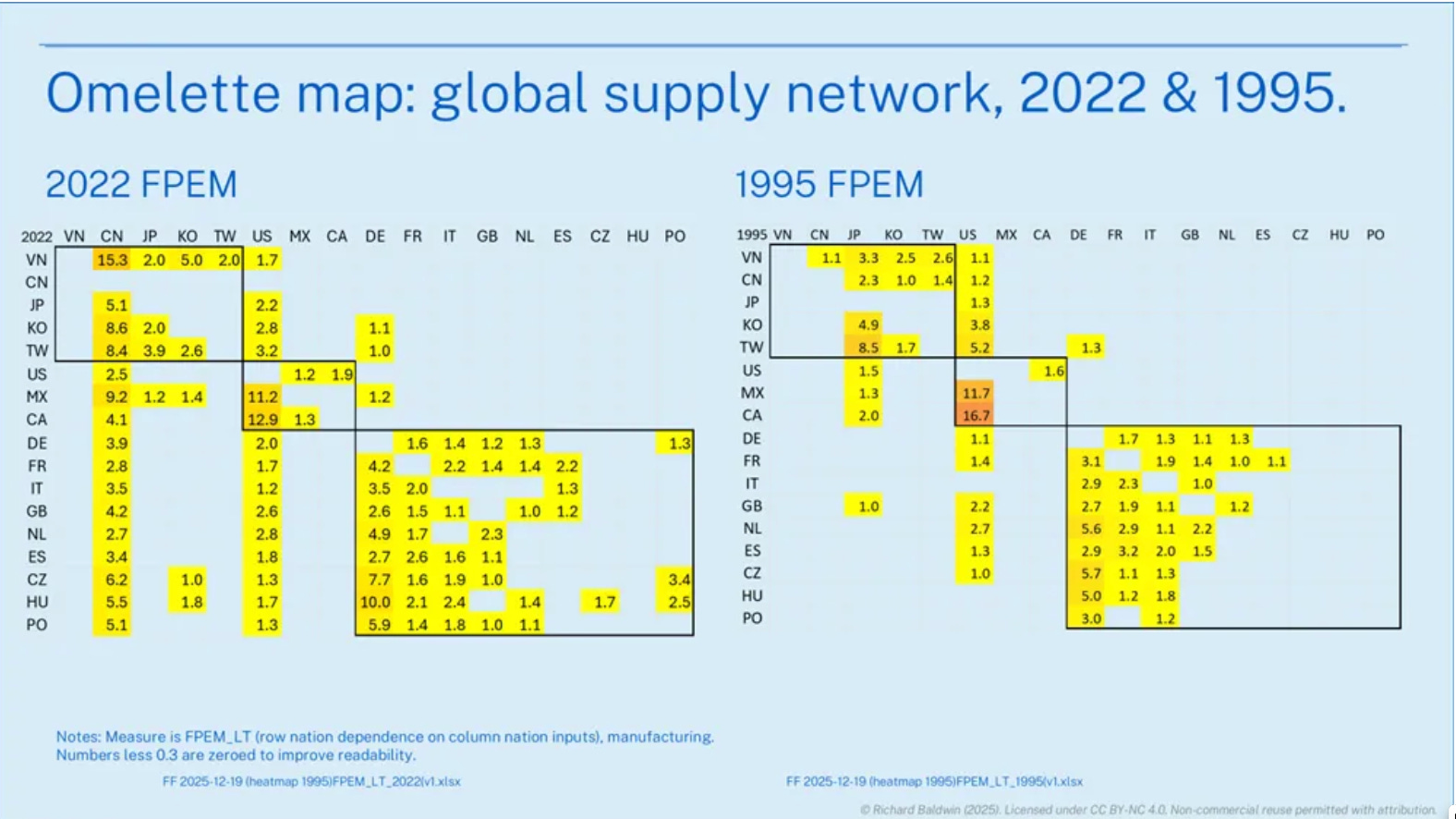
Richard Baldwin: Does Geopolitics have an Omelette Problem? <https://rbaldwin.substack.com/p/does-geopolitics-have-an-omelette>: ‘Coordinating complex manufacturing processes at great distances was impossible in the days of landlines, faxes, and express mail…. With ICT, G7 firms found they could lower costs by taking their technology and managerial know-how and combining it with low-wage labour abroad. This offshoring, and the industrialisation it triggered in emerging economies, reorganised and entangled manufacturing on a global scale…. By the 2000s… a global supply chain “omelette.”… Cooking the omelette propelled efficiency and progress… had miraculous results… pulled hundreds of millions out of poverty…. [But] today, shocks are no longer rare, localised, and passing…. Extreme weather events and purposeful or accidental digital disruptions…
Look at… the row countries’ imports of industrial inputs from the column countries… normalized by the gross manufacturing output of the importing nation…. All the entries below 1% are zeroed out for clarity….
China is the dominant supplier of intermediates… [but] has very low exposure…. The US is the second most significant source of industrial inputs… but the numbers are smaller than China’s…. The exceptions are… “Factory North America”…. Germany is number three…. Its column is lit for most nations, and its role is especially important in “Factory Europe”…. All the big European nations are significant suppliers to each other….
One general observation…. The numbers are all pretty small. At the macro level, the big nations are largely self-sufficient…. However, these average over all inputs and all manufacturing sectors. The vulnerabilities that are a major concern today take place in very special inputs and very specific importing sectors…
Give a gift subscription
And I have a few thoughts:
I do wish the table were not bigger but taller. Adding extra column for other countries would be pointless—almost all the cells would be blank. But it would be very interesting to take a look at the extent to which other, poorer countries are achieving enough economic complexity on their own to get within hailing distance of manufacturing (not technology!) near self-sufficiency. But that is for another day.
On a “weaponized interdependence” level, China holds all the manufacturing-sector cards. (It does not hold all the advanced-technology c ards not yet, although the Trump administration is doing its damnedest to make sure that it soon will.) That is the big reason why Trump’s launching a one-on-one trade war with China was such a disaster. The U.S. has a great deal of leverage vis-à-vis the other two countries of Factory North America, but in a world in which country’s prosperity levels and price structures make the construction of continent-wide economic blocks an extremely productivity-enhancing strategy, attempting to use that leverage for short-run PR is a road to impoverishing Factory North America. That is already happening: Canada is looking east, and Mexico is looking east and west, for ocean water transport is much cheaper per mile than rail transport.
And these tables do help us understand why Boris Johnson’s and Nigel Farage’s Brexit has been such an unmitigated disaster for the United Kingdom.
Suppose for a moment that one does believe that the 2000s as a whole are going to be characterized by a race to be the furnace where the future is forged for the world, a race between:
the shotgun marriage of the Leninist party-state with the von Hayekian market economy, blessed by the governmental-stewardship ethos of Master Kung, the residual egalitarian aspirations left from Chen Duxiu and Li Dazhao, and Xi Jinping thought.
whatever the post-neoliberal United States turns out to be:
a return to the New Deal Order social-democratic mass-production shotgun marriage of von Hayek and Polanyi, blessed by John Maynard Keynes;
a reinvigorated Neoliberal Order shotgun marriage of von Hayek and James Buchanan, blessed by Milton Friedman;
something new—perhaps a Platon’s werewolf kleptocratic semi-ethnostate, to which you can fully belong only as long as you honor your ancestors buried in Appalachian Hills, and neglect those buried in West Godavari.
Then one might read these tables to say that that contest is essentially over: Agglomeration makes the shape of the omelette very hard to alter once it has set. Scale and local spillovers in intermediate production generate self‑reinforcing clusters; raising trade costs rarely disperses entrenched cores once formed. The geography of risk is asymmetric: U.S., Japan, and Germany are more exposed to Chinese intermediates than China is to theirs; leverage in weaponized interdependence tilts toward the hub, not the spokes.
And if it was not over in 2024, it will be over by 2028, as the U.S.’s trustability account built up over the entire period from 1941 to 2003 finally finishes goes into the red, as very few want to be in any coalition of the willing under the thumb of a U.S. that clearly has a strong Mr. Hyde unbelnevolent hegemon streak. Policy that weaponizes tariffs shrinks room for coalition management: bilateral, unpredictable levies force allies into defensive concessions, eroding capacity to coordinate on genuine China‑risk mitigation.
Am I wrong?
Leave a comment
If reading this gets you Value Above Replacement, then become a free subscriber to this newsletter. And forward it! And if your VAR from this newsletter is in the three digits or more each year, please become a paid subscriber! I am trying to make you readers—and myself—smarter. Please tell me if I succeed, or how I fail…