


Not popularity—permission: Trump’s power is conferred by élites who take down guardrails and normalize distributed chaos, with institutional passivity becoming a machinery of wreckage. Trump doesn’t wield power alone; it’s lent to him by party barons and a deferential Court. The result is a durable capacity to break things without building anything…
Josh Marshall on the 2025 election:
Josh Marshall: A Few Day-After-the-Election Thoughts <https://public.hey.com/p/qK6R86USmK6c6Hc8UyKALUHm>: ‘As the results were coming in last night, Trump hopped on Truth Social and declared that none of it was his fault. Republicans were getting hammered, he insisted, because 1) he wasn’t on the ballot and 2) the shutdown. Not my fault is typical Trump. But… Donald Trump won’t ever be on the ballot again…. And he seems to be conceding that the shutdown is a disaster for Republicans….
The biggest impact of last night’s result may be to collapse D.C.’s collective denial about the sheer scale of Donald Trump’s unpopularity…. He does have a lot of power. He can break things. A lot of things. Here and abroad…. The political class has read Trump’s power, perversely, as popularity…. But that’s not how it works…. A number of morning-after reviews I’ve seen say… Democrats… still hadn’t addressed… [whether] it [is] a future of Spanbergers or Mamdanis…. That doesn’t seem quite right…. Find candidates suited to their constituencies and focus on cost of living issues and opposition to Donald Trump’s autocracy. Full stop. It’s not more complicated than that…
My thoughts: With respect to the question of Trump’s power: Trump has power only because Thune, Johnson, and Roberts give him power. Authority in American politics is rarely self-executing; it is conferred, shielded, and normalized by gatekeepers who choose accommodation over constraint. Senate Majority Leader John Thune, House Speaker Mike Johnson, and to an appalling degree Chief Justice John Roberts have repeatedly treated Trump’s demands as binding party discipline—whether by structuring impeachment defenses, stalling bipartisan immigration frameworks, or aligning the House calendar to electoral strategy—thereby transforming personal leverage into institutional muscle. It is true that Roberts has not endorsed every Trump claim. But his key rulings on presidential immunity, administrative deconstruction, and deference to claims of executive prerogative have greatly widened the zone in which a willing political movement can act.
Why? They do not have to do so.
Historical precedents for how chaos actors can be constrained abound: Nixon could not survived politically after Republican élites withdrew support. Joe McCarthy was ascendant as long as Taft and Eisenhower thought he was useful; he was a drunkard has-been once he became an obstacle to the workings of a Republican-controlled government. Power, here, is not charisma or crowd size—it is the cumulative choice of institutional actors to prioritize partisan cohesion, judicial minimalism toward political hardball, and short-term advantage over long-term constitutional guardrails, thereby converting a factional leader’s preferences into durable governance.
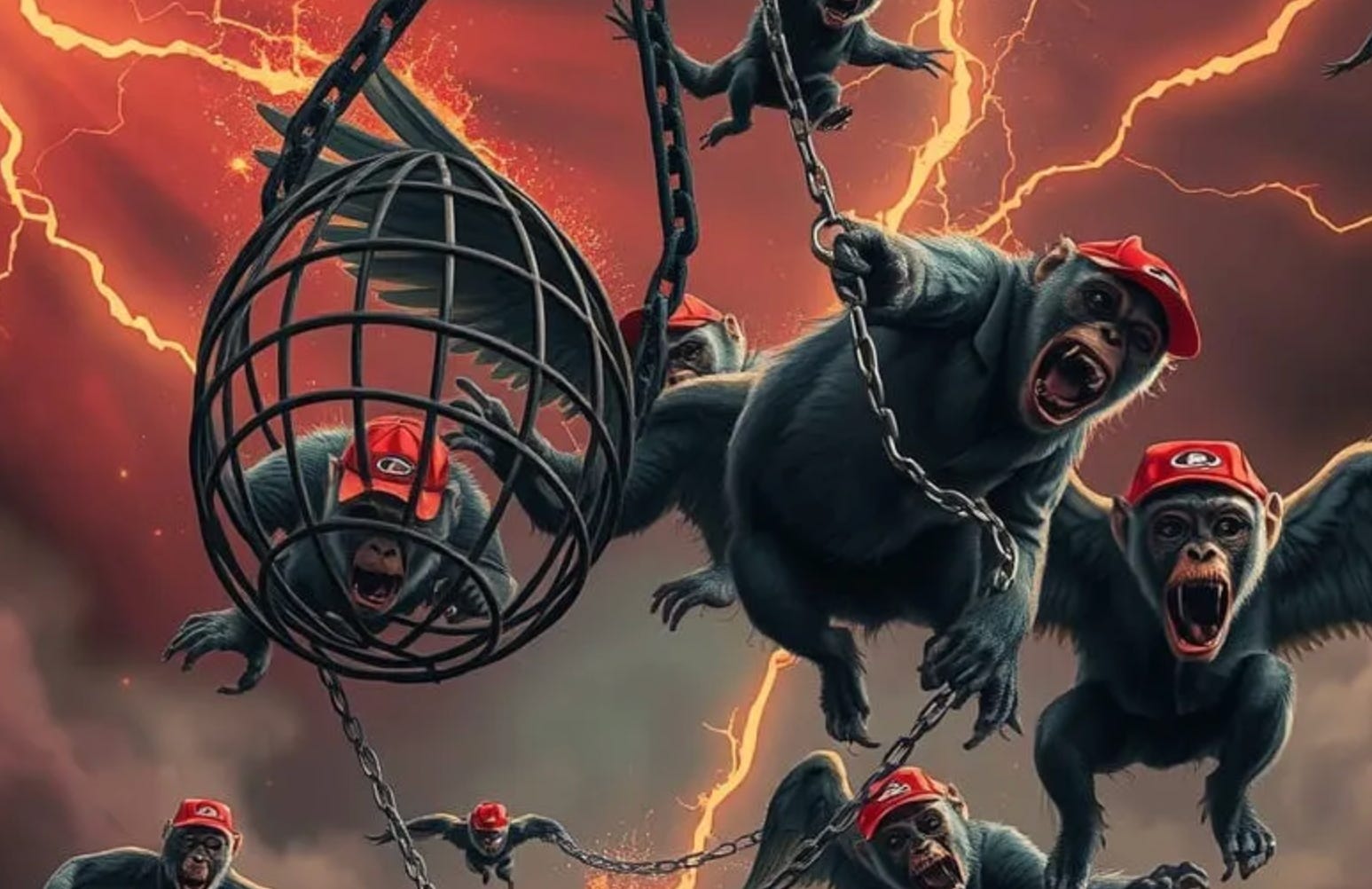
Or, rather, Thune, Johnson, and Roberts do not enable Trump. They enable Trump, plus all the people who claim he gave them the baton. They give them the power to break things. And Trump breaks things too, as a result of his own senile demented chaos-monkey nature. Trump’s outsized influence is less a solitary force than a system of delegated disruption. Falling guardrails green‑light a wider cadre who claim his mantle to smash procedural norms, weaponize institutional choke points, and flood the zone with bad‑faith claims: House committee chairs amplifying election‑denial narratives, state officials drafting legally adventurous schemes to nullify certification, or activist attorneys pushing fringe constitutional theories now dignified by proximity to power. Each takes the baton and runs. Trump’s own chaos—agenda whiplash, loyalty tests, and performative grievance—magnifies breakage by making opportunists the decisive actors, while professionals exit or go quiet. The macro lesson is that institutions fail not only when leaders misbehave but when veto players choose passivity; the enabling coalition converts one man’s appetite for transgression into a distributed capacity to break things—and keeps breaking them even when the original instigator wanders off‑script.
It is very unclear to me why they are acting as they do. It is not that Trump is popular. It is not that Trump is successful.
The conventional explanation for Thune and Johnson is that, in the Congress, the Republican caucuses have learned the Gingrich lesson: congressional Republicans, since the mid‑1990s, have internalized the hard electoral calculus: when a president of your own party looks like a failure, your marginal district members become collateral damage, so party survival demands unified defense, message discipline, and procedural hardball even when policy or constitutional prudence would counsel restraint. This logic was forged in the 1994 realignment and reinforced since. Hence Thune and Johnson translate that into tangible choices—choreographing votes to avoid splits that could brand the president as weak; structuring investigations to deflect blame onto out‑parties or bureaucrats; and using calendar control to bury cross‑pressures. The media environment amplifies the incentive: with polarized cable ecosystems and primary electorates primed to punish deviation, breaking ranks carries immediate reputational costs while loyalty can be laundered into base enthusiasm and small‑dollar fundraising. The coordination equilibrium of keeping the president afloat to protect the caucus—that privileges short‑run unity over institutional guardrails, even at the expense of legislative craftsmanship or long‑term credibility.
There is no conventional explanation for John Roberts. Roberts, whatever his stated minimalism, strongly tilts toward empowering presidential hardball while disabling technocratic ballast. It thus functions as an enabling architecture for disruptive executive-branch actors that claim the baton to run with it, destructively.
But giving Trump free rein doesn’t make him look successful. Rather, it magnifies visible dysfunction. Taking down the guardrails gets neither policy success nor durable coalition management, but paralysis. Meanwhile Trump’s own chaos‑monkey tendencies—staff churn, loyalty purges, contradictory directives—ensure implementation failure even when headlines look favorable; agencies are destabilized, competent officials exit, and projects die in the gap between announcement and execution. The change from policy production to grievance performance degrades state capacity and erodes public trust, producing a visible “failure equilibrium” that cannot be to the advantage of the caucuses.
Therefore insight into what the highly partisan Republican barons—Thune, Johnson, and Roberts—think they are doing would be very welcome.

