


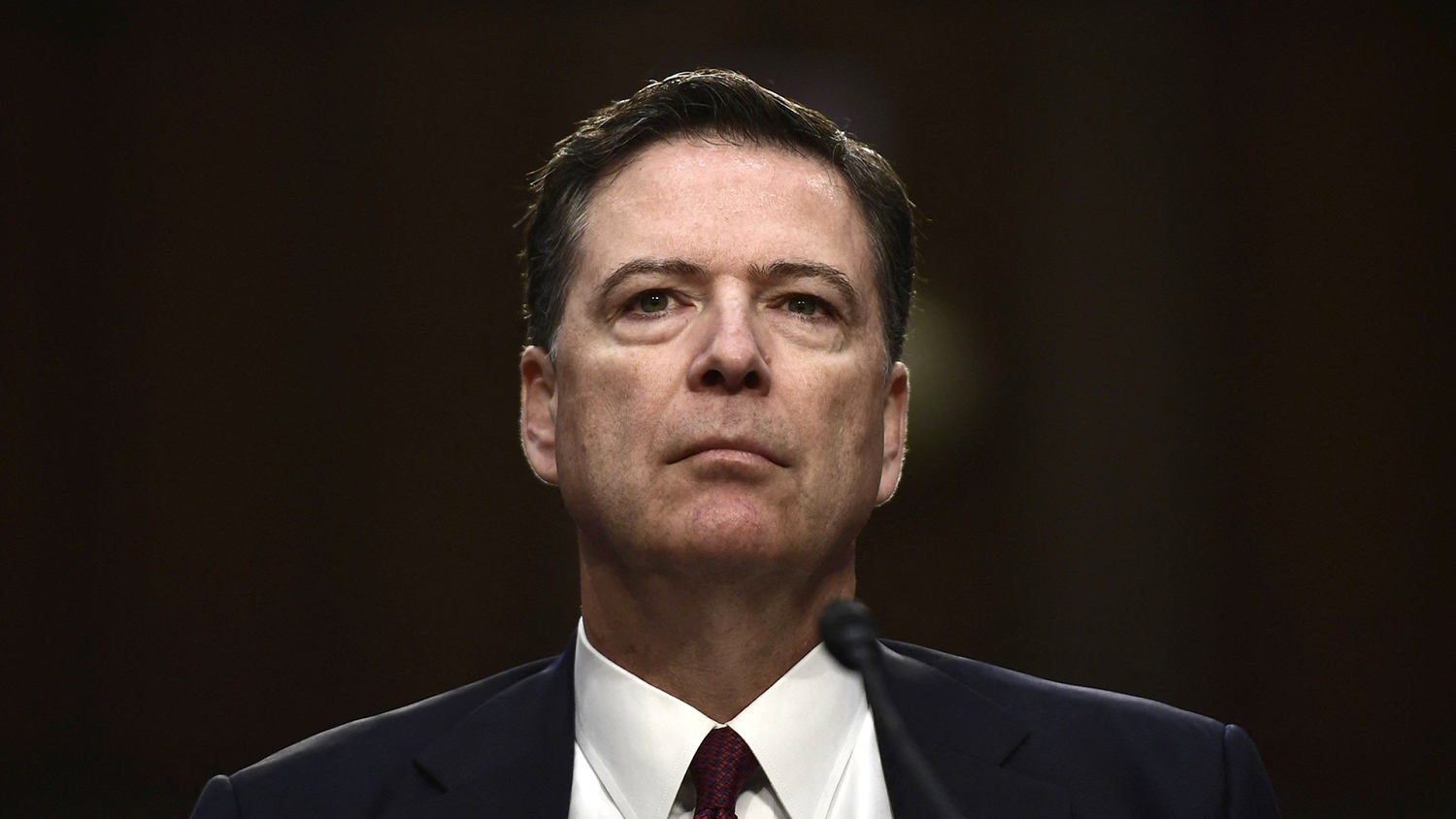
The Justice Department admitted on Wednesday that not every member of the grand jury in former FBI Director James Comey’s case saw the final version of the indictment, an error that could get the case thrown out.
The rare admission of fault from the administration came toward the end of a hearing on Comey’s arguments that the case should be dismissed because he’s the victim of a “selective and vindictive” prosecution.
U.S. District Judge Michael Nachmanoff pressed prosecutor Tyler Lemons on concerns about information that had been raised by two other judges about information that appeared to be missing from the transcripts of the grand jury proceedings in the case.
The concerns centered on two separate indictments that been drafted — the first, which showed the grand jury had indicted Comey on two of three counts, and a second that had just the two counts.
Lemons acknowledged that a grand jury coordinator had “edited” the first indictment, which was then signed by acting U.S. Attorney for the Eastern District of Virginia Lindsey Halligan.
“The second indictment is a document that was never shown to the entire grand jury?” Nachmanoff asked. “Yes, that is my understanding,” Lemons responded.
The judge then briefly questioned Halligan, a former personal lawyer to President Donald Trump with no prior prosecutorial experience.
Halligan — who presented the case to the grand jury on her own just days after being appointed — said the foreperson and one other grand juror were with her when she presented the second indictment to a magistrate judge.
The indictment was signed by the foreperson, but not reviewed by the entire grand jury, as the first one was, Halligan said.
Nachmanoff also pressed Lemons on whether attorneys in Halligan’s office had sent her a memo advising against charging Comey because of a lack of sufficient evidence to prove the case. NBC News and other news outlets have reported on the existence of a “declination memo,” but Comey’s attorneys said they don’t have proof of the document.
Lemons repeatedly tried dodging the judge’s questions on the issue.
“At this point, my posture would be whether one existed would be privileged,” the prosecutor said.
Nachmanoff said he’d been looking for a yes or no response, and asked Lemons if he was “not permitted by someone to answer.”
Lemons eventually said he’d been directed by the deputy attorney general’s office to keep privileged information close to the vest. He acknowledged to the judge that there had been a memo from the prosecution team and he had reviewed it, but did not go into detail.
Comey was in court for the hearing, where his lawyer argued that his client was only being prosecuted by Halligan’s office because the president wanted him to be charged with something.
Trump’s dislike of his client “is perhaps justification to fire him from his position,” attorney Michael Dreeben told the judge, but “it is not a justification for bringing down the full weight of the Justice Department.”
He asked the judge to dismiss the charges. “This is an extraordinary case, and it merits an extraordinary remedy,” he said.
Lemons pushed back on the allegation that Halligan was doing Trump’s bidding.
“It was her decision and her decision only,” Lemons said, adding, “Ms. Halligan was not a puppet.”
The judge did not rule from bench, saying the issues are “too weighty and too complex” for a quick decision.
Comey was charged in September with making a false statement to Congress and obstructing a congressional proceeding, days after Trump publicly urged Attorney General Pam Bondi to prosecute Comey and others. Comey pleaded not guilty to the charges.
Comey’s lawyers believe the Trump administration has singled out their client because of his protected speech and what they call Trump’s “personal animus” toward Comey. Trump fired Comey as FBI director in 2017 after the two clashed over the Justice Department’s investigation into the Trump campaign’s ties to Russia. Comey had been an outspoken critic of Trump since then.
“The Constitution forbids the government from prosecuting an individual based on his protected speech or based on a government official’s animus toward the individual,” attorneys for Comey wrote in filings. “Objective evidence establishes that President Trump directed the prosecution of Mr. Comey in retaliation for Mr. Comey’s public criticisms and to punish Mr. Comey because of personal spite.”
Comey’s lawyers want Nachmanoff to dismiss the case with prejudice, meaning the case cannot be brought for a second time. Such motions rarely succeed in court, but legal experts say if there was ever a situation where it would succeed, this case may be the one.
“This is that rarest of all beasts. This is actually a vindictive prosecution,” Patrick J. Cotter, a former federal prosecutor who is now a partner at UB Greensfelder, told NBC News.
Cotter said. “If there is ever going to be a vindictive prosecution motion that is successful, it will be this motion.”
Cotter pointed to the evidence that Trump ordered the attorney general to indict Comey and others, and his long-standing animus toward the former FBI director.
The Trump administration argues the charges against Comey are legitimate.
“The societal interests in this prosecution are readily apparent and overwhelming. The defendant is a former FBI Director who lied to Congress about his conduct while at the helm of the Nation’s primary federal law-enforcement agency. His prosecution implicates societal interests of the highest order,” DOJ wrote in a filing.
Comey, it says, “asks the Court to take the extraordinary step of dismissing his indictment because — he says — he is being vindictively and selectively prosecuted. Given the deep-seated separation-of-powers principles at stake, his request can be granted only if “the Constitution requires it.”
Comey and New York Attorney General Letitia James, whom the Trump administration indicted in October, separately filed motions to disqualify Halligan from her post on the grounds that her appointment was unlawful.
Trump named Halligan to the post after her predecessor resigned under pressure to indict Comey and James.
A separate judge, Magistrate Judge William Fitzpatrick, earlier this month accused the DOJ of taking a “indict first, investigate later” approach to Comey’s case.

