


Alexander Bublik’s latest frustration with tennis balls lit up the offseason conversation, but Australian doubles star Ellen Perez quickly stepped in to add crucial context. After Bublik publicly criticized the Dunlop balls he has been practicing with ahead of the 2026 Australian Open, Perez offered a clarification that directly challenged the narrative taking shape online.
Ellen Perez Addresses Misconceptions After Alexander Bublik’s Australian Open Ball Criticism
Concerns over ball quality have become one of the most persistent topics on the ATP Tour in recent years, particularly as the modern game has evolved into a faster, heavier, and more physically demanding one.
Players have repeatedly warned that balls wearing down too quickly can dramatically alter playing conditions mid-match, neutralizing serves, reducing shot penetration, and forcing longer, more grinding rallies.
Those changes are not just tactical. They also raise concerns about player health, as heavier and fluffier balls place added strain on wrists, elbows, and shoulders. That broader backdrop explains why Bublik’s images struck a nerve and why Perez’s clarification mattered.
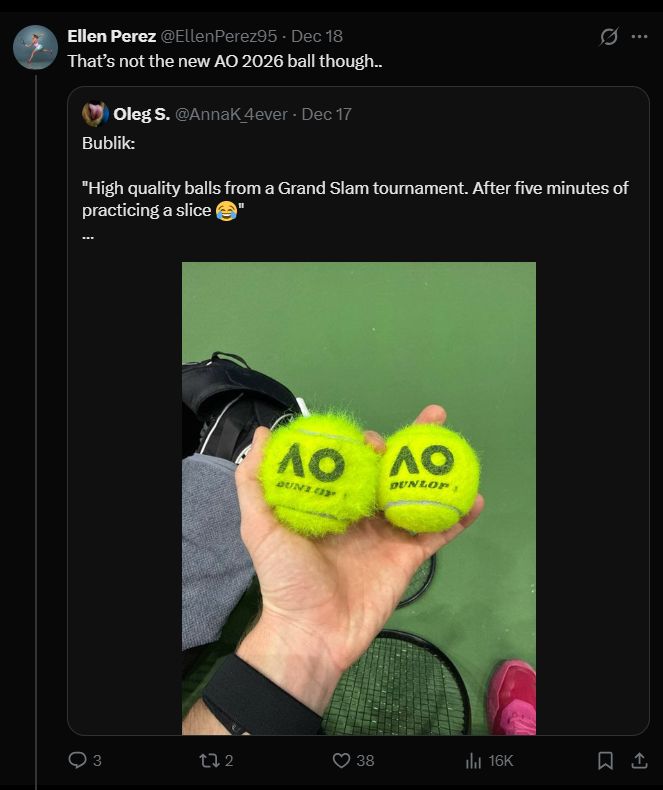
Bublik had been testing Dunlop balls he believed would be used at the 2026 Australian Open, hoping to acclimate early. The session left him unimpressed. After just a few minutes of slicing, the balls appeared heavily scuffed, prompting him to post photos on Telegram with a sarcastic remark about “high quality balls” from a Grand Slam event.
The image spread quickly. Perez then reshared one of the photos on X, pointing out that the criticism was misdirected. “That’s not the new AO 2026 ball though,” she wrote.
In a follow-up post, she went further, sharing a short video to highlight a key distinction. “There’s no 1 after the Dunlop,” Perez explained, referring to the labeling. “Training ball is very different to the official AO2026 ball.”
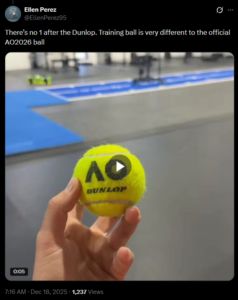
When a fan asked whether the official balls were more durable, Perez responded without sugarcoating the issue. “Yea the training balls are total garbage,” she wrote. “They’re heavy and fur up quickly. The playing ball is much lighter and doesn’t get as big. More durable and just overall better.”

Why Has Ball Standardization Remained an Unresolved Issue in Professional Tennis?
The debate Perez weighed into has been brewing for years. Players across generations have criticized the inconsistency in tennis balls from one tournament to the next. Each Grand Slam uses a different manufacturer, with Dunlop at the Australian Open, Wilson at the French Open and US Open, and Slazenger, long associated with Wimbledon. That patchwork approach has drawn repeated complaints.
MORE: After Repeated Complaints From Novak Djokovic, Daniil Medvedev, Alexander Zverev, Others, ATP Finally Releases Ball Change Measures
Novak Djokovic has suggested that inconsistent balls may contribute to injuries. At the same time, Alexander Zverev, Stan Wawrinka, Sebastian Korda, and Daniil Medvedev have all expressed concerns about the rapid degradation of balls and their perceived heaviness. Bublik himself has been among the most outspoken, frequently using social media to highlight what he sees as a growing problem.
The ATP has acknowledged those complaints and has promised gradual reform. Earlier this year, the tour outlined plans to bring more structure and consistency to ball selection, including grouping tournaments by region and aligning specifications where possible.
Officials have emphasized that change will take time due to existing contracts with manufacturers; however, the long-term goal is greater uniformity, allowing players to trust their performance week to week. ATP Chairman Andrea Gaudenzi has also stated that the tour intends to centralize ball selection once existing manufacturer contracts expire, emphasizing that player concerns are being taken seriously.

