


The FIFA World Cup returns to North America in 2026, and this time the history is not just repeating itself. It’s being rewritten.
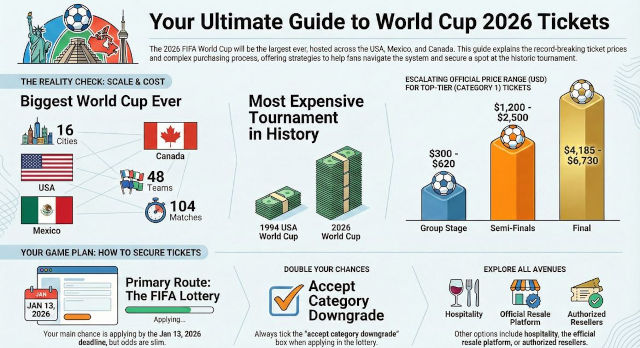
The highly anticipated competition kicks off at the Estadio Azteca on June 11, when football embarks on its most ambitious tournament yet. With 48 teams, 104 matches, three host nations, and 16 cities stretched across a continent where the beautiful game has been steadily, defiantly, carving out its place in the sporting consciousness, the upcoming FIFA World Cup will be the one to remember.
Memories of the 1994 World Cup are still echoing strong, with pastel kits and indoor stadiums creating a sun-drenched, slightly surreal spectacle that ultimately delivered record attendance and Brazil’s redemption. Three decades onwards and the infrastructure is sleeker, the stakes are higher, and the ticket prices…well, they’re stratospheric.
Category 1 seats for the final at MetLife Stadium will set you back £5,313 ($6,730), making this the most expensive World Cup in history.
Yet for all the commercial excess, there remains something exciting about the prospect of football’s greatest show unfolding in stadiums built for American football, in cities where supporters groups have created their own football culture from scratch. From Seattle’s perpetually sodden Sounders faithful to Atlanta’s record-breaking crowds at Mercedes-Benz Stadium, this tournament will test whether the world’s game can truly take root in North America’s most competitive sports market.
The FIFA World Cup 2026 logistics are daunting.
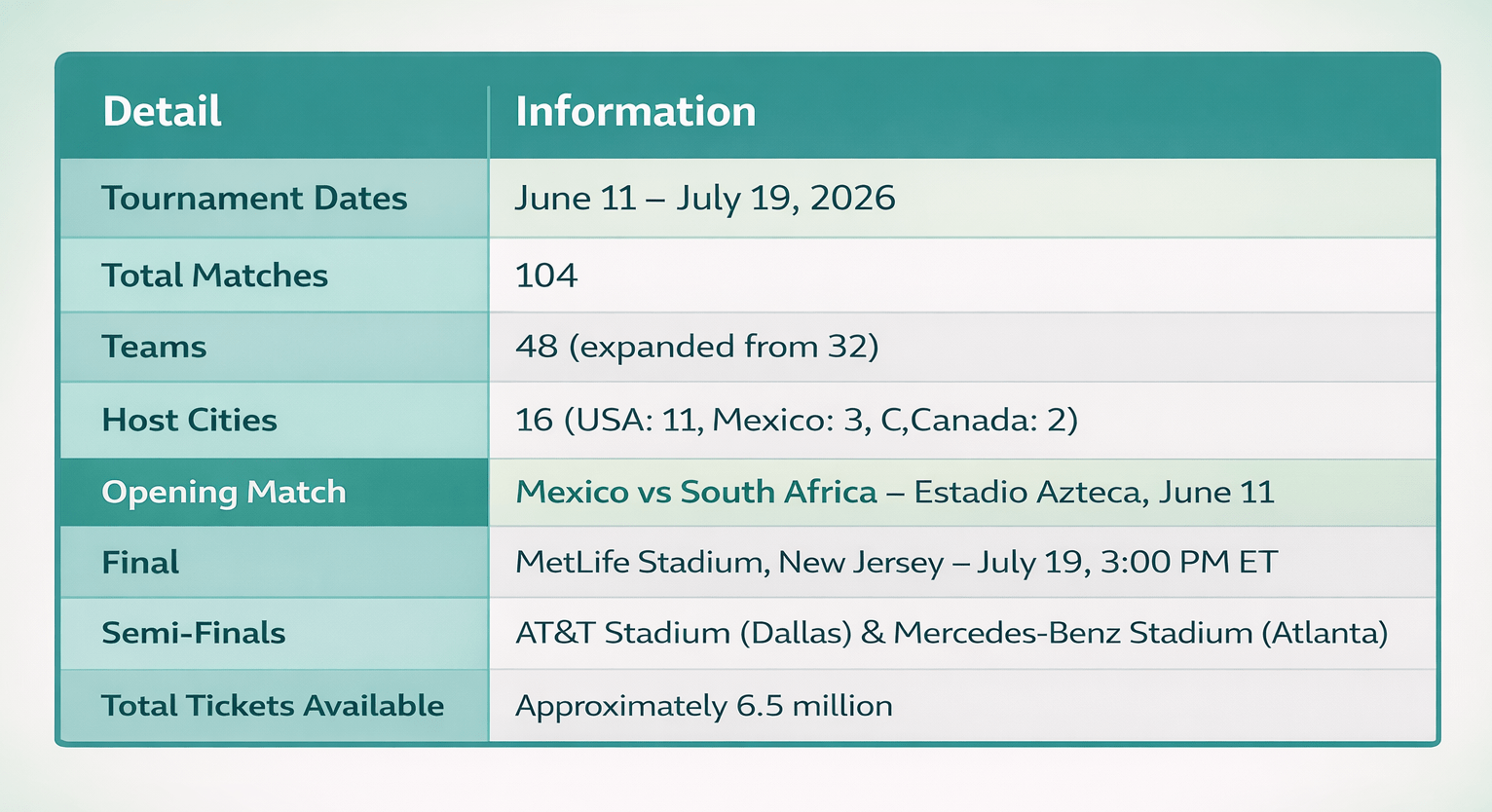
Matches will be played across time zones that span three hours, in cities separated by distances that would dwarf most European nations. The United States will host 78 of the 104 matches, while Mexico and Canada share the remaining load. For international supporters, this comes as both opportunity and headache: the chance to experience multiple American cities in one trip, offset by the brutal reality of cross-continental travel and eye-watering accommodation costs.
With everything surrounding one of the most anticipated competitions in 2026, this SoccerNews guide is here to cut through the chaos.
We’ll navigate FIFA’s ticketing process, decode the pricing structure that varies wildly by venue and opponent, and explain why your chances of securing tickets through official channels are somewhere between slim and none. We’ll explore every USA host city, and provide practical advice on how to buy World Cup 2026 tickets without mortgaging your future.
Why? Because beneath all the corporate sponsorships and inflated prices, there’s a tournament worth witnessing.
Let’s begin.
How to Buy FIFA World Cup 2026 Tickets
The fans looking to get their hands onto the World Cup tickets will have more ways than one to do so. We’ll break it all down below.
The Lottery System: Your Primary Route
FIFA’s ticketing process operates on a lottery system that offers no favors. As it should be the case after all.
None of the devoted supporters who’s followed their national team through qualifying hell will have any kind of upper hand, nor will the casual fan who’s decided a World Cup might be a nice way to spend a weekend.
The current Random Selection Draw (Phase 3) runs until January 13, 2026, at 11:00 AM ET, and here’s the unvarnished truth: your odds of securing tickets are slim.
To enter the Draw, you need a FIFA account.
One can be created for free at fifa.com/tickets, but remember to have your credit card at the ready.
The process itself is straightforward: select your preferred matches and indicate how many tickets you’d want (maximum of four per match). The most important step is to tick the box marked as “accept category downgrade.”
That downgrade option effectively doubles your chances. If your requested category is unavailable, FIFA may offer you a lower tier. Given the fierce competition for tickets, accepting any seat inside the ground is a markedly better outcome than standing outside with the ticketless masses.
The FIFA lottery isn’t first-come, first-served. You can submit applications throughout the entire window, and they will randomly allocate tickets in February 2026. If you get in, your credit card will be charged automatically. If not, you join millions of other people looking for alternatives.
Beyond the Lottery: Alternative Routes
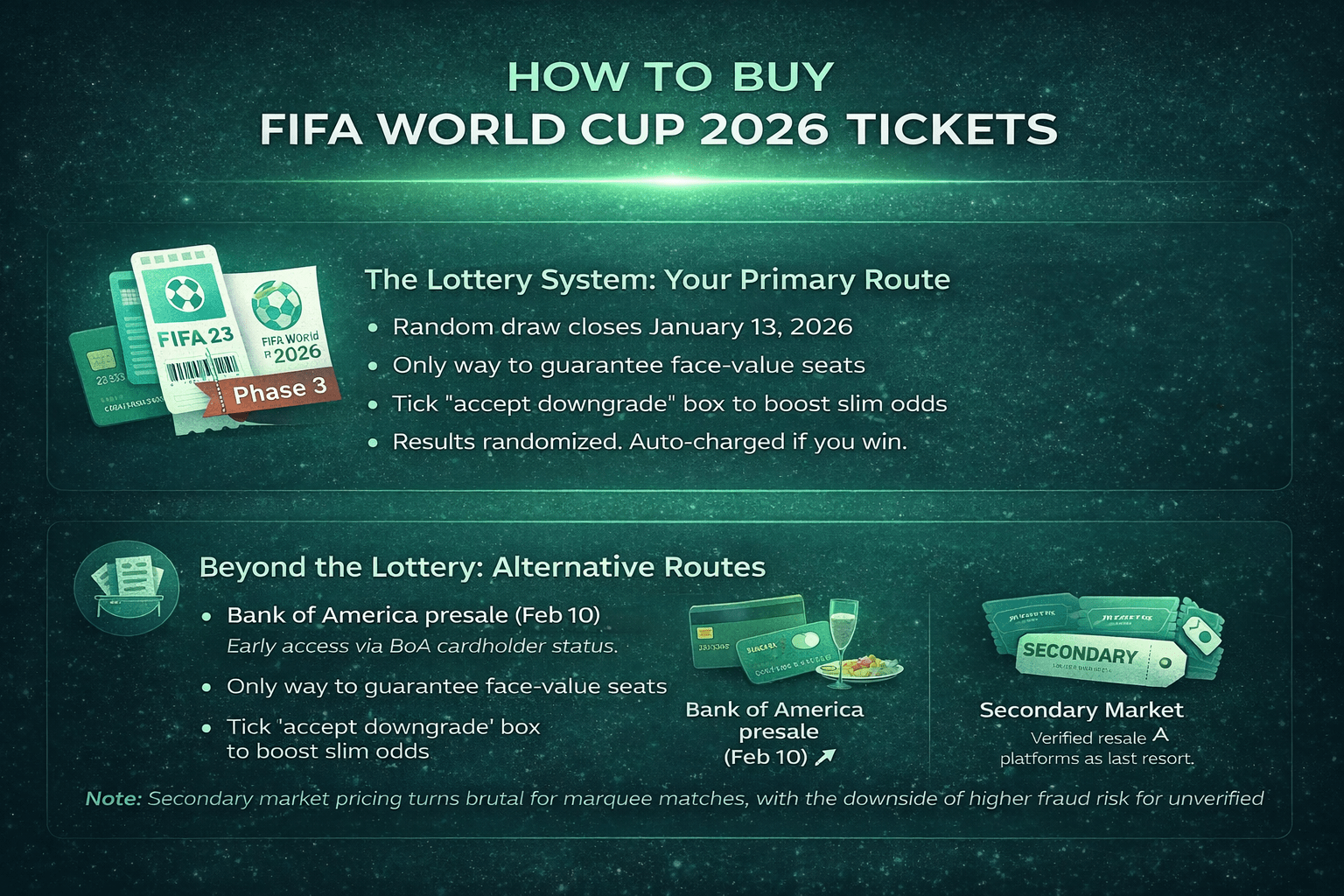
There are other ways to obtain tickets, obviously. For instance, the cardholders of Bank of America will have presale access beginning February 10, 2026.
This can be seen as an advantage in a system with the general lack of the same. Spring 2026 opens a new window when the general sale starts. However, calling it “general” overstates the ticket accessibility. We should probably expect website crashes, virtual queues stretching into oblivion, and other stress factors that make it pretty difficult to get the tickets this way.
For those with deeper pockets, hospitality packages offer easy entry. On Location, FIFA’s official hospitality partner, provides all-inclusive experiences starting at roughly £1,065 ($1,350) for group stage matches.
Premium packages for the final go over £57,700 ($73,200), which includes the sort of access that makes it perfectly clear this isn’t just about watching football. It is about being seen watching football, preferably with champagne in hand.
These packages combine tickets with accommodation, meals, beverage service, and VIP lounge access. For corporate clients entertaining high-value relationships, they’re also tax-deductible networking events. For individual supporters, they represent the clearest (albeit most expensive) path to guaranteed attendance.
The secondary market is an option as well.
The likes of StubHub, Viagogo, and SeatGeek all offer World Cup tickets, with prices not meant for everyone’s pocket. Group stage matches currently start from £125 ($158) for genuinely unwanted fixtures to well over £2,350 ($3,000) for more notable games. The final match? You’re looking at five figures, minimum. While these platforms offer buyer protection, FIFA makes no guarantees about third-party tickets.
The risk of counterfeit tickets isn’t negligible, though reputable resellers have improved their authentication considerably.
For complete peace of mind and guaranteed access without the eye-watering hospitality costs, platforms like TicketCenter.com offer verified World Cup 2026 tickets with comprehensive buyer protection.
As an authorized secondary marketplace, TicketCenter provides access to premium inventory that’s already been through multiple verification layers, meaning you can plan your trip with confidence, knowing your tickets are legitimate and guaranteed for entry.
FIFA’s official resale marketplace also provides a safe alternative. It allows supporters to sell tickets they can no longer use at or near face value. Availability fluctuates wildly as circumstances change. This of course includes illness, schedule conflicts, or visa problems, which all create occasional opportunities for determined ticket hunters willing to check repeatedly.
Ticket Prices: A Reality Check
FIFA’s four-tier pricing structure for 2026 represents a departure from previous tournaments. We’re here to break it down for you.
Understanding the Category System
Unlike the previous tournaments, the FIFA World Cup 2026 introduces categories, which are now determined primarily by seat height rather than horizontal positioning.
This creates anomalies where Category 1 seats behind the goal might offer worse views than Category 3 seats at halfway line upper tier—but you’ll pay Category 1 prices regardless.
Ticket Categories Explained
| Category | Location | % of Inventory | View Quality | Availability |
| Category 1 | Lower bowl (all positions) | 60-70% | Variable—halfway line excellent, behind goal adequate | Most common |
| Category 2 | Upper & lower tier sides | 15-20% | Mixed—some upper tier better positioned than Cat 1 corners | Moderate |
| Category 3 | Upper tier, behind goals | 10-15% | Distant but central sightlines | Limited |
| Category 4 | Upper corners | ~10% | Most distant views in stadium | Extremely scarce |
Category 4 tickets, the supposed bargain option, account for perhaps 10% of available ticket offering. These seats occupy the upper stadium corners. They might be distant, yes, but are still within the stadium, which beats standing outside checking social media for score updates.
The widely publicized £47 ($60) tickets?
They exist in theory. FIFA recently announced the record ticket demand exceeding 20 million requests during the random selection draw stage, further claiming that fans will be given a chance to benefit from a dedicated ticket pricing tier, especially designed to make their trips more affordable.
FIFA introduced the Supporter Entry Tier which is supposed to be available at the fixed price of $60 for all 104 matches – including the final.
In practice, however, the ticket selection and distribution processes will be managed by the participating national football federations. Each country will then define its own eligibility and distribution conditions. As a general rule of thumb, these tickets will be distributed among the most loyal supporters, typically those with years of membership history and attendance records.
The Reality of Pricing
This is the full breakdown of the FIFA World Cup 2026 ticket prices.
| Base Price | FIFA Fees (+15%) | Final Cost | Secondary Market (+20-40%) |
| £237 ($300) | £36 ($45) | £273 ($346) | £328-382 ($415-$485) |
| £394 ($500) | £59 ($75) | £453 ($575) | £544-635 ($690-$805) |
| £631 ($800) | £95 ($120) | £726 ($920) | £871-1,017 ($1,104-$1,288) |
To provide more context to the table above, FIFA adds roughly 15% in fees atop face values, turning a £237 ($300) ticket into £273 ($346) at checkout.
On the secondary market, platform fees compound further, often adding another 10-20%. These costs accumulate quietly until your “budget-friendly” World Cup experience resembles a luxury holiday you hadn’t planned to take.
Price Ranges by Match Stage
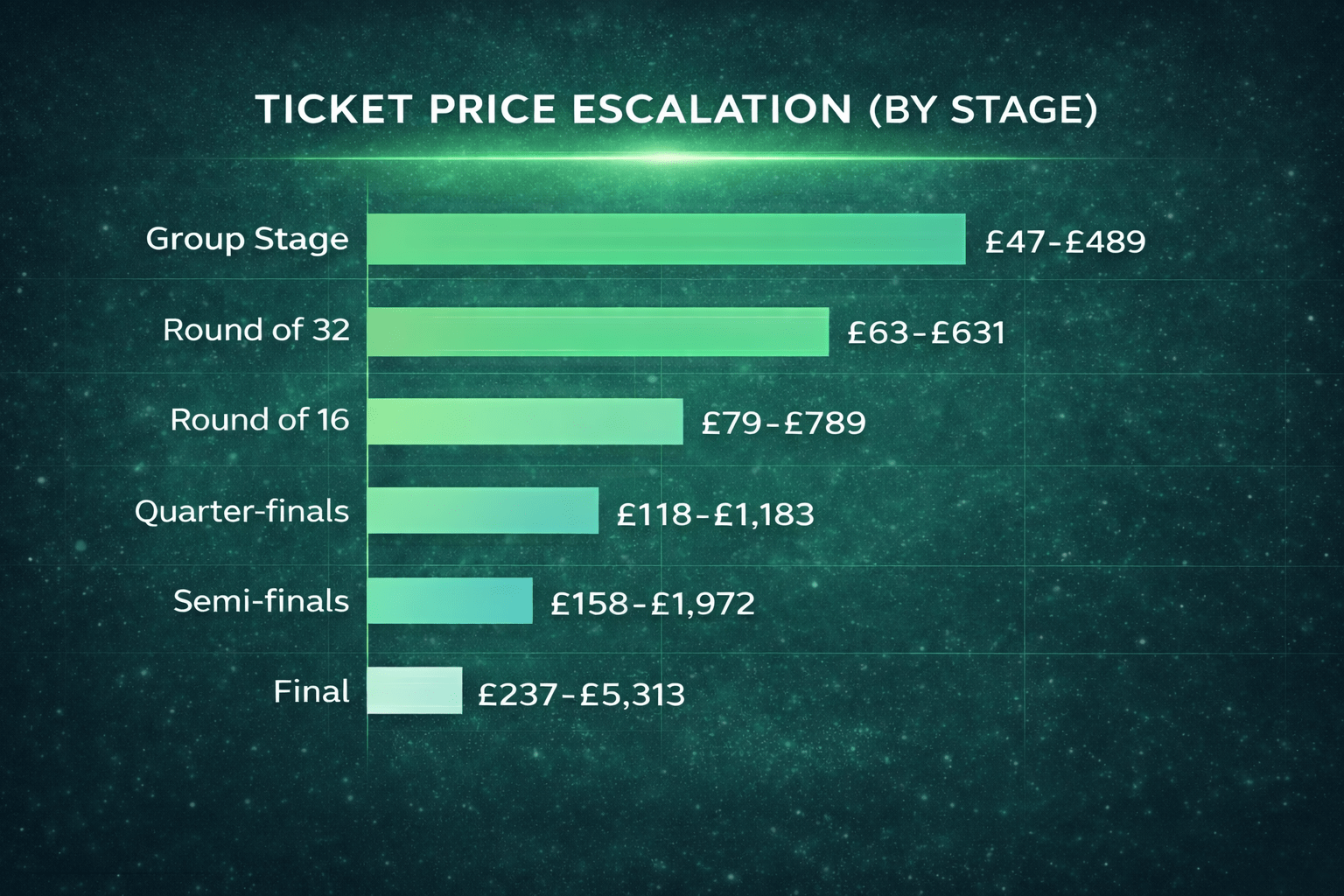
Group stage matches begin at £47-82 ($60-$105) for Category 4 seats, rising to £237-489 ($300-$620) for Category 1.
These prices involve neutral matchups, and each avid fan knows what this means. Throw a more exciting opponent into the mix – such as USA, England, Argentina, Spain or Brazil – and you’re straight in the premium territory.
The knockout round prices escalate as expected:
- Round of 32 ticket prices range from £63-118 ($80-$150) to £315-631 ($400-$800),
- while Round of 16 climbs to £79-158 ($100-$200) through £394-789 ($500-$1,000).
Quarter-finals mark where prices start approaching absurdity: £118-237 ($150-$300) to £631-1,183 ($800-$1,500).
Semi-finals vault higher still at:
- £158-315 ($200-$400) for Category 4 and
- £946-1,972 ($1,200-$2,500) for Category 1.
The final itself represents the apotheosis of World Cup pricing:
- £237-394 ($300-$500) gets you into the stadium’s furthest reaches,
- £3,299-5,313 ($4,185-$6,730) secures Category 1 seats for what FIFA promotes as the greatest match in football.
Historical context provides more insight into the unbelievable trajectory of the FIFA World Cup ticket prices:
- USA 1994 charged $25 for the cheapest tickets and $475 for the final.
- Qatar 2022 asked £54 ($69) and £1,268 ($1,607) respectively.
The 2026 tournament represents a 140% increase in minimum pricing and a 320% jump at the top end compared to 1994. Even accounting for inflation, these figures outpace economic reality by considerable margins.
The United States Host Cities: Where the Football Happens
Without any ado, let’s dive into the US World Cup 2026 host cities.
New York / New Jersey: The Final Destination
Embed from Getty Images
MetLife Stadium in East Rutherford doesn’t technically sit in New York City, but try explaining that to anyone outside the metropolitan area. This 82,500-capacity colossus straddles the New Jersey Meadowlands, hosting both Giants and Jets while maintaining the architectural personality of a corporate conference center. On July 19, 2026, it becomes the stage for football’s biggest match.
Getting there from Manhattan requires NJ Transit buses from Port Authority. It’s a 40-50 minute journey that feels longer when sardined against fellow supporters. Newark Airport sits 15 minutes away; JFK manages 45 minutes in light traffic, reliably over an hour in reality.
Midtown Manhattan hotels exceed £237 ($300) nightly during the tournament, with final week rates approaching £394 ($500) or beyond. Brooklyn offers marginally better value; Jersey City and Hoboken might save you £79 ($100) per night. The trade-off? Your World Cup experience in New Jersey.
The final itself generates its own ecosystem with fan zones across Manhattan, viewing parties everywhere, traffic gridlock that makes normal New York congestion quaint. Coldplay’s half-time involvement promises spectacular entertainment or bewildering irrelevance, depending on your tolerance for stadium rock.
Factor in £394-631 ($500-$800) for accommodation, £79-118 ($100-$150) for local transport, and tickets starting at £3,299 ($4,185). This isn’t a weekend getaway. It’s a significant financial commitment requiring months of planning.
| Detail | Info |
| Stadium Capacity | 82,500 |
| Matches Hosted | 8 (including World Cup Final) |
| Nearest Airport | Newark (EWR) – 15 min; JFK – 45 min |
| Transit | NJ Transit bus from Port Authority (40-50 min) |
| Key Feature | FINAL VENUE – July 19, 2026 |
[Complete Guide to World Cup Tickets in New York/New Jersey will soon be available here →]
Los Angeles: American Glamour Meets World Football
Embed from Getty Images
SoFi Stadium in Inglewood represents American sports infrastructure at its most extravagant: £4.3 billion ($5.5 billion) transformed into a translucent-roofed temple featuring a 70,000-square-foot video board larger than some Premier League pitches. The 70,240-capacity venue creates the unsettling impression of watching football inside a particularly expensive terrarium.
Los Angeles hosts eight matches, including both USA group stage fixtures. The June 12 opener sees the United States face Paraguay in what American supporters hope becomes a statement match rather than nervous mediocrity. SoFi also hosts a quarter-final.
LAX sits 10 minutes from the stadium when traffic cooperates—which it won’t. Plan 45 minutes minimum. The Metro K Line reaches the stadium, offering refuge from automotive dystopia. Santa Monica and Venice Beach cost £237-394 ($300-$500) nightly; Inglewood itself might save £79-118 ($100-$150) while eliminating travel logistics.
USA tickets command significant premiums. Category 1 seats for the Paraguay opener list around £2,155 ($2,735) through FIFA, with resale markets adding 20-40%. Budget £5,520-8,116 ($7,000-$10,300) for three group matches including accommodation and transport.
| Detail | Info |
| Stadium Capacity | 70,240 |
| Matches Hosted | 8 (including Quarter-Final) |
| Nearest Airport | LAX – 10 min (in perfect traffic) |
| Key Matches | 2 USA group stage games |
| Key Feature | $5.5B venue, translucent roof |
[Complete Guide to World Cup Tickets in Los Angeles will soon be available here →]
Dallas: Texas-Sized Football in Jerry World
Embed from Getty Images
AT&T Stadium is universally known as “Jerry World” and it houses 80,000 supporters with expandable capacity reaching 94,000. The retractable dome and climate control create ideal July conditions, while the infamous 60-yard video screen hangs so low that punted footballs occasionally strike it. This captures the stadium’s commitment to excess over elegance.
Dallas hosts nine matches, including a semi-final on July 14. DFW Airport sits 20 minutes from Arlington in reasonable traffic. Here’s the drawback: virtually no public transport exists. You’re driving, arranging rideshares, or booking shuttles. Post-match, 80,000 people simultaneously request Ubers.
Dallas proper offers amenities at £158-237 ($200-$300) nightly. Fort Worth provides smaller-city charm at similar costs. Arlington might save £39-79 ($50-$100) but means spending evenings in a sprawling suburb of chain restaurants and parking lots. Stay in Dallas or Fort Worth.
Semi-final tickets start around £946 ($1,200) for Category 1 through official channels, potentially doubling on resale markets. Budget £1,577-2,366 ($2,000-$3,000) minimum.
| Detail | Info |
| Stadium Capacity | 80,000-94,000 (expandable) |
| Matches Hosted | 9 (including Semi-Final) |
| Nearest Airport | DFW – 20 min |
| Transit Challenge | Limited public transport; driving required |
| Key Feature | Retractable dome, climate controlled |
[Complete Guide to World Cup Tickets in Dallas will soon be available here →]
Atlanta: Where American Football Culture Meets the World Game
Embed from Getty Images
Mercedes-Benz Stadium is both thoroughly modern and genuinely beloved.
Opened in 2017, the 71,000-capacity venue features a retractable roof opening like a camera aperture and fan-friendly concession pricing. Five-dollar hot dogs and two-dollar soft drinks initially appeared to be accounting errors.
Atlanta United regularly fills this stadium.
Their 2018 MLS Cup drew 73,019 supporters, which was the largest American soccer crowd in 22 years. This goes to demonstrate genuine football enthusiasm rather than World Cup tourism. Atmosphere requires knowledgeable supporters, not just numbers, and Atlanta delivers both.
The stadium hosts eight matches, including the other semi-final on July 15. Hartsfield-Jackson Airport sits 15 minutes away via MARTA, Atlanta’s functional public transport. You can attend matches without renting vehicles, which is a distinction from Dallas’s transit wasteland.
Downtown accommodation runs £158-237 ($200-$300) nightly, with proximity to MARTA stations. Midtown offers neighborhood character at similar pricing. Semi-final tickets face £946-1,183 ($1,200-$1,500) minimum, potentially doubling depending on advancing teams.
| Detail | Info |
| Stadium Capacity | 71,000-75,000 |
| Matches Hosted | 8 (including Semi-Final) |
| Nearest Airport | ATL – 15 min via MARTA |
| Transit | Direct MARTA rail access |
| Key Features | $5 concessions, MLS-proven atmosphere |
[Complete Guide to World Cup Tickets in Atlanta will soon be available here →]
Seattle: Pacific Northwest Football
Embed from Getty Images
Lumen Field (69,000 capacity) hosts six matches including USA’s third group stage fixture against Australia on June 19th, 2026.
The Sounders faithful have earned their reputation as America’s most passionate supporters, generating atmospheres that surprise European visitors. June weather remains temperate—far preferable to sweltering humidity elsewhere.
Sea-Tac Airport connects efficiently downtown via light rail. Seattle’s walkable core makes logistics straightforward. Accommodation runs £158-237 ($200-$300) nightly, with budget options in neighborhoods slightly removed from downtown concentration.
| Detail | Info |
| Stadium Capacity | 69,000 |
| Matches Hosted | 6 (including 1 USA match) |
| Nearest Airport | SEA – 20 min via light rail |
| Key Feature | Sounders atmosphere, temperate weather |
[Complete Guide to World Cup Tickets in Seattle will soon be available here →]
Miami: Latin American Football Hub
Embed from Getty Images
Hard Rock Stadium underwent £276 million ($350 million) renovations, transforming mediocrity into respectability. The 65,000-capacity venue hosts seven matches, including a quarter-final and third-place match. Miami Gardens sits 30 minutes from Miami International Airport.
Accommodation reflects Miami’s resort economy: £237-394 ($300-$500) nightly minimum, with South Beach commanding premiums. The city’s Latin American community ensures genuine football atmosphere, though summer humidity creates conditions better described as oppressive than tropical.
| Detail | Info |
| Stadium Capacity | 65,000 |
| Matches Hosted | 7 (Quarter-Final + Third Place) |
| Nearest Airport | MIA – 30 min |
| Key Feature | Messi Copa América venue, Latin culture |
[Complete Guide to World Cup Tickets in Miami will soon be available here →]
San Francisco Bay Area: Silicon Valley’s Statement
Embed from Getty Images
Levi’s Stadium sits in Santa Clara, not San Francisco. This is a distinction that matters considerably when navigating California’s transport chaos. The 70,900-capacity venue represents Silicon Valley architecture: modern, expensive, vaguely soulless. It hosts seven matches across group and knockout rounds.
SFO sits 30 minutes north in theoretical traffic; SJC manages 10 minutes. Staying in San Francisco offers cable cars and waterfront dining at £237-394 ($300-$500) nightly but means 45-60 minute commutes.
San Jose provides proximity at £158-237 ($200-$300), sacrificing urban appeal for suburban convenience.
| Detail | Info |
| Stadium Capacity | 70,909 |
| Matches Hosted | 7 |
| Nearest Airport | SFO – 30 min; SJC – 10 min |
| Key Feature | Silicon Valley location, wine country proximity |
[Complete Guide to World Cup Tickets in San Francisco will soon be available here →]
Houston: Climate-Controlled Refuge
Embed from Getty Images
NRG Stadium’s retractable roof acknowledges that July football in Texas humidity constitutes cruel punishment without intervention. The 72,200-capacity venue shields supporters from weather making Mediterranean summer feel temperate. The dome closes, air conditioning engages, and suddenly you’re watching World Cup football in controlled comfort.
George Bush Intercontinental (IAH) sits 25 minutes north; Hobby (HOU) manages 15 minutes. Downtown Houston offers amenities at £158-237 ($200-$300) nightly. Houston’s immigrant diversity creates exceptional food.
Vietnamese, Pakistani, Mexican, Nigerian cuisines thrive here so there is plenty of international appeal.
| Detail | Info |
| Stadium Capacity | 72,220 |
| Matches Hosted | 7 |
| Nearest Airport | IAH – 25 min; HOU – 15 min |
| Key Feature | Retractable roof, climate controlled |
[Complete Guide to World Cup Tickets in Houston will soon be available here →]
Kansas City: The Soccer Capital’s Moment
Embed from Getty Images
Kansas City styles itself “Soccer Capital of America,” and this claim carries weight.
Sporting KC’s devoted support and youth infrastructure create conditions rare in American markets. Arrowhead’s 76,400 capacity makes it one of the NFL’s loudest venues, with its infrastructure translating effectively to football.
MCI Airport sits 25 minutes away.
Accommodation costs £118-197 ($150-$250) nightly, which is no comparison to New York premiums or LA inflation. The city’s central location creates strategic value: Dallas 500 miles south, Chicago 500 miles northeast, Denver 600 miles west.
The barbecue justifies hype. Joe’s Kansas City, Q39, Arthur Bryant’s—legitimate temples to smoked meat excellence.
| Detail | Info |
| Stadium Capacity | 76,416 |
| Matches Hosted | 6 |
| Nearest Airport | MCI – 25 min |
| Key Feature | Sporting KC culture, BBQ excellence |
[Complete Guide to World Cup Tickets in Kansas City will soon be available here →]
Philadelphia: Historic City, Modern Stadium
Embed from Getty Images
Lincoln Financial Field (69,800 capacity) occupies South Philadelphia’s sports complex, providing competent infrastructure designed for reliability rather than architectural statements.
Philadelphia hosts six group stage matches, positioning it as solid mid-tournament option appealing to supporters prioritizing historical tourism over premium football.
Philadelphia International sits 15 minutes from the stadium.
The Broad Street Line subway reaches the complex directly, which is part of infrastructure that handles 70,000 supporters simultaneously. Accommodation in Center City and Rittenhouse ranges £158-237 ($200-$300) nightly.
The city sits equidistant from New York (90 minutes by train) and Washington DC (two hours), creating substantial local support without requiring dedicated travel.
| Detail | Info |
| Stadium Capacity | 69,796 |
| Matches Hosted | 6 |
| Nearest Airport | PHL – 15 min |
| Transit | Broad Street Line direct access |
| Key Feature | Northeast corridor positioning, historical sites |
[Complete Guide to World Cup Tickets in Philadelphia will soon be available here →]
Boston: New England’s Suburban Outpost
Embed from Getty Images
Gillette Stadium occupies Foxborough, Massachusetts.
It sits 30 miles southwest of Boston, accessible via commuter rail or automobile but not via Boston’s otherwise comprehensive transit. This creates logistical friction distinguishing Boston from more convenient hosts.
Boston Logan sits 40 minutes from Foxborough in ideal traffic. Therefore, make sure to budget 90 minutes during peak periods. The MBTA commuter rail offers alternatives, though service frequency tests patience.
Staying in Boston offers historical sites and seafood excellence at £237-394 ($300-$500) nightly but means commuting logistics transforming stadium access into half-day undertakings.
Honest assessment: Boston deserves visits for reasons having nothing to do with football. The World Cup provides convenient excuse to experience New England’s most significant city.
| Detail | Info |
| Stadium Capacity | 65,878 |
| Matches Hosted | 6 |
| Location | Foxborough, MA (30 miles from Boston) |
| Nearest Airport | BOS – 40 min minimum |
| Challenge | Suburban isolation, limited transit |
[Complete Guide to World Cup Tickets in Boston will soon be available here →]
Mexico and Canada: The International Dimension
Mexico contributes three venues across three cities, each hosting four or five group stage matches totaling 13 fixtures.
Estadio Azteca in Mexico City becomes the first stadium to host three World Cups (1970, 1986, 2026), as Mexico prepares to head into the opening match against South Africa on June 11.
The 87,500-capacity venue sits at 2,250 meters elevation, where oxygen thins and visiting players struggle. Mexico City’s sprawling metropolitan chaos provides vibrant cultural experiences alongside logistical challenges. This primarily includes traffic that makes Los Angeles look efficient, pollution that tests respiratory systems, and altitude that affects everyone.
Guadalajara’s Estadio Akron (48,071 capacity) and Monterrey’s Estadio BBVA (53,500) complete Mexico’s hosting duties.
Both cities offer more manageable scale than Mexico City while maintaining authentic Mexican culture. Accommodation costs significantly less than American venues. One might say £79-158 ($100-$200) nightly remains pretty achievable, even though international supporters should factor visa requirements, travel insurance, and potential safety considerations into planning.
Canada’s two venues present the tournament’s most geographically spread hosting locations.
Toronto’s BMO Field (45,736 capacity, expanded for the tournament) hosts Canada’s opening match on June 12, while Vancouver’s BC Place (54,500) stages their subsequent group fixtures. Both cities provide functional infrastructure, strong public transport, and accommodation at prices marginally below American equivalents. Vancouver’s spectacular Pacific Northwest setting rivals Seattle’s natural beauty, while Toronto offers Canada’s most cosmopolitan urban experience.
International supporters considering Mexican or Canadian venues should weigh lower costs and unique cultural experiences against travel complexity.
If you’re flying internationally anyway, these cities offer legitimate alternatives to American locations, particularly for group stage matches where ticket prices and accommodation rates run 30-40% below US equivalents. The trade-off is accepting that knockout stages occur elsewhere, requiring either multiple trips or resignation to streaming from abroad.
Following the United States National Team: A Strategic Guide
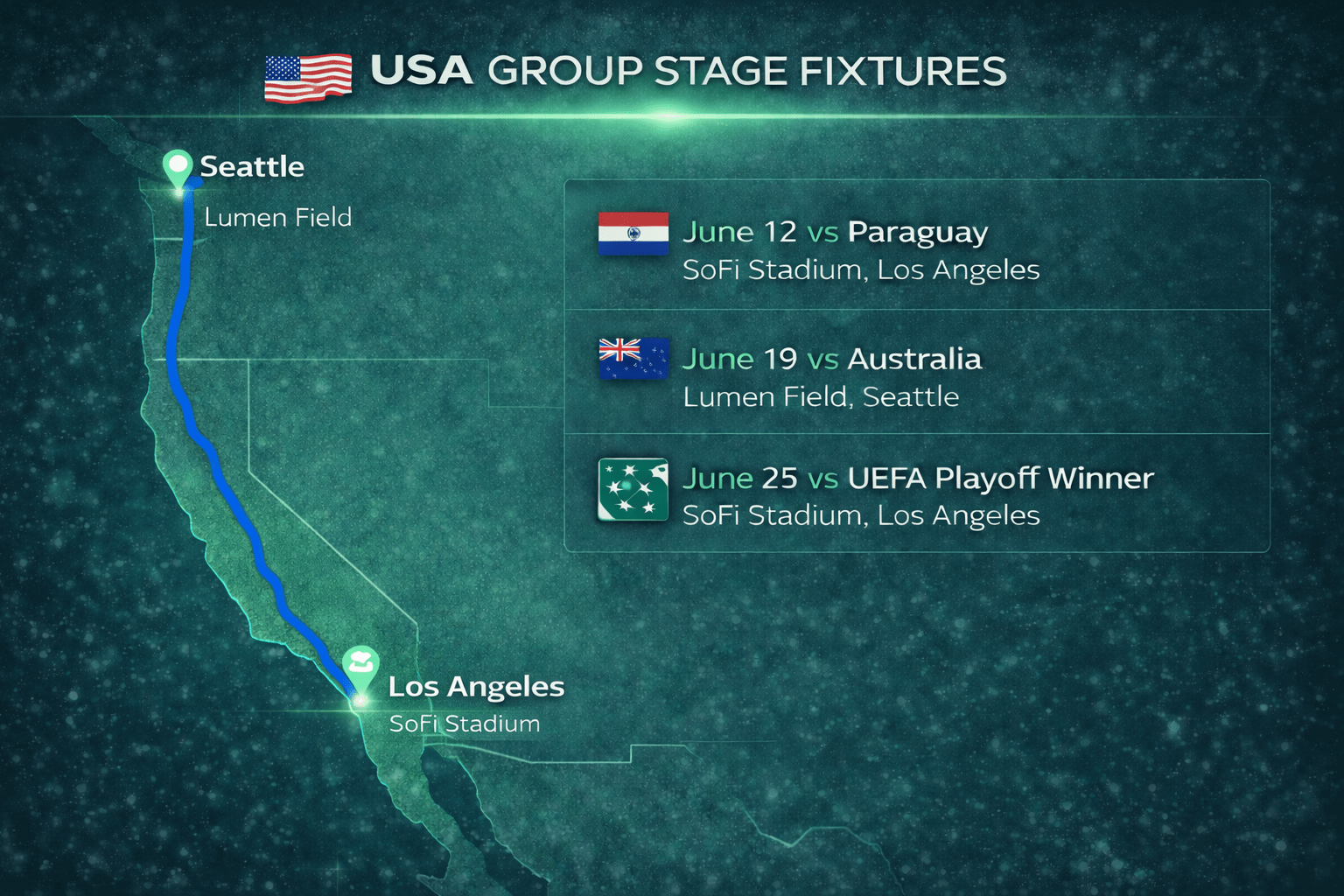
The United States enters Group D alongside Australia, Paraguay, and a yet-to-be-determined UEFA playoff winner from the pool containing Slovakia, Kosovo, Turkey, and Romania.
On paper, this represents an easily navigable group for the home side.
Australia and Paraguay are the team that qualified through competitive confederations, the UEFA addition creates uncertainty but shouldn’t terrify. In practice, however, the pressure of home-soil expectations might crush the Americans as effectively as any tactical disadvantage.
USA’s group schedule unfolds strategically.
- June 12 against Paraguay at SoFi Stadium in Los Angeles,
- June 19 versus Australia at Lumen Field in Seattle,
- and June 25 facing the UEFA playoff winner back in LA.
This west coast concentration minimizes travel disruption while maximizing home support.
The progression also builds pressure appropriately. Paraguay as an opener is there to settle nerves, the playoff winner as escalation, and Australia as a potential group-clinching finale.
Ticket demand for USA matches exceeds all rational bounds.
The Paraguay opener lists at £2,155 ($2,735) minimum for Category 1 through FIFA’s lottery, with resale markets already quoting £2,366-3,943 ($3,000-$5,000).
If the United States advances from the group, which is not guaranteed, but expected, their Round of 32 match likely occurs at either SoFi or Lumen Field, maintaining that home advantage while pushing ticket prices towards £3,155-4,732 ($4,000-$6,000) for Category 1 seats.
Here’s the uncomfortable mathematics.
Attending all three USA group matches requires £6,309-11,831 ($8,000-$15,000) in tickets alone, assuming you secure lottery allocations at face value.
Add £1,972-3,155 ($2,500-$4,000) for accommodation across two cities, £789-1,183 ($1,000-$1,500) for flights and transport, and £394-631 ($500-$800) for food and expenses, and you’re approaching £9,464-16,800 ($12,000-$21,300) for a nine-day football tour.
This isn’t a casual sporting event; it’s a substantial financial commitment requiring months of planning and budgeting.
Strategic alternatives exist.
Target one or two USA matches rather than the complete set, perhaps the opener and finale. Apply for less popular matches at the same World Cup 2026 host cities. If you’re in Los Angeles anyway, watching Spain versus Uruguay becomes vastly more achievable financially while maintaining the World Cup experience. Consider that watching the United States at a packed sports bar in Seattle, surrounded by devoted Sounders supporters, might deliver more authentic atmosphere than isolated expensive seats.
The brutal reality hits differently, however. Most American supporters won’t attend any USA matches despite the home tournament. Prices and availability make this mathematically inevitable. But the World Cup offers 101 other matches, many featuring world-class football at a fraction of USA ticket costs. Supporting your country doesn’t require financial martyrdom, and sometimes the better choice is enjoying the tournament while watching the national team from somewhere with reasonably priced beer.
Budget Planning: The Complete Financial Picture
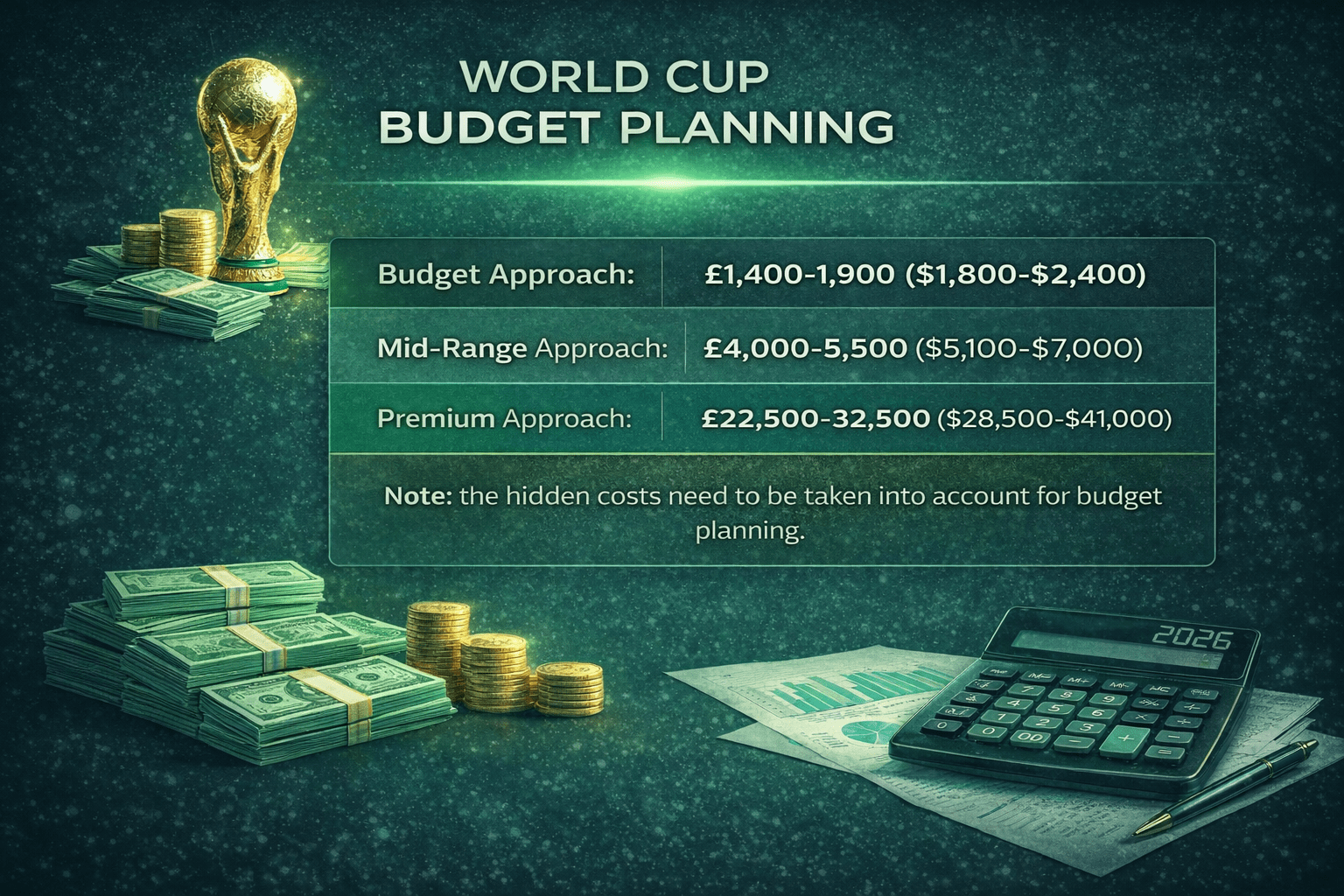
The budget reality breaks down into three distinct spending levels, each with specific trade-offs between comfort and financial prudence. So here is what the FIFA World Cup 2026 actually costs.
Budget Approach: £1,400-1,900 ($1,800-$2,400)
This requires discipline and flexibility.
Target neutral group stage matches in mid-market cities like Kansas City, Houston, or Philadelphia where demand runs lower. Book hostels or budget Airbnbs well in advance, use public transport religiously, and eat street food rather than restaurants.
The breakdown:
- £394-631 ($500-$800) for two Category 2 or 3 tickets,
- £315-394 ($400-$500) for domestic flights,
- £473-551 ($600-$700) for six nights basic accommodation,
- and £237-315 ($300-$400) for food and local transport.
This is lean but achievable if you’re willing to watch Egypt versus Cape Verde rather than USA versus Paraguay. The football quality remains World Cup standard, as these are international competitors, not pub league sides.
You just won’t be watching marquee fixtures from premium seats.
Mid-Range Approach: £4,000-5,500 ($5,100-$7,000)
The realistic middle ground for serious football tourists.
This budget allows one knockout round match (Round of 16 or quarter-final) plus two quality group stage fixtures featuring established nations. Stay in three-star hotels, take occasional taxis when public transport proves inconvenient, and eat proper restaurant meals without obsessing over costs.
The breakdown:
- £1,577-2,366 ($2,000-$3,000) for three Category 1 or 2 tickets,
- £631-789 ($800-$1,000) for flights with checked luggage,
- £1,183-1,577 ($1,500-$2,000) for eight nights at comfortable hotels across two cities,
- and £631-789 ($800-$1,000) for food, drinks, and local transport.
This tier delivers genuine World Cup experience without financial martyrdom.
Premium Approach: £22,500-32,500 ($28,500-$41,000)
This one’s intended for those treating this as premium experience or corporate entertainment. This means hospitality packages for major matches, luxury accommodation throughout, business class flights, and zero budget constraints on dining or activities.
The costs:
- £15,775-23,663 ($20,000-$30,000) for hospitality package at the final plus Category 1 semi-final tickets,
- £1,183-1,577 ($1,500-$2,000) for business class flights,
- £3,943-4,732 ($5,000-$6,000) for ten nights at four-star hotels,
- and £1,577-2,366 ($2,000-$3,000) for premium dining and transport.
This isn’t rational spending. It’s experiential investment where football becomes backdrop to comprehensive luxury event.
The Hidden Costs That Accumulate
As already mentioned above, FIFA adds roughly 15% in fees to face values.
That £394 ($500) ticket becomes £454 ($575) at checkout, and that’s before any secondary market premiums. Stadium concessions run £16-20 ($20-$25) per item at most venues, though Atlanta’s revolutionary five-dollar pricing provides relief. Transport to stadiums averages £24-79 ($30-$100) per trip when surge pricing hits during matches. Parking at American stadiums typically costs £24-39 ($30-$50).
These daily incidentals, conservatively amounting to £79-158 ($100-$200) per match day, will transform seemingly reasonable budgets into financial strain. A supporter attending three matches suddenly faces additional £237-473 ($300-$600) in costs that don’t appear in initial ticket calculations.
Insurance and Flexibility
Travel insurance isn’t optional at these spending levels.
A comprehensive policy costing £118-158 ($150-$200) protects against cancelled flights, medical emergencies, and potentially ticket issues depending on coverage. Given you’re committing thousands of pounds before securing lottery tickets, this represents essential protection rather than luxury addition.
Similarly, book refundable accommodation despite slight premiums over non-refundable rates. Lottery results won’t arrive until February 2026 and you need flexibility if applications fail. Hotel prices only increase as tournament approaches, making early booking with cancellation options the prudent strategy.
Leveraging Points and Perks
Credit card rewards offer modest relief for those already holding substantial points balances.
American Airlines AAdvantage allows redeeming 75,000 miles for group stage tickets or 965,000 miles for the final. These are absurd requirements that nonetheless convert points to tickets without cash outlay. Bank of America cardholders receive presale access beginning February 10, 2026, potentially securing inventory others miss.
These advantages are marginal as you’re not gaming the system or discovering hidden loopholes. But marginal gains matter when demand vastly exceeds supply. If you’ve accumulated airline or credit card points through normal spending, applying them toward World Cup costs makes financial sense even at poor redemption rates.
The Honest Bottom Line
Even “budget” World Cup attendance costs more than most sporting events combined. The mid-range experience approaches annual vacation spending for many households. Premium packages exceed used car prices. These aren’t exaggerations—they’re mathematical realities of attending football’s premier tournament in one of the world’s most expensive countries.
Plan accordingly, budget realistically, and accept that compromises are inevitable. The question isn’t whether you’ll spend more than anticipated—you will. The question is whether witnessing World Cup football on American soil justifies the financial commitment. For some, absolutely. For others, streaming from a pub with properly priced pints makes considerably more sense.
Insider Strategies for Navigating the World Cup
The difference between securing tickets and watching from hotel bars often comes down to preparation rather than luck.
FIFA’s lottery system rewards strategic thinking. Therefore, understanding what actually works, versus what sounds sensible but accomplishes nothing, separates successful applications from disappointed ones. The January 13 deadline approaches rapidly, and technical difficulties during registration shouldn’t cost you participation in what may be your only opportunity to attend a North American World Cup.
Do’s and Don’ts: What Actually Works
| DO | DON’T |
| ✅ Create FIFA account immediately with Visa payment ready | ❌ Wait until last minute or assume Mastercard works (it doesn’t) |
| ✅ Tick “accept category downgrade” box—doubles your chances | ❌ Demand specific seat categories out of pride |
| ✅ Apply for multiple matches across different days and venues | ❌ Concentrate all applications on USA’s three group matches |
| ✅ Target less glamorous matchups (Wed afternoon, neutral teams) | ❌ Only apply for marquee fixtures with premium pricing |
| ✅ Book refundable accommodation early at reasonable rates | ❌ Wait for hotel prices to drop (they only increase) |
| ✅ Buy tickets immediately when available at acceptable prices | ❌ Gamble on future secondary market discounts |
| ✅ Use authorized platforms with buyer protection (FIFA, TicketCenter.com) | ❌ Buy from Facebook/Instagram accounts (overwhelmingly scams) |
| ✅ Consider 1-2 nearby cities to minimize travel complexity | ❌ Plan romantic multi-city tours across 2,600-mile distances |
| ✅ Target third-place match in Miami for knockout value | ❌ Overlook lower-tier knockout matches with world-class players |
| ✅ Verify time zones thoroughly for West Coast matches | ❌ Assume all matches suit your local viewing schedule |
Strategic Insights Worth Remembering
The “accept category downgrade” box deserves particular emphasis, as ticking it effectively doubles your allocation chances.
Pride about seat location is expensive at a World Cup. Being inside the stadium matters exponentially more than your view quality. To put it even more bluntly, Category 4 beats streaming from a hotel bar regardless of what your ego suggests.
Similarly, Wednesday afternoon group matches between African and Asian confederation teams cost 80% less than weekend fixtures featuring host nations or traditional powers. The football quality might exceed expectations as these are all World Cup participants, not pub league sides. As a result, you’d get prices that remain grounded in reality rather than hype.
Multi-city itineraries sound romantic until confronting geographic reality.
Dallas to Los Angeles spans 1,400 miles; Atlanta to Seattle covers 2,600. Domestic flights add £237-473 ($300-$600) per segment, accommodation shifts every few days, and you’re essentially restarting logistics repeatedly. Sometimes concentrating on one or two nearby cities makes more practical and financial sense than attempting continental tours.
The third-place match in Miami represents exceptional value for neutral supporters.
You’ll witness world-class players in a knockout fixture at prices approaching group stage levels. Quality typically exceeds expectations as teams shed defensive caution and play attacking football—exactly the entertainment casual supporters seek without USA ticket premiums.
Time zone differences matter more than anticipated.
West Coast evening kickoffs translate to midnight Eastern Time and early morning in Europe. If coordinating attendance with overseas friends or family, verify scheduling thoroughly. Missing a match because you miscalculated time zones would sting precisely as much as you’d imagine.
Critical Dates and Deadlines
| January 13, 2026 | Phase 3 lottery closes at 11:00 AM ET |
| February 2026 | Lottery results announced; winners charged automatically |
| February 10, 2026 | Bank of America presale begins |
| Spring 2026 | General sale begins (first-come, first-served) |
| June 11, 2026 | Tournament opens: Mexico vs South Africa, Estadio Azteca |
| June 12, 2026 | USA opens vs Paraguay at SoFi Stadium, Los Angeles (9:00 PM ET) |
| June 11-27, 2026 | Group stage (104 teams, 48 matches) |
| June 28 – July 3, 2026 | Round of 32 |
| July 4-7, 2026 | Round of 16 |
| July 9-11, 2026 | Quarter-finals |
| July 14-15, 2026 | Semi-finals (AT&T Stadium, Dallas & Mercedes-Benz Stadium, Atlanta) |
| July 18, 2026 | Third-place match (Hard Rock Stadium, Miami) |
| July 19, 2026 | FINAL (MetLife Stadium, New Jersey – 3:00 PM ET) |
The Path Forward
The 2026 World Cup represents football’s most ambitious undertaking.
With 48 teams and three host nations, the upcoming 104 matches spread across a geographic expanse that would swallow most European countries comfortably.
It’s simultaneously the most accessible World Cup for American and Canadian supporters and the most financially demanding tournament in history. These contradictions define the event.
Your path to attendance requires navigating FIFA’s lottery system, understanding the genuine scarcity of affordable tickets, and accepting that significant financial commitment is unavoidable.
Those £47 ($60) tickets exist in theory and nowhere else.
Realistic minimum costs for a basic World Cup experience hover around £1,183-1,577 ($1,500-$2,000), with £3,943-5,521 ($5,000-$7,000) representing a comfortable mid-range budget. Premium experiences escalate exponentially from there.
Yet for all the commercial excess and logistical complexity, this remains the World Cup. It’s the tournament that captivates billions, defines sporting legacies, and creates moments that transcend football itself. It’s happening on North American soil for the first time in 32 years, in stadiums purpose-built for modern spectacles, in cities where football culture has been steadily, defiantly growing despite American sport’s crowded landscape.
The January 13 lottery deadline approaches.
Create your FIFA account, prepare your payment method, apply for multiple matches across different categories and venues. Target less glamorous fixtures alongside your preferred matches. Book refundable accommodation in host cities. For verified ticket access without lottery uncertainty, TicketCenter.com provides comprehensive World Cup 2026 inventory with guaranteed delivery and customer protection.
Whether through official channels or trusted secondary markets, securing legitimate tickets requires immediate action.
The football begins June 11 in Mexico City.
The final unfolds July 19 in New Jersey.
Between those dates, 104 matches will determine football’s next world champions while generating moments that will be replayed, analyzed, and remembered for decades. The question isn’t whether to attend.
Most readers consulting this guide have already decided.
The question is simply which matches, in which cities, and how you’ll navigate the financial and logistical labyrinth standing between you and the stadium.
Start planning now. The World Cup waits for no one, and neither do ticket prices.

