


Indiana is the setting for three all-time great sports movies — “Hoosiers,” “Rudy,” and “Breaking Away.” And now comes another cinematic underdog story set in the state, except this one is unscripted. Over the last century, defeat has been the near-constant companion of Indiana University football. But then arrived a new coach who’d never gotten a shot at the big-time. He brought new players, a new energy and — cue music — suddenly, Hoosier hysteria reigns as top-ranked Indiana is the unlikely darling of college football. The Hoosiers are undefeated, just upset powerhouse Ohio State, and might win a national championship before the credits roll.
They come from the cities and they come from the smaller towns. More than 55,000 fans, converging on Bloomington to watch the Indiana Hoosiers.
Built from limestone extracted from local quarries, Memorial Stadium is 65 years old. But this is a completely new look: home to a football dynamo. Indiana had always been a basketball school, no longer.
This season, the Hoosiers have won at home and on the road. They’ve won in blowouts. And won with their season on the brink.
This game-winning touchdown against Penn State stands as the play-of-the-year in college football. And they’re hardly doing it with prized recruits.
Fernando Mendoza: I think a lot of people on our team, whether it’s coaches, players or staff, have all been overlooked.
Jon Wertheim: You say outcasts and transfers and rejects. You guys are doing pretty well.
Fernando Mendoza: Well, I wouldn’t say we’re like, for sure outcasts and rejects. I think we’re all still really, really good football players here.
60 Minutes 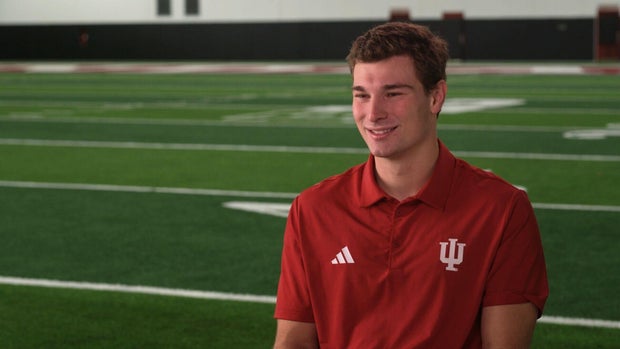
That’s Fernando Mendoza, Indiana’s star quarterback. He’s come to embody the team. A few years ago he was a middling Miami high school player. Just last night, he won the Heisman trophy, the first in IU history.
Jon Wertheim: Can you pause, for a second, and admire the story?
Fernando Mendoza: Human nature is like, wow, like, how did I get here? And there’s a little bit of an imposter syndrome from that point. Whoa, am I supposed to be here? I was a two star recruit. I wasn’t a five star. Who’s supposed to be in this position, who’s supposed to be on the number one team in the nation.
Jon Wertheim: Talk about your imposter syndrome—gone. Does the program still have imposter syndrome?
Fernando Mendoza: I think that we believe. We believe.
The belief has been hard-won. Indiana entered this season as the losingest program in major college football history, more than 700 defeats.
So imagine the astonishment last weekend when Indiana took down the defending national champion, undefeated Ohio State, to win the Big Ten title. The previous time Indiana was conference champion? 1967.
Jon Wertheim: Paint the picture of IU football the first 50 years you’ve been doing this job.
Don Fischer: I’d say up and down except that most of it’s been down.
Don Fischer has been the voice of Indiana football since 1973.
Don Fischer: This is the greatest turnaround– and I hate that word because I don’t think it expresses really what these last two seasons have been like here in Indiana.
Jon Wertheim: Turnaround doesn’t do enough lifting. It’s even bigger than that.
Don Fischer: No. It’s not– it’s not a good enough term.
Jon Wertheim: So I’m thinkin’ Peyton Manning wins the Super Bowl like an hour up the road. And you’ve got Notre Dame. Football is not an alien sport to Indiana. Why did it seem so hard to unlock it here?
Don Fischer: A big problem for Indiana was we could not recruit offensive and defensive linemen.
Jon Wertheim: Big boys.
Don Fischer: The big guys. We just didn’t have very many of ’em. And football here was not a big sport- It just hadn’t clicked as a football place.
60 Minutes 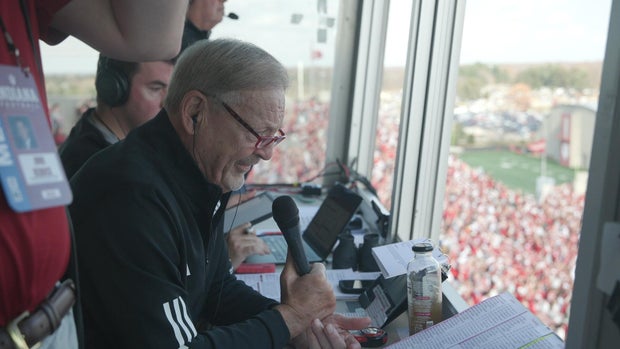
Jon Wertheim: Was there one low moment?
Don Fischer: Oh, I don’t know if there was one.
Here’s one: it’s Indiana legend, but the charismatic coach at the time, Lee Corso, confirms it to us. In a 1976 game, lowly Indiana took an early 7-to-6 lead over mighty Ohio State, so unexpected that Corso burned a timeout for the purpose of commemorative photos. When the game ended, Indiana still had seven points. Ohio State had… 47.
One diehard fan in attendance that afternoon: John Mellencamp, bard of Indiana, who’s been going to Hoosier games ever since his father took him as a kid.
In the ’90s, he funded this indoor practice facility, in hopes it would lure recruits.
Jon Wertheim: You’ve been a fan for, like, 50 years. You’re not a bandwagon guy.
John Mellencamp: No. No, I– I’ve been around through thick and thin.
Jon Wertheim: How thin did it get?
John Mellencamp: Pretty thin.
He says that for years the tailgates drew more interest than the actual games.
Jon Wertheim: You’re goin’ to these football games and the stadium’s half full and fans are leaving–
Jon Wertheim: –at half time.
John Mellencamp: Whoa– w– whoa, whoa, they’re not even half full.
Jon Wertheim: Less than half full.
John Mellencamp: Yeah, less than half full. I mean, you know, like, if this is the stadium, there’s just, like, a few people up here.
In 2023, yet another dismal season, the team finished 3-9 and the athletic director Scott Dolson set out in search of answers.
Jon Wertheim: What was the hole you had to fill?
Scott Dolson: I think– certainly the right coach is– is the biggest hole to fill.
60 Minutes 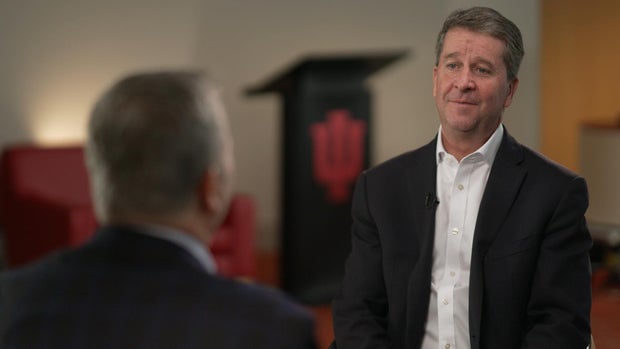
As he scoured for candidates, he had some non-negotiables.
Scott Dolson: We wanted an existing head coach. We wanted a coach who was offensive minded, who had developed quarterbacks.
Jon Wertheim: So the– the slick, offensive coordinator at the big school, that’s not who you wanted?
Scott Dolson: No. We really felt having that head coach experience was– was really important.
Dolson went off the board and settled on a little-known lifer who’d won relentlessly, but also been overlooked relentlessly.
Jon Wertheim: So two years ago, when Curt Cignetti’s name surfaces as a candidate, what’d you know about him? Anything?
Don Fischer: Nothing.
Jon Wertheim: You’ve been covering college football for more than 50 years, and you’ve never heard his name before.
Don Fischer: Never heard his name.
Don Fischer: And when he became the hire– I was surprised by it, but then I looked him up a little bit. I Google– I Googled him.
Jon Wertheim: You Googled him?
Don Fischer: Yes, I did.
That was a direct order from the new coach.
Mere weeks on the job — tired of the ‘who are you?’ questions — Curt Cignetti dropped his usual modesty and said this: “Yeah, it’s pretty simple. I win. Google me.”
Here’s what Googling would have revealed: Cignetti pinballed around the country’s sidelines. Once an assistant for Nick Saban at Alabama, he left the big time to take head coaching jobs at smaller schools, like Elon University and James Madison. When Indiana called, Cignetti was well beyond the usual sell-by date for a maiden job at this level.
Jon Wertheim: You’ve had terrific success wherever you’ve been. But at age 62 this was your first Power Four, big-time job. Did you come in here with a bit of a chip on your shoulder?
Coach Curt Cignetti: The chip probably came from when I got here. Right away I detected an atmosphere that, “You can’t get it done here.”
Jon Wertheim: You sensed that?
Coach Curt Cignetti: — Oh, absolutely. As soon as I walked in the building. Facilities that had been neglected. The stadium banners that looked old. The offices that looked like they were from 1980. And then– you know, just the general attitude of the people I met, the lack of excitement.
Coming from a winning program, he was, well…
Coach Curt Cignetti: I was– furious, pretty much. ‘Cause all we did was win conference championships year in, year out as a staff–
Jon Wertheim: At– at your old school.
Coach Curt Cignetti: Yeah. And– I mean, we– we win. And so it was a clashing of two worlds. And I wasn’t gonna lower my standards.
60 Minutes 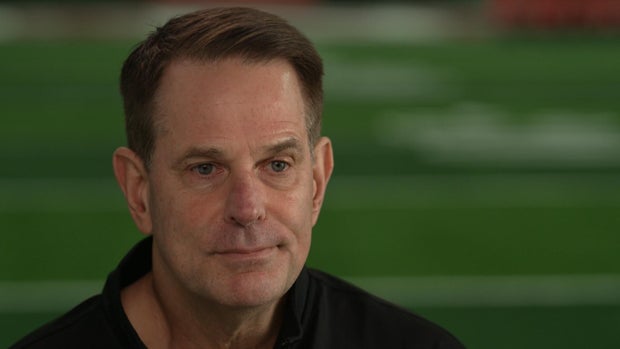
It erupted when Cignetti was first introduced to fans at an Indiana basketball game…
Coach Curt Cignetti at basketball game: Purdue sucks… But so does Michigan and Ohio State! Go IU!
As the kids say, shots fired.
Coach Curt Cignetti: I had to see if the fans were dead or just on life support. I had to wake ’em up, and set an expectation, and create some– some buzz and excitement.
Jon Wertheim: You think they woke up?
Coach Curt Cignetti: Little bit.
The irony: Cignetti is skeptical of anything resembling look-at-me. He may be from Pennsylvania, but his temperament is pitch perfect for southern Indiana. He’s measured. He commands respect. His fallback language is coachspeak.
Jon Wertheim: Coaches aren’t in the habit of sharing the playbook, but what is the magic here?
Coach Curt Cignetti: There’s no magic here. The– it’s fundamentals. You know, I would like to think the leader, which is me, knows what he’s doin’, and has a blueprint, and a plan. Create the intangibles on your football team, the culture, the mindset, the philosophy on how you wanna play.
Under Cignetti, the program is unrecognizable. The last two seasons, Indiana has gone 24-2 without losing a home game…that’s the what. The how is more complicated. It starts with the coach. Not just his eye for recruiting talent, but his ability to develop it once it arrives. Based on what he’s seeing from his perch – a shack atop the stadium press box, where he can smoke, John Mellencamp has his own explanation for Cignetti’s success.
John Mellencamp: He does not show emotion.
Jon Wertheim: He’s not emotional.
John Mellencamp: Not outwardly. Not outwardly. Jon, I’ve made my worst decisions being emotional. And I bet you have, too.
60 Minutes 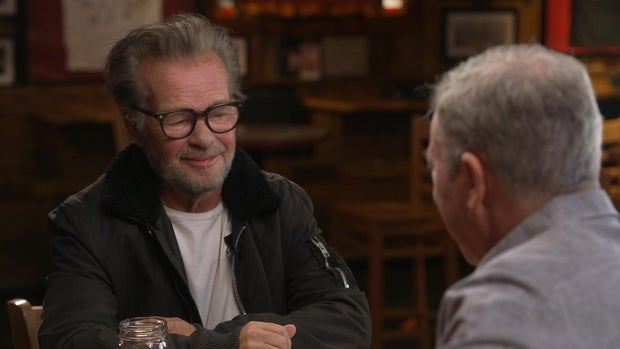
The poise of Cignetti and the turnaround he’s orchestrated? It makes for a hell of a Cinderella story – but this is also a story about contemporary college sports. Indiana’s rise has been helped by new rules. Athletes are now able to enter the so-called “transfer portal” and switch schools at will. Cignetti fortified the roster by bringing 13 players with him from James Madison. Fernando Mendoza played at Cal-Berkeley last season.
Then there’s the money. College players now can be paid for the licensing of their name, image and likeness and, starting this year, they can get a cut of team revenue. Mendoza is reported to be making two million dollars this season.
Fernando Mendoza: I wrote a paper in high school saying why NCAA athletes should not be able to get paid.
Jon Wertheim: Should not be.
Fernando Mendoza: Should not be. And then now I’m contradicting myself as I’m getting paid now. So… there’s so many different dynamics that were never there in college football. And I think that’s why you see so many teams either rising or fizzling. Just because the new structure, whether it’s people talking about compensation in the locker room, which is either uniting or dividing a locker room, whether it’s people going to not only one or two schools like myself going to four schools. I mean, you see coaches leaving midseason, it is. It’s chaos.
In 2024, thanks partially to donors — including IU alum Mark Cuban — Indiana spent more than $60 million on football alone, this as the school is cutting academic jobs and programs.
Jon Wertheim: There are people who wIll say, “Wait a second. These are tough times for colleges and universities. And you’ve got $50 million, $60 million bein’ spent on one sport. That doesn’t make sense.”
Scott Dolson: So certainly the market is what the market is. And it costs a lot of money. But we earn that money. We make it through our revenue streams. And at the same time people understand if we can get football going, the impact and the consequences for the rest of the university are– are significant.
Jon Wertheim: You can have all the marketing meetings you want, and changing logos, and uniforms, but winning games is what’s gonna do it.
Scott Dolson: Absolutely. And I’ve joked before, if I’da known that winning consistently– would– would have that impact, we shoulda tried that a long time ago.
Now the No. 1 seed in the upcoming College Football Playoffs, the Hoosiers’ next game is New Year’s Day. But at Indiana, the joy is tempered by a fear this all could vanish as quickly as it emerged. The school vows to keep spending on football; far more than on basketball. And in hopes the coach doesn’t transfer out, Indiana recently gave Cignetti an eight-year, $90 million contract, more than 15 times his compensation at his last job.
Jon Wertheim: Been around this sport a long time. It’s a lot different now than it was when you started. Do you embrace that?
Coach Curt Cignetti: Oh, you have to embrace that. If not, you have no chance of bein’ successful.
Jon Wertheim: Doesn’t matter if you like it or not. Those are the rules of the road?
Coach Curt Cignetti: You gotta adapt, adjust, and improvise.
Jon Wertheim: Take what the defense gives ya.
Coach Curt Cignetti: Attack at all times.
Produced by David M. Levine. Associate producer, Meghan Lisson. Broadcast associate, Mimi Lamarre. Edited by Michael Mongulla.

