


When late-night show Jimmy Kimmel Live! came back from its temporary “break,” viewers in many markets discovered something odd: Kimmel wasn’t back on their local stations. In markets with ABC affiliates owned by media giants Sinclair and Nexstar, stations skipped the show entirely, substituting their own content instead.
This incident highlights a bigger question that regulators can no longer ignore: as fewer companies control more local TV stations, who decides what shows get aired?
With Nexstar’s announced plans to acquire Tegna in a $6.2 billion deal, the Federal Communications Commission (FCC) must once again face a familiar question: Are the agency’s decades-old media-ownership rules protecting local programming (especially journalism) or hastening its demise?
This question lies at the heart of the modern localism debate, where the FCC’s structural approach to preserving community-focused broadcasting confronts a rapidly changing economic reality that has outpaced the regulatory framework.
Defining the Stakes
The FCC has historically defined localism as the principle that broadcasters should serve the unique needs of their communities. Since the Communications Act of 1934, the commission has pursued this goal as part of a “policy triad” of competition, diversity, and localism. For years, the FCC sought to achieve this goal primarily through structural ownership rules that limit how many stations a single entity can control within a local market, or nationally.
The approach rested on what was seen as a social compact: broadcasters received free licenses to use scarce public airwaves in exchange for serving the public interest. But as Justice Clarence Thomas noted in 2009’s FCC v. Fox Television, this regulatory regime was built on specific “factual assumptions” about spectrum scarcity and market structure that “dramatic technological advances” have since “eviscerated.”
The question now is whether clinging to this decades-old framework serves localism or undermines it.
The Case Against Consolidation
Organizations like Free Press and the National Hispanic Media Coalition argue that mergers threaten authentic local coverage. Their logic follows a straightforward economic narrative: new owners seeking efficiency gains will target the high fixed costs of local-news production, replacing expensive community reporting with cheaper, centrally produced national content.
This concern reflects legitimate economic pressures. Local newsrooms require substantial investments in fixed talent, equipment, and production staff. When stations merge, the temptation to eliminate duplicative costs by consolidating newsrooms or replacing local programming with syndicated content appears economically rational.
The recent closure of local-news operations at stations like WNWO-TV in Toledo, Ohio—which abandoned its newscasts in favor of Sinclair’s centrally produced news content—would appear to validate these fears about corporate consolidation prioritizing cost cutting over community service:
Consider what happened in Toledo, Ohio. WNWO-TV, the Sinclair-owned NBC affiliate, made headlines when it abandoned locally-produced news in 2023. It was not a lack of need for local journalism that drove this decision; it was the brutal math of business reality. The station had been a perpetual ratings underdog, and despite efforts to cut costs, it could not justify continuing to fund a money-losing operation. Instead of producing its own newscasts, WNWO now airs Sinclair’s Washington, D.C.-based “National News Desk” news programming, supplemented with network-provided content and syndicated shows. The station still delivers NBC programming to viewers, but it no longer employs a local news staff.
On the other hand, some stations—such as WOOD-TV in Grand Rapids, Michigan—have shifted away from nationally syndicated programming in favor of locally produced content:
A prime example of this trend is Nexstar’s WOOD-TV 8 in Grand Rapids, Michigan. The station has drastically reduced its daytime schedule of syndicated national programming, now airing just two hours of non-news or non-lifestyle content between 9 a.m. and 8 p.m. The remaining hours are filled with expanded local news broadcasts and a locally produced lifestyle show. WOOD-TV 8 recently introduced new news blocks at 4 p.m. and 7 p.m., complementing its existing coverage and reinforcing its commitment to delivering timely, relevant information to viewers in West Michigan. Additionally, the station airs one hour of national NBC news at 1 p.m., maintaining a minimal connection to network programming.
It may not seem important now, but keep in mind that WNWO-TV had been characterized as an “underdog” station that ranked third in ratings among the top four stations in its market. On the other hand, WOOD-TV has been called a “powerhouse” that “garners some serious ratings.”
Consolidation Could Save Local News
As I noted in an earlier edition of the Telecom Hootenanny, legacy broadcasters face regulatory asymmetries that place them at a severe competitive disadvantage. While local stations operate under a 39% national audience cap, streaming services like Netflix and YouTube can reach 100% of the U.S. market without comparable restrictions.
In addition, local stations face an economic squeeze from two directions:
- The collapse of syndicated daytime programming has eliminated a crucial cross-subsidy that historically funded local-news operations. Shows like Judge Judy and Wheel of Fortune once provided reliable revenue streams that allowed stations to support their more expensive, less profitable news departments. As viewers migrate to digital platforms, this financial cushion has largely disappeared.
- Local broadcasters must compete for both audiences and advertising revenue against much larger and better-capitalized technology companies operating under fundamentally different regulatory constraints.
In this environment, mergers offer two critical advantages that may actually preserve, rather than threaten, localism.
Consolidation creates economies of scale that can make local-news production more financially viable. Merged entities can share expensive resources like investigative teams, weather systems, and production facilities, reducing the average cost of journalism, rather than eliminating it. Additionally, larger broadcast groups gain enhanced leverage in negotiating retransmission-consent fees—the payments cable and satellite providers make to carry broadcast signals. Revenues from retransmission fees for local stations now nearly equal those stations’ advertising revenues. These fees have become essential for cross-subsidizing local-news operations.
Market Bifurcation in Practice
The current market reveals a telling bifurcation that supports the consolidation argument. Strong, well-positioned stations (e.g., WOOD-TV) are increasing their investment in local content, abandoning syndicated programming in favor of additional news and lifestyle shows. For market leaders, local news represents “must-have” content that national competitors cannot replicate, providing powerful leverage in fee negotiations and creating valuable differentiation for local advertisers.
Meanwhile, persistently underperforming stations (e.g., WNWO-TV) are making the opposite calculation, abandoning expensive local-news operations they cannot financially sustain.
Both strategies reflect rational economic decision making in response to the same market pressures, with station positioning—rather than ownership structure—determining the outcome.
The immediate consumer response to individual station changes appears minimal. TVREV reports that there was no significant public outcry when WNWO-TV ceased local-news production. The station’s relatively small audience simply substituted competing local newscasts, suggesting consumer indifference to programming changes at underperforming stations.
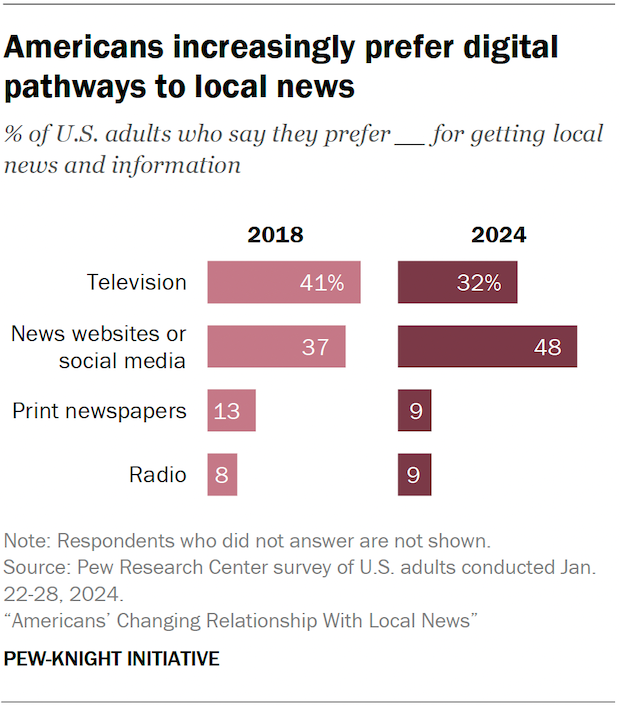
This may be because, according to Nielsen, a large and growing number of Americans prefer to get their news from online sources, rather than TV.
Reframing the Policy Question
The question should not be “Will mergers reduce localism?” That question does not have a yes-or-no answer. Instead, the question should be, “How will broadcasters respond to a merger?” The answer to that question is a more nuanced: “It depends.”
Generally speaking (perhaps a bit too generally), the market appears to be bifurcating, with a hollowing out of the middle ground:
- The strong get stronger: Well-positioned stations invest in the product that differentiates them and drives their most profitable revenue streams: local news and content.
- The weak retreat: Poorly positioned stations may not be able to afford to compete in the expensive local-news arena, and rationally retreat to a lower-cost business model, becoming passive conduits for national content.
The same fundamental economic logic of profit maximization drives both decisions. Stations start from different positions on the competitive path and choose different routes to achieve financial stability. The greatest threat to localism may not be concentration in a mid-sized market, but the financial collapse of stations forbidden from adapting to competitive reality.
Clinging to ownership rules based on 1970s technological assumptions represents a policy of managed decline. I’ve previously argued that technology-specific regulations that prevent market participants from achieving necessary scale often produce the opposite of their intended effects.
A more rational approach would eliminate outdated structural restrictions and allow broadcasters the flexibility to consolidate and compete effectively against unregulated digital platforms. Consumers may not notice the immediate effects of individual mergers, but they will certainly notice when financial pressures force their local stations to abandon journalism entirely.
The choice facing policymakers is not between corporate consolidation and preserving localism, but between allowing or stifling market-driven adaptation.

