



I would like to respond to the President’s Washington Post op-ed, “Rebuilding Something Better.” All quotes in this post are from the President.
Nearly six months ago, my administration took office amid the most severe economic downturn since the Great Depression.
The President and his team use this language to lower the bar against which they are measured. The U.S. economy was quite unhealthy on January 20th, and it still is. Still, Donald Marron shows that, while the President’s statement is almost technically true, there is a big difference between “most severe … since the Great Depression” and “comparable to the Great Depression.” Here is Donald’s graph:
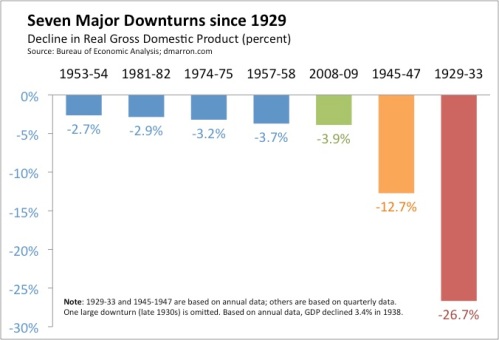
You can see that the recession of the past 19 months is not comparable to the Great Depression.
Nearly six months ago, my administration took office … and many feared that our financial system was on the verge of collapse.
Incorrect. In September-December of 2008, many feared that our financial system was on the verge of collapse. Large financial institutions were failing roughly every other week. By January 20th, we were pretty much out of the woods in avoiding a financial crash. Things were still bad and needed serious long-term repair, but that’s not the same as on the verge of collapse. Had our financial system been on the verge of collapse in January, we (the Bush team) would not have waited to draw down the last $350 B of TARP funding.
The swift and aggressive action we took in those first few months has helped pull our financial system and our economy back from the brink.
The President uses the past tense: “has helped.” Which actions, exactly, have had positive effects so far?
The Administration and the Fed deserve credit for the stress tests, which have encouraged banks to raise private capital. And they have continued the Bush Administration’s efforts to prevent particular too-big-to-fail financial institutions (AIG, Citi, Fannie & Freddie) from imploding.
They successfully followed the path (which President Bush laid in late December) to allow GM and Chrysler to enter and exit bankruptcy, although they did it in a much more heavy-handed way than we had hoped. President Bush’s and President Obama’s actions allowed these firms to avoid immediate liquidation, but it is too soon to call this effort a success.
That’s pretty much it so far:
- The stimulus has not yet had any measurable macroeconomic benefit, although it will, starting a few months from now.
- The much-hyped TARP “Financial Stability” program to buy risky assets (aka “the Public-Private Investment Partnership,” or PPIP) has been dialed back to a fraction of its originally proposed extent. The specifics were announced only last week.
- As of June 17th, CBO could find no evidence that any of the $50 billion allocated for foreclosure mitigation had been spent. (See footnote (d) on page 2.)
- The President’s announced small business loan program does not yet exist.
- The President’s budget would make our fiscal position much worse than current law, necessitating both higher taxes and more debt over the next decade. And, other than the stimulus and a huge appropriations bill, none of it has yet been enacted into law.
- Creeping Congressional and Administration protectionist actions are filling the gap left by Presidential inaction on the free trade agreements with Colombia, South Korea, and Panama.
Aside from the important and apparently successful stress tests for which the Administration and the Fed rightly deserve credit, the most successful and effective actions taken by the Obama Administration in its first six months were the continuation of the TARP capital purchase program and the extension of the auto loans. Both were initiated by President Bush.
I cannot see what else counts as as “swift and aggressive action” that “we
Share This Story, Choose Your Platform!
Go to Top

