In normal times, today would have been a jobs day. However, the Bureau of Labor Statistics (BLS) has been forced to delay the release until December 16 due to the lingering impacts of the Trump administration radically restricting BLS operations during the government shutdown. Further, BLS has announced that we will never have data from the monthly survey of households for October. This means that valuable information for that month—like the overall unemployment rate or the unemployment rate for various demographic groups—will never be known. During the last federal shutdown in 2018–2019, BLS did not suspend its activities and released its employment situation report as normal. In fact, this is the first time in 12 years that a jobs report was delayed and the first time a month of household data will be missed completely.
Federal statistical agencies (FSAs) like BLS and the Census Bureau provide the gold standard data that are crucial for understanding the labor market. The monthly jobs report provides policymakers, businesses, and the public with the most rigorous and timely labor market data they need to make high-stakes decisions. Unfortunately, without a timely release, the Federal Reserve will meet next week without the best data on the state of the labor market. This will materially harm their ability to make a data-informed decision on interest rate policy.
This is not the first time the Trump administration has sought to weaken FSAs. In August, Trump fired the BLS commissioner for accurately reporting data that the administration found politically inconvenient. Amid these historically unprecedented threats, we assembled a new Data Accountability Dashboard that tracks next-best data from other (non-federal) data sources—including ADP employment data, job cut announcements from the Challenger report, and consumer sentiment reports.
These are clearly inferior to the datasets that have historically been collected and analyzed by the nonpartisan, expert professionals who work at FSAs, but they still provide some insights into the direction the economy is moving. This data would also—over time—provide some potential signal if official FSA data were being manipulated or suppressed to hide an economic downturn. Updates to those next-best data this week suggest some weakening in the labor market. Whether this is supported by the FSA data coming back online in coming weeks is a key question people should be watching.
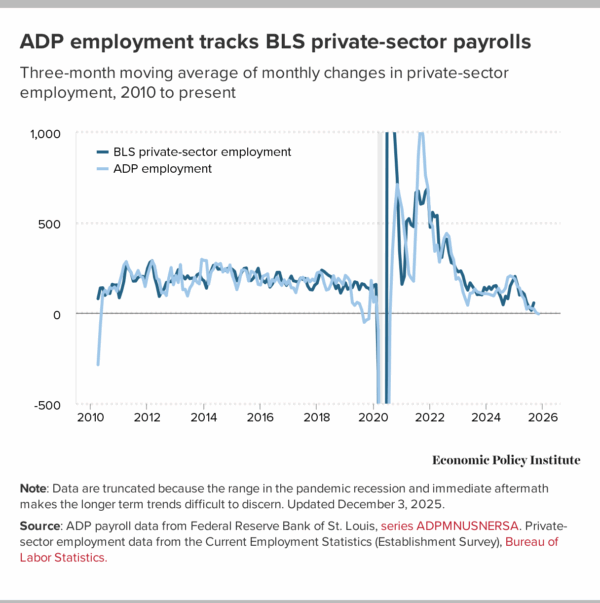
On Wednesday, ADP’s monthly National Employment Report showed a loss of 32,000 jobs in the private sector in November. Our dashboard uses a three-month moving average to remove some volatility and, in making this adjustment, tracks BLS private-sector employment a bit more closely. As shown in Figure A below, ADP employment has dipped below zero for the first time since the pandemic. BLS data available only through September show a similar slowdown. It is possible that Trump administration attacks on immigrant communities have sharply reduced labor supply and driven some of the radical slowdown in job growth. However, even with reduced immigration, the U.S. economy still needs non-zero job growth to keep the labor market from deteriorating. I’ll be looking closely at the official data for October and November released on December 16 to see if they reflect the trends shown here.
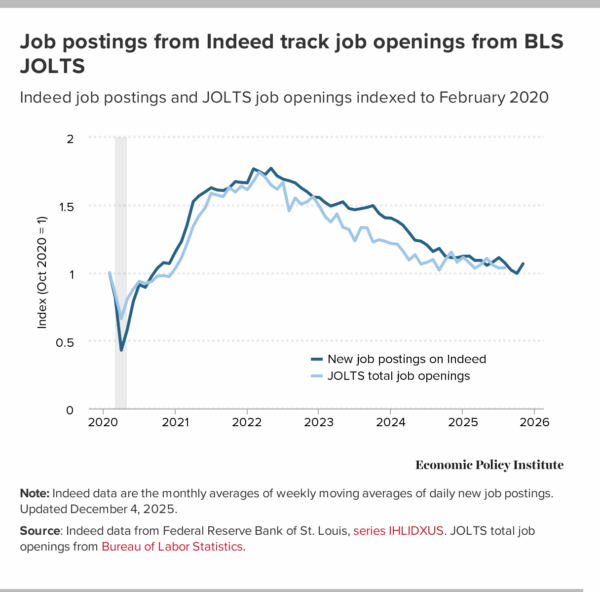
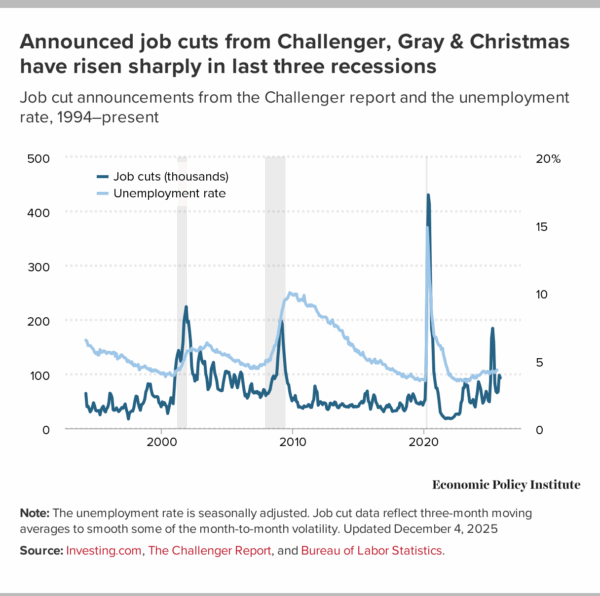
On December 9, the BLS will release data for September and October from the Job Openings and Labor Turnover Survey (JOLTS). Currently, the latest JOLTS data are only available through August. Data from Indeed on job postings (Figure B) and data from Challenger on job cuts (Figure C) provide some insights into job openings and layoffs, given the current lack of gold standard data. Indeed data are provided on a daily basis but are aggregated into a monthly average, which we use here to compare with JOLTS job openings data. So far, the latest data suggest little change in job openings.
Job cut announcements, while volatile, appear to be slowly rising. The official layoffs rate released as part of the JOLTS data has not yet reflected this rise. But it is concerning given that the hires rate remains depressed, a rate similar to the immediate aftermath of the Great Recession. That makes the downside risk of higher layoffs all the greater if laid-off workers have less opportunity to find another job. Put simply, the only reason the unemployment rate has been able to stay relatively low in the last year even as hiring has been depressed is because layoffs have been extraordinarily low. If layoffs pick up while hiring remains weak, unemployment will quickly spike. This makes layoffs a key indicator to watch when the JOLTS data are released next week.