


Today I was intending to analyze developments in China but for now we can look East but to the land of the rising sun or Nihon, because it is in a bond crisis. I would say a slow motion one as it is not a collapse, but the heat is on.
*JAPAN 2-YEAR YIELD RISES ABOVE 1% FOR FIRST TIME SINCE 2008 ( Investing.com)
I have chosen hat one because it presents several nuances. The first is that I consider yields up to 2 years to be strongly influenced by the central bank and expectations for policy. Except Japan has taken an age to raise interest-rates to 0.5% and was hinting we would have 1% by now back in February and has done nothing.
My sense is that the neutral interest rate would be at
least around 1 percent. Therefore, I think it is necessary for the Bank to raise the short-term interest rate to at least that level by the second half of fiscal 2025 to contain the upside risks to prices and achieve the price stability target in a sustainable and stable manner.
That was Board Member Tamura-san from when I looked at his words on the 6th of February and note he said at least 1% and since then they have done nothing.
Next up is the crisis for holders of Japanese Government Bonds of which the largest is the Bank of Japan. As of November 20th The Tokyo Whale held 558,145,180,187,00 Yen of them. If we stay with the two-year bond it will even be having losses on them on a mark to market basis which is quite hard to do. After all you could argue the QQE policy was set up to avoid that as remember even a bond yield of 0% is a profit when you charge yourself -0.1%. But when you charge yourself even as little as 0.25% or 0.5% you have a loss.
Next is a simple point in that Japan now has actual interest-rates after them being essentially 0% for much of The Lost Decade period. We have 1% for the two-year and we also have this.
Japan’s 10-Year Yield Just Broke a 30-Year Trend — The Free-Money Era Is Officially Ending…….For three decades, the **10-year Japanese Government Bond (JGB)** yield hovered near **zero** — sometimes below it. Now it’s at **1.829%**, the highest since **2011**. ( Ajay Patel)
Actually Ajay went a little early because it rose to 1.88% today. When I said several years back that I thought we were going to between 1.5% and 2% we are now maybe looking at the upper part of that. Let me now show you something from The Macro Compass on the 20th of November.
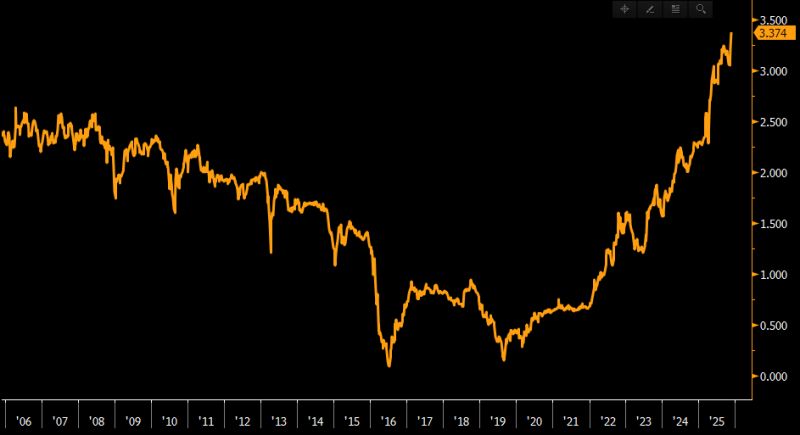
Back then the thirty-year yield had risen to 3.37% and now 3.4%.
The Carry Trade
For newer readers the situation was that if you wanted to borrow you did so in Japanese Yen as you could do so at 0%. Well now even if you borrow two-year money it is 1%. Rather than describe the impact let me show you.
BREAKING: Bitcoin falls -$4,000 in 2 hours as mass liquidations return. $400 million worth of levered longs have been liquidated over the last 60 minutes. (The Kobeissi Letter)
Does the rise in yield overnight explain this? No. But the overall environment has those on margin having a think and markets are pulled lower in case they want to sell.
What has caused this?
There has been a speech today in Nagoya by Bank of Japan Governor Kazuo Ueda.We can start with him providing a critique of the words of Kazuo Ueda.
the International Monetary Fund (IMF) revised its projection for the global economy for 2025 downward to 2.8 percent in April this year, taking into account the impact of U.S. tariff policies. Thereafter, however, the IMF continued to make upward revisions, projecting in its latest October WEO that the global economy will maintain growth above 3 percent in both 2025 and 2026. As described, the impact of tariff policies, which for a while was considered to be a factor that would significantly push down the global economy, has so far not materialized to a considerable degree.
The Trump Tariffs were used as an excuse to not raise interest-rates and as you can see the excuse was exaggerated. Bodies like these so rarely get called out on this. Then we got quite a critique of the Japanese economic situation in the bit I gave highlighted.
, the annualized growth rate is 0.9 percent –– above the potential growth rate, which is estimated to be around 0.5 percent. Given this, the Bank views that its basic assessment that Japan’s economy has recovered moderately remains unchanged.
There are more than a few similarities between Italy and Japan but even the “girlfriend in a coma” has hopes of 1%.
Also we get rather a critique of what has been the Holy Grail for the Bank of Japan in The Lost Decade period which is sustained inflation.
Looking at developments in private consumption in the left panel, consumption of nondurable goods has continued on a decreasing trend, reflecting consumers’ increased thriftiness due to a rise in food prices and other factors…….That said, the burden of price increases on households remains high, and due attention to the impact of price increases is therefore warranted.
You may also like to note that in the Japanese culture of politeness and “face” that is rather a critique of the policies of the new Prime Minister or Abenomics 2.0.
Now to interest-rates.
If the outlook for economic activity and prices outlined so far is realized, the Bank, in accordance with improvement in economic activity and prices, will continue to raise the policy interest rate and adjust the degree of monetary accommodation.
There is an issue here with the use of the word continue. As whilst it is literally true the reality is that they have done as little as they think they can get away with. The irony is that the zombie companies they have tried to protect are being hit by higher bond yields. Then we got the bit to attract attention.
With this in mind, given factors such as the recent decline in uncertainties surrounding the U.S. economy and tariff policies, the Bank considers that the likelihood of the baseline scenario for economic activity and prices being realized is gradually increasing.
So he wants everyone to think he intends to raise interest-rates.
Comment
In the arcane and euphemistic language of central bankers they have a code. One of the features of this is where if they think they will not do something they will put in the public arena that to quote Carly Rae Jepsen.
I really, really, really, really, really, really like you
So that should he not raise interest-rates it will look like he was unable to and thus not his fault. But he “really, really, really, really, really, really” wanted to….
Such a move would immediately collide with the Abenomics 2.0 policy of Prime Minister Sanae Takaichi.
Let me give you another example as remember he thinks the potential growth rate is a mere 0.5% per annum. Well that morphs into this.
Looking back, the aggressive macroeconomic policies adopted by the government and the Bank over the past decade have had a strong stimulative effect on Japan’s economy.
Podcast

