


No matter who acquires Warner Bros. Discovery, whether it’s ultimately Netflix or Paramount Skydance, the deal will be one of the largest media mergers in history.
Yet antitrust authorities reviewing these transactions face an unusual obstacle: they cannot reliably calculate market shares for the streaming services at the heart of the proposed deals. The standard tools used to define relevant markets and measure concentration—such as subscriber counts and revenue figures—produce unreliable results in the streaming industry, exposing fundamental limitations in traditional merger analysis. This matters because, under the Clayton Act, merger review must rely heavily on these metrics to predict competitive harm.
Netflix announced earlier this year that it would cease reporting quarterly subscriber numbers, instead directing investors to focus on revenue and operating margin. Disney followed soon thereafter, ceasing to break out subscriber counts for Disney+, Hulu, and ESPN+ separately. These shifts eliminate the kinds of data that the U.S. Justice Department (DOJ) and Federal Trade Commission (FTC) would typically use to calculate market concentration for horizontal mergers under the agencies’ merger guidelines.
The Subscriber-Count Problem
Amazon Prime Video demonstrates the core difficulty. Amazon reports more than 200 million global Prime members, but the number who actively use Prime Video remains undisclosed. The European Commission, in its review of Amazon’s 2022 acquisition of MGM, had to devise its own methodology to estimate Prime Video’s market share, as many Prime subscribers join for shipping benefits, rather than streaming content.
The Commission acknowledged in its decision that “the prevalence of multi-homing by subscribers for subscription video-on-demand (SVOD) services implies that a large number of subscribers of rival SVOD services may subscribe to Prime Video” concurrently. This observation reveals another fundamental problem: subscriber counts cannot simply be added to determine total market size when consumers routinely maintain multiple subscriptions simultaneously.
Password-sharing crackdowns further complicate what constitutes a “subscriber.” Netflix’s 2023 policy changes converted some shared accounts into separate paid subscriptions, while eliminating others entirely. Year-over-year comparisons became misleading, as did cross-platform comparisons among services with different sharing policies.
Table: U.S. Subscribers to Subscription Video Services (2024)
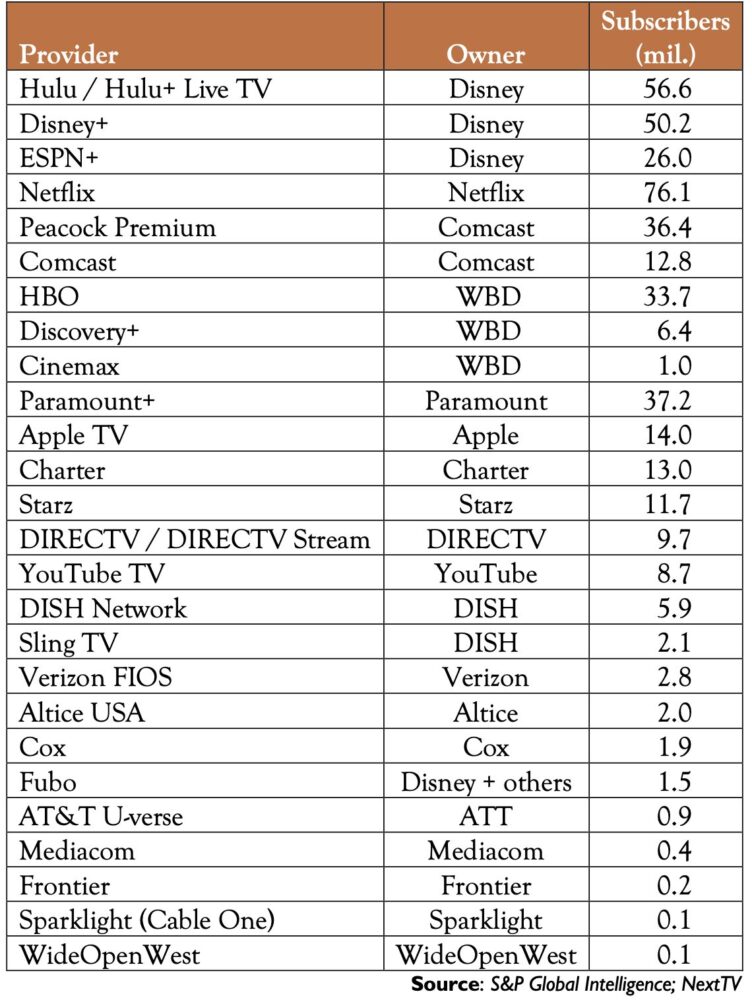
The table above presents 2024 U.S. subscriber numbers, but interpreting these figures requires caution. Disney’s combined services total 132.8 million subscribers across Disney+, Hulu, and ESPN+. Does this represent three separate products, one bundled product, something in between, or something different? The answer affects whether Disney holds three modest market positions or one dominant position.
Revenue Calculations Face Similar Problems
Revenue-based market shares encounter different but equally serious obstacles. Most major SVOD services now offer cheaper ad-supported tiers alongside traditional subscription plans. This transforms streaming services into two-sided platforms serving both viewers and advertisers.
Jean-Charles Rochet and Jean Tirole demonstrated in their foundational work on platform economics that two-sided platforms may rationally set the price on one side very low—or even at zero—to attract users who can be monetized on the other side. Calculating market share based solely on subscription revenue overlooks advertising revenue, resulting in an incomplete picture of a platform’s economic strength.
The U.S. Supreme Court addressed this issue in Ohio v. American Express Co., holding that antitrust analysis of two-sided platforms must account for competitive effects on both sides simultaneously. A platform charging low subscription fees but generating substantial advertising revenue cannot be properly assessed solely by subscription revenue.
Bundling practices create additional complications. Disney sells a Disney+/Hulu/ESPN+ bundle at a significant discount compared to purchasing the services separately. Allocating that bundled revenue across the three services requires arbitrary accounting decisions that do not reflect actual consumer valuations.
Amazon Prime Video represents the extreme case. The service primarily functions as a component of the broader Amazon Prime ecosystem, rather than as a standalone profit center. E-commerce profits subsidize the streaming service. Any revenue-based market-share calculation must decide how to attribute value to a service that Amazon treats as a loss leader for its core retail business.
Third-Party Data Sources Measure Different Things
Given the scarcity of official data, analysts often turn to third-party measurements. Nielsen’s The Gauge reports the percent of total television-viewing time captured by each platform. For October 2025, Nielsen reported that streaming platforms collectively accounted for 45.7% of television-viewing time. YouTube captured 12.9% of total TV viewing time in that measurement period.
This reveals consumption patterns but does not translate directly to market share for antitrust purposes. YouTube’s 12.9% share of viewing time reflects its vast library of short-form content and user-generated videos. Although it’s difficult to quantify, it is widely understood that YouTube generates far less revenue per viewing hour than Netflix does from its library of feature films and series. Viewing time and economic market power do not correlate in a straightforward way.
JustWatch, a streaming-guide platform, publishes what it calls “market share” figures based on user engagement with its service. JustWatch CEO David Croyé acknowledged in a 2023 interview that “our market share statistics must be taken with a grain of salt and more directional in showing longer-term trends” because “JustWatch users are mostly heavy users with several streaming services.” The methodology captures stated interest in content, rather than actual subscriptions or revenue.
The U.S. Securities and Exchange Commission (SEC) does not require publicly traded companies that own streaming platforms to report streaming subscribers, revenues, or usage metrics in any sort of consistent manner, beyond the general mandate that public companies must report information that would be “material” to investors. Firms report different combinations of these metrics, when they report them at all, leaving analysts to piece together incomparable proxies.
Implications for Merger Review
These measurement challenges do not make antitrust analysis impossible, but they do require different analytical approaches than merger review traditionally employs. The 2023 Merger Guidelines from the DOJ and FTC warn that “an analysis of the existing competition between the merging firms can demonstrate that a merger threatens competitive harm independent from an analysis of market shares.”
For SVOD mergers, evidence of existing competition between merging firms might include internal documents showing executives view specific competitors as their primary rivals, subscriber switching data demonstrating which services consumers view as substitutes, or pricing studies revealing how subscription decisions respond to competitors’ prices and content offerings.
Even with compulsory disclosure during merger review, the DOJ and FTC will struggle to produce reliable market shares in the streaming market. Data may not be comparable across firms due to different accounting methods, bundle treatments, and geographic coverage. Creating a consistent denominator for market-share calculations requires numerous judgment calls about promotional subscribers, bundle revenue allocation, multi-homing treatment, and advertising revenue weighting.
The merger guidelines traditionally rely on Herfindahl-Hirschman Index (HHI) calculations based on market shares to establish prima facie cases of competitive harm. In the SVOD context, mechanical application of HHI thresholds becomes problematic when the underlying market shares cannot be calculated consistently. Merger enforcement may need to rely more heavily on qualitative evidence of competitive effects.
Third parties analyzing these mergers face an even greater practical challenge. Without access to confidential data produced during merger review, outside analysts must rely on the incomplete and incomparable public data sources described above. Any published market share figure for SVOD services should be accompanied by an explicit discussion of methodology, assumptions, and limitations. Presenting a single market-share number without these caveats misleads readers about the certainty of the underlying analysis.
Measurement difficulties in streaming services may preview similar challenges in other digital markets, where platform business models, bundling, and multi-homing are common. Antitrust analysis will need to adapt its tools to these market structures, rather than forcing them into frameworks designed for single-product firms selling to single-homing customers.

