


Sweden’s unequal wealth distribution
19 Dec, 2025 at 09:12 | Posted in Economics | Leave a comment
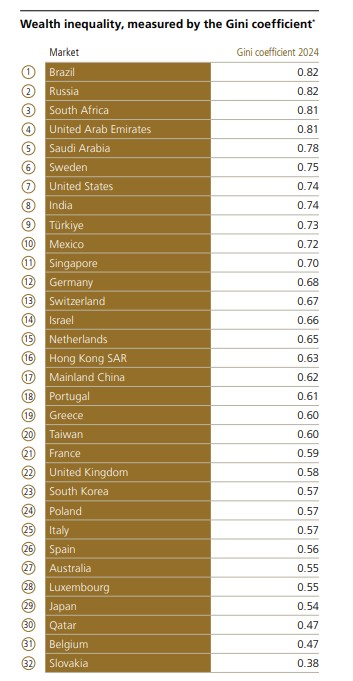 UBS Global Wealth Report 2025 reveals that Sweden — once a global beacon of equality — has now fallen to the far less enviable position of sixth place among the world’s most unequal countries in terms of wealth.
How could things have gone so wrong for a country that, not so long ago, was seen as a model of equality?
Almost a decade ago, Thomas Piketty’s Capital in the Twenty-First Century hit the shelves. In many ways, it marked a turning point in the global conversation about economic inequality. But last year, Swedish economics professor Daniel Waldenström, of the Research Institute of Industrial Economics (which is controlled by the Confederation of Swedish Enterprise, an employers’ organisation and an interest group for Swedish business), published the book Superrika och jämlika: Hur kapital och ägande lyfter alla (Super-Rich and Equal: How Capital and Ownership Lift Everyone), arguing that Piketty is fundamentally wrong about the trajectory of wealth inequality.
Waldenström’s case hinges on shifting the time frame. Instead of focusing mainly on the past 40 years — as Piketty does — he stretches the analysis over 130 years. The result, he claims, is a far more optimistic story: although the number of super-rich Swedes has risen, inequality has not. In fact, he insists that wealth has never been more evenly distributed. Why? Because (1) Swedes today are, on average, 30 times richer than in the late 19th century, (2) much of that wealth now comes from housing and pension savings, and (3) this has broadly levelled out wealth distribution, even though the richest 1% have pulled ahead in recent decades.
Piketty attributed the long decline in wealth inequality during the 20th century largely to the upheavals of the two world wars and the rise in capital taxation. Waldenström disagrees. He points instead to institutional changes — universal suffrage and expanded education — as the key drivers, since these raised wages and made widespread saving in housing and pensions possible.
But Waldenström doesn’t stop at describing what he sees as the historical trend. His book also dishes out advice — to policymakers and individuals — on how to tackle inequality. Unsurprisingly, that advice is steeped in a distinctly conservative worldview.
Take housing. Many of us have long thought Sweden’s housing policy has tilted far too much toward promoting private ownership at the expense of affordable rental housing. The politically driven conversion of rental units into condominiums has left vulnerable groups struggling to find reasonable housing. Waldenström, however, says we should double down — pushing even harder for condominiums and owner-occupied flats. In his view, only when households own their homes will buildings be properly maintained. Rising house prices and the growing number of outright homeowners? Purely positive, in his book. That this has also made Swedes one of the most indebted peoples in the world, he waves away, insisting we should measure debt not against disposable income but against asset values. Mirabile dictu!
It’s striking how unequivocally Waldenström treats pension funds and privately owned homes as clear markers of wealth equality. Ask today’s young people—forced to borrow millions just to get on the housing ladder — whether they feel like winners in this supposed game of equality. The same goes for pensioners. Locked-away pension assets don’t feel like the same kind of wealth as stocks or other liquid holdings.
On taxes, Waldenström wants income taxes cut—hardly a novel proposal from the political right, and one that could in theory appeal more broadly if it meant targeted relief for the lowest earners alongside higher taxes on top incomes and capital. But that’s not on his radar. The real problem, in his view, isn’t that capital is undertaxed—it’s that higher taxes might dampen the “incentives” of the country’s “successful owner families and entrepreneurs” to innovate and create jobs.
When it comes to whether extreme wealth concentration poses a threat to democracy, Waldenström again sees no real issue. Many — after watching the antics of Elon Musk, for example — would beg to differ. For him, the solution is not to “curb wealth” but to “strengthen the integrity of the political system.” A more naïve reading of the link between money and power would be hard to imagine.
Much of Waldenström’s argument — that inequality has declined — rests on comparing today’s Sweden to the late 19th century. And sure — no one disputes that Sweden is more equal and wealthier now than when a single person could hold a majority of votes in a local parish. But that’s not the point. Critics of Sweden’s neoliberal turn since the 1980s have focused on the rise in inequality within our lifetimes. And here the facts are clear: for the past 40 years, it’s been getting worse. Telling people that “things were even worse 130 years ago” is like telling the unemployed today not to complain because joblessness was higher in the 1930s. Few will be persuaded.
The LO’s (Swedish Trade Union Confederation) latest report, The Power Elite: Rocketing Away from Reality, shows that corporate executive pay continues to skyrocket, reaching historic highs. In 2023, the CEOs of Sweden’s 50 largest firms earned, on average, more than 70 times what an industrial worker makes. For Waldenström, this is not a problem. On Swedish television’s news program Rapport, he commented that “as long as one simply discusses and lands [sic!] at both the CEO level and other employees’ level, it becomes the wage that is reasonable to bear.”
What can one say about this belt-and-suspenders defence of inequality? Backed by business-sector funding, Waldenström is trying to whitewash the vast disparities in Sweden today. But it doesn’t work.
The top 10% of earners now control the same share of disposable income as roughly the bottom 50% combined. Sweden has the second-highest wealth concentration in the EU. The idea that this is not a democratic problem is one that very few serious social scientists would endorse.
Waldenström’s book reveals a once-serious researcher who has chosen to become one of the loudest market-apologetic megaphones for Swedish big business — offering analyses that are little more than ideologically tinted whitewashing of serious social problems.
Mainstream economists over and over again tell us that inequality isn’t really a problem at all, because the gap between top and bottom will always be greater in a successful economy. This line of reasoning is a familiar refrain among market fundamentalists. It’s the old “trickle down theory”: feed the horse more oats, and eventually enough will pass through to feed the birds.
The problem is that the empirical evidence for this “trickle down” is precisely zero.
Several concurrent reports from autumn 2025 indicate that 700,000 Swedes are living in poverty. This represents a doubling since 2021, bringing the figure to nearly 7% of the population. The issue encompasses both social and material deprivation, with many unable to cover even the most basic expenses.
All economics is politics. All economics is power. Sweden has the second-highest concentration of wealth in the EU. The claim that this does not constitute a democratic problem is one shared by very few serious social scientists.

