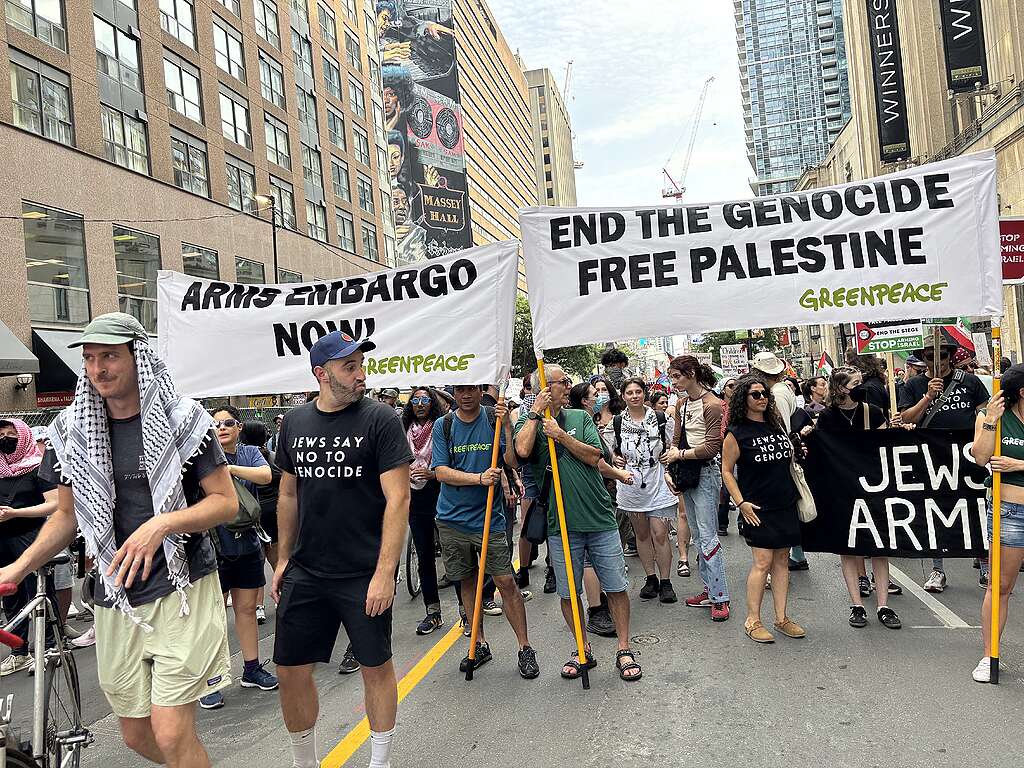
Canadians who support Greenpeace tend to share a simple conviction: We cannot build a livable planet without justice, dignity, and freedom for all people.
That conviction shapes how we respond to injustice everywhere. It includes the profound human and environmental catastrophe ongoing in Gaza. It also includes our response to the very real fear felt by Jewish communities in Canada and around the world.
Yet many Canadians find themselves hesitant to speak out and condemn the state of Israel for the destruction of Gaza. How can I criticize Israeli government actions without being accused of antisemitism? How do I honour and support Jewish communities while calling for an end to violence and suffering?
The response is both principled and clear: Criticizing Israel does not equate to antisemitism. Calling out state policies that violate human rights is not an expression of hatred.
Understanding this distinction is essential for protecting Jewish communities, defending human rights, and enabling honest public conversations.
Why this matters in Canada
Canada is home to diverse populations from around the world, including Jewish, Palestinian, Arab, and Muslim communities. We live, work, and organize together. In a country that aspires to reconciliation and human rights, we have a responsibility to keep our public conversations rooted in compassion and truth.
Speaking about Palestine and Israel in Canada is not only emotionally difficult but, for many people, genuinely unsafe. Palestinians, Arabs, Muslims, racialized and migrant workers, students, precariously employed people, and dissenting Jewish Canadians often face real risks when they speak out, including threats to their employment, academic standing, immigration status, or personal safety. The fear is not simply about “polarization,” but about the structural power dynamics that make some voices far more vulnerable than others. This blog does not pretend to remove those risks; instead, it addresses one specific source of fear that affects many Canadians: the confusion between antisemitism and legitimate criticism of Israeli government policies, and the worry that criticism of Israel and supporting Palestinians’ rights will be misinterpreted as hatred toward Jews. Clarifying this distinction is one step toward enabling safer, more honest conversations rooted in justice and human rights.
Antisemitism is real and must be opposed without hesitation
Antisemitism is hatred, discrimination, or violence directed at Jews because they are Jewish. It includes threats against synagogues, conspiracy theories about Jewish control, blaming Jews for world events, dehumanizing stereotypes, and attacks on Jewish schools and community spaces.
It is dangerous, deadly, and ongoing. It must be opposed clearly and consistently.
For many Jewish people — especially those raised with strong connections to Israel or taught that the state exists as a safeguard against persecution — criticism of Israeli policies can feel frightening or personal. That feeling is real. It is rooted in centuries of trauma, displacement, and the very real history of Jews being targeted when governments and institutions failed to protect them.
Recognizing this context is necessary for any compassionate, grounded conversation.
Judaism is not the same as the state of Israel.
Judaism is a diverse, global, diasporic religious and cultural tradition thousands of years old. The modern State of Israel, founded in 1948, is a political entity governed by elected officials who make policy decisions, like those of any other state.
The idea that Israel and Judaism are inseparable is not a historical fact — it is a political construction. Israeli governments and global advocacy networks have promoted this narrative as a strategic tool, aligning Jewish identity with state authority.
This conflation places an unfair burden on Jewish individuals by making them feel responsible for the decisions of a government of a country they often do not live in, erases the rich diversity of Jewish political beliefs, and chills essential debate by branding legitimate criticism as bigotry. It is crucial to understand the distinction: opposing the policies and actions of the Israeli government is not the same as opposing Jewish identity.
Criticizing a government is not prejudice; it is accountability.
Israel is a nation-state whose government’s decisions shape the lives of millions and carry profound environmental and humanitarian consequences. Critiquing its military actions, occupation policies, blockades, settlement expansion, violations of international law, or environmental devastation is not an attack on Jewish people — it is an act of civic responsibility. Greenpeace supporters regularly challenge the governments of Canada, the United States, Brazil, Indonesia, and many others, not out of dislike for their populations but because governments must be held accountable for the harms they cause. The same logic applies here.
How the conflation of Israel and Jewish identity creates danger
Successive Israeli governments and various advocacy networks have advanced — and in many cases explicitly stated — the idea that Israel represents “the Jewish people worldwide.” This framing is not incidental; it is a political project with a well-documented history. Human rights organizations, historians, and even former Israeli officials have shown how state institutions and global advocacy networks merge Jewish identity with Israeli state power, cultivating the belief that criticism of the government is equivalent to criticism of Jews as a whole. Israel’s 2018 Nation-State Law, which legally defines the country as “the nation-state of the Jewish people,” codifies this conflation, asserting formally what had long been implied: that Israel speaks for Jews everywhere.
Many scholars and commentators have also noted that this conflation is reinforced through a political landscape where Jewish trauma and fear — rooted in centuries of antisemitic violence — are regularly invoked to justify Israeli policies and silence dissent. At various moments in history, Israeli leaders have argued that Jewish safety depends on unwavering allegiance to the state, framing criticism as a threat to Jewish survival. But this strategy ultimately deepens the vulnerability of Jewish communities outside Israel, rather than reducing it. When a government insists that it acts on behalf of a global, diverse community, it creates the dangerous impression that Jewish people everywhere are collectively represented by, and therefore collectively responsible for, that government’s decisions and actions. And when those decisions include actions that violate international law or generate widespread moral outrage, Jewish communities — who had no role in shaping such policies — become unfair targets for backlash and hostility.
This dynamic does not combat antisemitism; it fuels it. It reinforces one of the oldest antisemitic myths — that Jews operate as a single political bloc or bear collective responsibility for the actions of a state — and makes Jewish individuals more vulnerable to scapegoating whenever Israel commits actions that shock the conscience. Instead of protecting Jewish communities, this narrative exposes them to heightened risk, erases the full diversity of Jewish political beliefs, and burdens individuals with accountability for state violence over which they have no control.
The deadly antisemitic attack in Australia this week underscores why this conflation is not merely an abstract political debate, but a concrete matter of Jewish safety. When violence targets Jewish people in the diaspora, Israeli officials and aligned advocacy networks frequently rush to frame the attack as further proof that Jews are unsafe everywhere without Israel, while simultaneously insisting that Israel speaks in the name of Jews worldwide. This response is profoundly counterproductive. It exploits real Jewish fear and trauma, but it also reinforces the very logic that endangers Jewish communities: the idea that Jewish people everywhere are extensions of a state and its actions. In moments of grief and vulnerability, this framing does not protect Jews in Sydney, Melbourne, Toronto, or Paris; it heightens their exposure by collapsing the distinction between a diverse global community and the policies of a single government. The tragedy in Australia should therefore sharpen — not silence — our insistence on clarity: antisemitic violence must be confronted unequivocally, and it must never be instrumentalized to justify state violence or to bind Jewish safety to unquestioning loyalty to any government.
Understanding and rejecting this conflation is not only accurate — it is essential for Jewish safety and for the integrity of any human rights movement. Jewish identity is not reducible to the actions of a government. In fact, clarity on this point is one of the most important steps we can take to protect Jewish communities, support principled public debate, and uphold universal human rights.
Why Greenpeace speaks out about Israel’s actions
Greenpeace does not take sides in wars. We do, however, take the side of:
- Human rights,
- Environmental protection,
- Civilian safety,
- Justice,
- And the right of all people to live free from violence.
The scale of destruction in Gaza — to human life, land, water, air quality, agriculture, and infrastructure — demands scrutiny. Environmental devastation is never neutral; it falls heaviest on the most marginalized. Speaking about this is not antisemitic. It is necessary, responsible, and aligned with our mission.
How Canadians can talk about this clearly and safely
- Critique policies and actions.
- Affirm opposition to anti-Palestinian racism, antisemitism and Islamophobia.
- Stay grounded in international law and evidence.
- Recognize that Jewish communities hold diverse political beliefs.
- Reject collective blame.
This approach protects everyone.
Canadians deserve honest, courageous conversations.
If we want a future rooted in peace, justice, and environmental integrity, we must reject narratives that silence truth or weaponize fear.
And we must be clear: Criticizing Israel is not antisemitic. Silencing such criticism harms Palestinians and Jewish communities alike.
What we stand for — together
As Canadians dedicated to creating a just and sustainable world, we can affirm:
- Palestinian lives matter.
- Jewish safety matters.
- Human rights and environmental protection matter.
- Accountability matters.
- Justice matters.
These commitments do not conflict; they strengthen one another. Justice is not a zero-sum endeavour — it is a shared path forward.