


Highlights From These Itineraries
Below are the highlights from our 5-day Croatia itineraries. From national parks and beaches to ancient ruins and medieval townscapes, these destinations make up an inspired collection of places across the country. We’ve provided links to a few of them so you can get more in-depth travel info to help you plan your Croatia adventures.
Zagreb
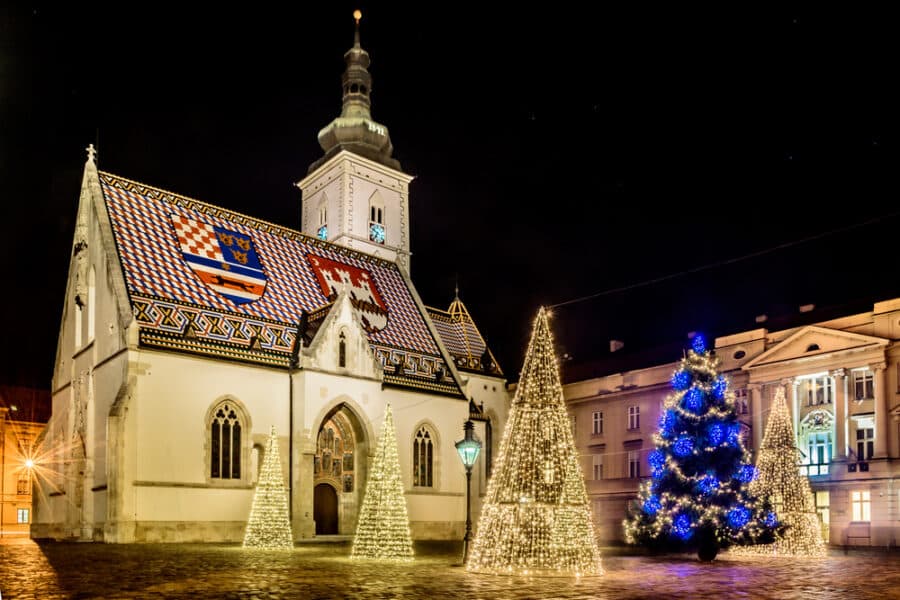
Croatia’s landlocked capital, Zagreb, is the country’s largest city. This northern city may not have the coastal charm of Dubrovnik or Split, but it still packs a punch for sightseeing.
Exploring here means meandering the red roofs and cobbled lanes of the Upper Town (complete with Gothic cathedrals and medieval buildings) and spending time in the Lower Town with its attractive parks, bustling city squares, and fascinating museums. It’s the perfect jumping-off point for exploring northern Croatia.
Read more about Zagreb here. ↳
Dubrovnik
Dubrovnik is well known these days to fans of Star Wars and Game of Thrones. The list of filming locations draws tourists to the Old Town — a walled city with a warren of cobbled streets edged by Baroque palaces and Gothic churches. Though it can get busy with tourists during the peak summer months, there are plenty of opportunities to escape the crowds, thanks to nearby beaches and the chance to hike up Mount Srd.
Read more about Dubrovnik here. ↳
Split
Another Croatian destination famous for its Game of Thrones filming locations, the southern city of Split is another historical coastal town awash with beautiful buildings and picturesque streets. Centered around Diocletian’s Palace, built in 305 AD, Split’s Old Town is strewn with relics of the past. Island-hopping adventures await travelers eager for more.
Read more about Split here. ↳
Zadar
With its own Roman ruins, centuries-old churches, and youthful cafe scene, Zadar is the antidote to the tourist crowds of Dubrovnik and Split. Situated on a peninsula, the port town has enough sights to keep you entertained for more than a day.
Some excellent transport links can get you from the mainland to some far-flung Adriatic islands if you want to get off the beaten track.
Read more about Zadar here. ↳
Hvar
The island of Hvar is one of many idyllic islets that dot the Dalmatian coast. This dreamy destination is famous for its sunny weather and attracts Croatian and international vacationers alike.
While Hvar has an exclusive side, complete with yachts and expensive clubs, much of the island also has a down‑to‑earth Mediterranean atmosphere. Needless to say, you’ll probably want to stay longer.
Read more about Hvar here. ↳
Plitvice National Park
Plitvice Lakes National Park is Croatia’s most famous natural wonderland. Designated as a UNESCO World Heritage Site, spanning over 74,000 acres, Plitvice is famed for its karst landscape and terraced lakes connected by waterfalls.
Most people visit on a day trip; if you stay longer, you’ll get to indulge in the scenery (think hiking and walking trails) for more than just a few hours.
Read about accommodation in Plitvice here. ↳
Elafiti Islands
Situated to the northwest of Dubrovnik, the family-friendly Elafiti Islands have a relaxed atmosphere and are an ideal escape from Croatia’s crowded coastal cities — at least in the height of summer.
Though made up of 13 islands, the main islands in the archipelago are Lopud (car-free), Kolocep, and Sipan. Please spend some time zipping between them by boat to discover old-world villages, Roman ruins, and sparkling beaches.
Read more about the Elafiti Islands here ↳
Mljet National Park
Comprising the northern part of the island of Mljet, this forested national park is a gem for nature lovers seeking to explore unspoiled landscapes. Famed for its connections to Greek mythology (legend has it that Odysseus spent seven years here), today, it attracts hikers, campers, and beach-goers who want some adventure.
Read more about Mljet National Park here ↳
Trogir
Day trippers often visit Trogir from Split, but staying longer is worth it. The attractive island, connected to the mainland by bridges, is home to picturesque buildings and plenty of history.
It’s a UNESCO World Heritage Site thanks to its Venetian architecture, Romanesque towers, and Gothic churches.
And Game of Thrones fans may recognize it as one of several filming locations used in the series.
Read more about Trogir here ↳
Rovinj
On the west coast of the Istrian Peninsula, Rovinj is a time-worn fishing port with Roman, Byzantine, Frankish, Venetian, and Austrian connections. Known in Italian as Rovigno (Italian is an official language here as well as Croatian), the town is an enticing mix of pedestrianized streets, soaring churches, and local squares to discover.
The summer months see it bustling with families on vacation.
Read more about Rovinj here. ↳
Vis
Once a naval base, Vis has flourished as a tourist draw since it was “opened up” in the late 1980s.
Located around 35 miles from Split, it is one of the more remote inhabited islands in Croatia.
Its decades-long isolation and distance from the mainland have allowed its flora and fauna to thrive. Add in ancient churches and Roman ruins for extra historical charm.
Read more about Vis here. ↳
Bol
The ever-popular vacation destination of Bol lies on the island of Brac, just off the coast of Split. Fringed by its pine tree-clad pebble beach, Zlatni Rat, the town is centered around its glistening marina.
Bol’s streets are lined with old stone buildings and colored with overflowing flowers. Historic sights may be fewer than in other parts of Croatia, but it’s a charming, centuries-old spot that buzzes with life in the summer.
Read more about Bol here. ↳
Pula
Pula sits on the southern end of the Istrian Peninsula. This coastal city has a lot going for it — and it’s been a strategic location for various civilizations since prehistory. Romans, Ostrogoths, and even World War II forces stationed here have all left their mark.
Most impressive of all is the Roman amphitheater, set right in the center of the city, that was constructed between 27 BC and 68 AD. It’s one of the largest Roman arenas still standing today.
Read more about Pula here. ↳
Korcula
For more Croatian island hopping, Korcula awaits. The slender island is a patchwork of old-world villages dotted with olive groves and vineyards. Its old town is a hidden gem, while its quiet beaches and secret coves on the southern coast can indulge even the most world-weary traveler.
Traditional festivals, crafts, and folk music remain an essential part of life in Korcula.
Read more about Korcula here ↳
Fazana
The fishing village of Fažana is enchanting.
Think pastel-painted harborside buildings, local fare served up in down-to-earth eateries, and postcard-perfect beaches (several, in fact). Though small, it is a popular vacation hotspot — thanks to all those beaches — and a jumping-off point for the Brijuni National Park islands.
Paklenica National Park
Outdoor enthusiasts flock to Paklenica National Park for its rugged karst scenery and winding trails. The landscape here is shaped by river canyons and tall limestone cliffs that bristle with forests of black pine, the haunt of wildlife from eagles and falcons to deer and bears. Hiking and rock climbing are very popular here.
Read more about Paklenica National Park here ↳
Kornati Islands
Made up of over 140 uninhabited islands, the Kornati Islands are an undeniable attraction for adventurous travelers. Spanning around 115 square miles, the archipelago features gleaming karst cliffs, rugged coastlines, and intriguing rock formations — a striking contrast to the ultramarine blue of the Adriatic Sea.
Read more about the Kornati Islands here ↳
Ston
Ston is an intriguing place. Strategically located on a peninsula and once an important town of the maritime Republic of Ragusa, the city is famed for its 3.4-mile-long defensive walls, among the longest preserved stone walls in Europe.
Within its medieval walls, Ston boasts a fascinating old town, pedestrianized streets to wander, and a booming gastronomic scene. It’s particularly famous for the mussels and oysters that grow in the channel between the city and the mainland.
Read more about Ston here. ↳
Peljesac Peninsula
Beginning at Ston and extending westward into the Adriatic Sea, the Peljesac Peninsula brims with dramatic mountains, verdant valleys, relaxed towns, and historic settlements. Though noted for its wine production, the peninsula is also a prime destination for road trips along its winding coastal routes.
Read more about the Peljesac Peninsula here ↳
Opatija
Featuring promenades, 19th-century vacation villas, and manicured gardens, Opatija was once a booming resort town during the Habsburg era. Though not as glitzy as in its heyday and lacking beaches, the city has seen a resurgence among well-heeled travelers who come for Opatija’s grand hotels, amiable year-round climate, and high-end dining scene.

