


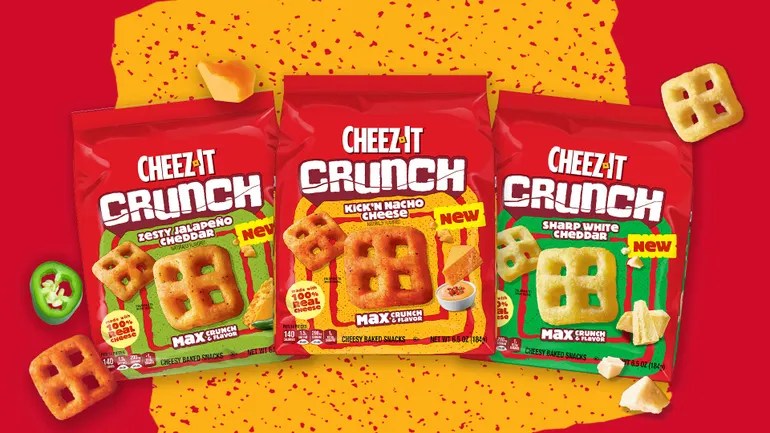
Armed with more information than ever before, consumers are reshaping how food manufacturers approach innovation.
With shopper preferences rapidly changing and inflation sharply curtailing how much shoppers are spending, innovation has become one of the primary levers for food companies to drive growth. New launches also reflect a realization by companies that a single one-size-fits-all product is no longer going to work for every consumer or eating occasion.
Pringles maker Kellanova, which became part of candy and snack maker Mars on Dec. 11, has leaned into consumer trends like protein and recently posted its largest annual increase in dollar sales from innovation in years. It’s also using tools like artificial intelligence to assist in everything from product development to data analysis.
Food Dive recently sat down with Nico Amaya, Kellanova’s North America president, to discuss product development in the food space, how it has evolved and why innovation is more important than ever before.
This interview, which took place before the completion of the Mars merger, has been edited for brevity and clarity.
FOOD DIVE: Please discuss the importance of innovation right now in food.
Nico Amaya: Innovation in the food and beverage sector has always been important. Now, what we’ve seen, based on our insights and our research, is certainly that consumers now have more information. They have different needs. They want things that are more personalized to their needs, and as a company we always stay very close to those insights and making sure that we serve that consumer, that we give them solutions.
We have more information to really be able to provide those solutions. And coming out of COVID, we were restricted by many factors, as was the industry and everyone. So now that we’re out of that and our supply chain is stable, innovation has really ramped up across all of our categories, and certainly we are leading innovation and really leading that growth as a company.
Is the pullback in consumer spending impacting innovation?
Amaya: We’re seeing a contraction from consumer spending, and that’s across the board, in many categories beyond the ones that we participate. There’s definitely a lot of uncertainty happening right now. So the consumer is a little bit restricted and also a little bit on the wait-and-see pattern.
Innovation is actually driving growth. And why is that? The consumer, of course, wants differentiated, whatever money they have, they want to ensure that it is well spent, and really gives them a solution.
Innovation is actually pulling up the food category with very highly indulgent items that the consumer really wants to pamper themselves. But also on the better-for-you side, which is actually growing significantly across all categories. So that’s really helping drive some of that growth and minimize the impact that we’re seeing.
We’re leading innovation right now for our category, so we are the ones bringing a lot of that news. We continue to introduce new items that are more relatable to what the consumer is looking for. So we launched Eggo Protein, which is doing fantastically well.
We are really hitting the consumer in terms of what is expected. We have RXBar, which we bought a couple years back, and then we are introducing new formats that contain a lot more protein. Also in our core brands like Pop-Tarts, we’re introducing a protein Pop-Tart that is really appealing for that young consumer looking for that type of product. So we are increasing our offerings from what we have done in the past.
Kellanova is on track to post its highest innovation years since the pandemic. Can you provide more insight into that?
Amaya: 2025 finished the year above $250 million, roughly, of innovation contribution to sales, which is fantastic. This is 40% more than what we had the prior year. And in 2026, we’re going to increase even more beyond that.
We are definitely putting more money, not only in launches, just making sure that consumers try them and are aware, but also in the process. We are investing more in research and development. We’re investing more in enabling the assets to be able to produce that, but we’re also putting more money to make sure that consumers are aware that we have that innovation.
Artificial intelligence is becoming a bigger part of operations for many food companies. How is Kellanova using AI within its business?
Amaya: Data and analytics are at the center of everything that we do and everything that we will do in the future. AI is really facilitating the mining and the anticipation of that information. We have been investing in the way we look at data, the way we organize it, the way we combine it, but now applying AI to many factors of those to really be able to maximize it and take advantage of it in real time.
Definitely, it’s a learning experience. It’s not that we’re there all the way, but you are certainly leaning in. How do we learn about the consumer? Now we do it in different ways. How do we create new products? Now we’re starting to do in different ways. How do we do creative advertising?
We are applying AI as well, but when you look internally in our plans, we have been preparing for years now to enable our plans to provide data and analytics. Now we’re going to start using AI in more effective ways to be able to adjust and capitalize on efficiencies. And then, of course, when we think about the way we process all our back end, our back office, we are applying there as well. So it has many applications.
AI, for sure, is transforming the way we do things, and for sure, it’s going to continue to be even more important into the future. So we’re certainly leaning into this territory.
What AI is helping us do is iterate faster … We can quickly iterate, create concepts, create prototypes in a much faster way than what we used to do, and be able to test that with the consumer to get an answer. So that is something that we can do quicker, and we also don’t just have one concept. We can have 20. We can have 50 in real time and get answers, which, in the past, that was not enabled. So that agility is being applied, and that’s the way we can anticipate something.
Given your history with the company and in the food business, I’d be curious to see how innovation has changed and evolved.
Amaya: Early in my career, I did a lot of innovation, and you always thought the consumer is the same, always. The reality is that the consumer today is thinking about multiple [points] throughout the day. “Okay, I wake up and I’m going to run, so what do I need?” And then later on, “Yes, I’m working, but I need to have something convenient, and at the end, I want to indulge myself.”
The consumer has a lot of facets during the day, during the week, during the year. But also the consumer has more information at this point in time.”I’d rather have something that is low carb, or maybe I have one with more protein.” So the consumer is more aware of that. And I think that’s what has changed throughout time is that you need to innovate for those different audiences in those different moments, beyond thinking that one product that is going to apply to everyone.
That’s opening opportunities to really bring things that are different but also appeal more to that consumer to engage in different ways than what it used to be in the past, which was one solution for all, which we all know is not true. So now, with all the data and information available, you can connect better with the consumer, let them know what you have, but also gain a lot of the insights that the consumer is providing.

