


You’ve probably had this experience: a voice assistant understands your friend perfectly, but struggles with your accent, or with your parents’ way of speaking.
Same language. Same request. Very different results.
That gap is exactly where sociophonetics lives — and why it suddenly matters so much for AI.
Sociophonetics looks at how social factors and speech sounds interact. When you connect that to speech technology, it becomes a powerful lens for building fairer, more reliable ASR, TTS, and voice assistants.
In this article, we’ll unpack sociophonetics in plain language, then show how it can transform the way you design speech data, train models, and evaluate performance.
1. From Linguistics to AI: Why Sociophonetics Is Suddenly Relevant
For decades, sociophonetics was mostly an academic topic. Researchers used it to study questions like:
- How do different social groups pronounce the “same” sounds?
- How do listeners pick up social cues — age, region, identity — from tiny differences in pronunciation?
Now, AI has brought those questions into product meetings.
Modern speech systems are deployed to millions of users across countries, dialects, and social backgrounds. Every time a model struggles with a particular accent, age group, or community, it’s not just a bug — it’s a sociophonetic mismatch between how people speak and how the model expects them to.
That’s why teams working on ASR, TTS, and voice UX are starting to ask:
“How do we make sure our training and evaluation really reflect who we want to serve?”
2. What Is Sociophonetics? (Plain-Language Definition)
Formally, sociophonetics is the branch of linguistics that combines sociolinguistics (how language varies across social groups) and phonetics (the study of speech sounds).
In practice, it asks questions like:
- How do age, gender, region, ethnicity, and social class influence pronunciation?
- How do listeners use subtle sound differences to recognise where someone is from, or how they see themselves?
- How do these patterns change over time as communities and identities shift?
You can think of it this way: If phonetics is the camera that captures speech sounds, sociophonetics is the documentary that shows how real people use those sounds to signal identity, belonging, and emotion.
A few concrete examples:
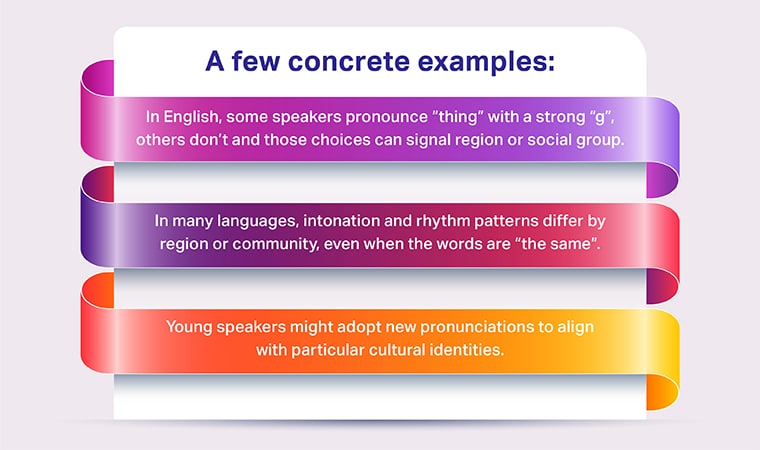
- In English, some speakers pronounce “thing” with a strong “g”, others don’t — and those choices can signal region or social group.
- In many languages, intonation and rhythm patterns differ by region or community, even when the words are “the same”.
- Young speakers might adopt new pronunciations to align with particular cultural identities.
Sociophonetics studies these patterns in detail — often with acoustic measurements, perception tests, and large corpora — to understand how social meaning is encoded in sound.
For an accessible introduction, see the explanation at sociophonetics.com.
3. How Sociophonetics Studies Speech Variation
Sociophonetic research typically looks at two broad areas:
- Production – how people actually produce sounds.
- Perception – how listeners interpret those sounds and the social cues they carry.
Some of the key ingredients:
- Segmental features: vowels and consonants (for example, how /r/ or certain vowels differ by region).
- Suprasegmentals (prosody): rhythm, stress, and intonation patterns.
- Voice quality: breathiness, creakiness, and other qualities that can carry social meaning.
Methodologically, sociophonetic work uses:
- Acoustic analysis (measuring formants, pitch, timing).
- Perception experiments (how listeners categorise or judge speech samples).
- Sociolinguistic interviews and corpora (large datasets of real conversations, annotated for social factors).
The big takeaway is that variation isn’t “noise” — it’s structured, meaningful, and socially patterned.
Which is exactly why AI can’t ignore it.
4. Where Sociophonetics Meets AI and Speech Technology
Speech technologies — ASR, TTS, voice bots — are built on top of speech data. If that data doesn’t capture sociophonetic variation, models will inevitably fail more often for certain groups.
Research on accented ASR shows that:
- Word error rates can be dramatically higher for some accents and dialects.
- Accented speech with limited training data is especially challenging.
- Generalising across dialects requires rich, diverse datasets and careful evaluation.
From a sociophonetic lens, common failure modes include:
- Accent bias: the system works best for “standard” or well-represented accents.
- Under-recognition of local forms: regional pronunciations, vowel shifts, and prosody patterns get misrecognised.
- Unequal UX: some users feel the system “wasn’t built for people like me.”
Sociophonetics helps you name and measure these issues. It gives AI teams a vocabulary for what’s missing in their data and metrics.
5. Designing Speech Data with a Sociophonetic Lens
Most organisations already think about language coverage (“We support English, Spanish, Hindi…”). Sociophonetics pushes you to go deeper:
5.1 Map your sociophonetic “universe”
Start by listing:
- Target markets and regions (for example, US, UK, India, Nigeria).
- Key varieties within each language (regional dialects, ethnolects, sociolects).
- User segments that matter: age ranges, gender diversity, rural/urban, professional domains.
This is your sociophonetic universe — the space of voices you want your system to serve.
5.2 Collect speech that reflects that universe
Once you know your target space, you can design data collection around it:
- Recruit speakers across regions, age groups, genders, and communities.
- Capture multiple channels (mobile, far-field microphones, telephony).
- Include both read speech and natural conversation to surface real-world variation in pace, rhythm, and style.
Shaip’s speech and audio datasets and speech data collection services are built to do exactly this — targeting dialects, tones, and accents across 150+ languages.
5.3 Annotate sociophonetic metadata, not just words
A transcript on its own doesn’t tell you who is speaking or how they sound.
To make your data sociophonetics-aware, you can add:
- Speaker-level metadata: region, self-described accent, dominant language, age bracket.
- Utterance-level labels: speech style (casual vs formal), channel, background noise.
- For specialised tasks, narrow phonetic labels or prosodic annotations.
This metadata lets you later analyse performance by social and phonetic slices, not just in aggregate.
6. Sociophonetics and Model Evaluation: Beyond a Single WER
Most teams report a single WER (word error rate) or MOS (mean opinion score) per language. Sociophonetics tells you that’s not enough.
You need to ask:
- How does WER vary by accent?
- Are some age groups or regions consistently worse off?
- Does TTS sound “more natural” for some voices than others?
An accented ASR survey highlights just how different performance can be across dialects and accents — even within a single language.
A simple but powerful shift is to:
- Build test sets stratified by accent, region, and key demographics.
- Report metrics per accent and per sociophonetic group.
- Treat large disparities as first-class product bugs, not just technical curiosities.
Suddenly, sociophonetics isn’t just theory — it’s in your dashboards.
For a deeper dive into planning and evaluating speech recognition data, Shaip’s guide on training data for speech recognition walks through how to design datasets and evaluation splits that reflect real users.
7. Case Study: Fixing Accent Bias with Better Data
A fintech company launches an English-language voice assistant. In user tests, everything looks fine. After launch, support tickets spike in one region. When the team digs in, they find:
- Users with a particular regional accent are seeing much higher error rates.
- The ASR struggles with their vowel system and rhythm, leading to misrecognised account numbers and commands.
- The training set includes very few speakers from that region.
From a sociophonetic perspective, this isn’t surprising at all: the model was never really asked to learn that accent.
Here’s how the team fixes it:

