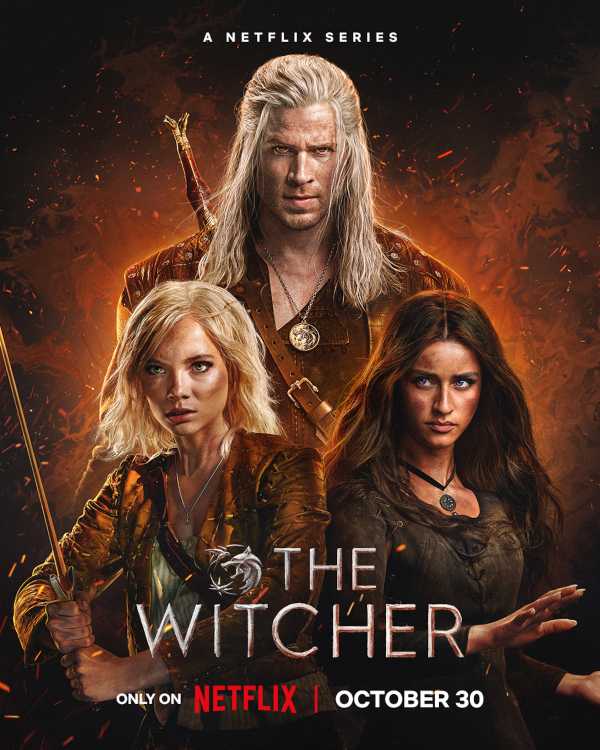
Netflix’s The Witcher has managed to stretch across four seasons, multiple spinoffs, and two actors portraying Geralt of Rivia (Henry Cavill, later Liam Hemsworth). Once touted as the next Game of Thrones, the series never reached the heights it was positioned to rival. Instead, it slowly drifted from its early promise and lost the momentum that once made it a fantasy frontrunner.
Despite launching with an incredibly strong first season that brought Geralt, Yennefer of Vengerberg (Anya Chalotra), and Ciri (Freya Allan) to life with confidence, The Witcher quickly went downhill. Its narrative detours, structural missteps, and tonal inconsistency let down fans of Andrzej Sapkowski’s novels, CD Projekt Red’s games, and the broader audience it earned during its earliest chapters.
Now, it’s becoming increasingly clear that there’s only one path forward. The source material holds massive untapped potential, but the Netflix show has drifted too far from what makes The Witcher special. To harness that potential, Netflix may need to cut its losses entirely and start again from scratch.
It’s Too Late To Save Netflix’s The Witcher
The Netflix Series Has Drifted Too Far From Its Original Strengths

The state of The Witcher as a franchise for Netflix is, to put it mildly, rather dire. It wasn’t always this way though. Season 1 of The Witcher worked because it embraced grounded monster-hunting stories rooted in character. Its nonlinear structure gave the world texture while keeping Henry Cavill’s Geralt of Rivia at the center.
However, after a stellar debut, The Witcher began to drift almost immediately, pushing away from the intimate tone that initially set it apart in the crowded fantasy landscape. Season 2 marked the moment the series lost its identity. Major deviations from Sapkowski’s plots, particularly the treatment of Vesemir (Kim Bodnia) and the events at Kaer Morhen, pulled the story away from its established lore.
While the cast remained strong, the writing no longer matched their performances, creating a widening gap between intention and execution. By Season 3, The Witcher leaned into spectacle without narrative clarity. Geralt’s arc stalled, Yennefer felt sidelined, and Ciri’s development lost cohesion. The growing disconnect between the show and its source material became impossible to ignore, frustrating longtime fans who once championed its potential.
The Witcher season 4’s recast with Liam Hemsworth added another complication. Though not his fault, the shift underscored how unstable the series’ foundation had become. When a show’s storytelling is already faltering, swapping out its lead amplifies every flaw. The resulting season felt like a different series entirely.
At this point, The Witcher resembles a ship patched too many times to keep afloat. With its tone inconsistent, its pacing erratic, and its characterization strained, the Netflix version appears beyond repair. A creative course correction isn’t enough. The problems run too deep. Netflix may be charging ahead with The Witcher season 5. Even if it performs well, however, for many viewers and former fans it will simply be too little, too late.
The Witcher Deserves A New Adaptation
The Source Material Is Still Rich Enough To Support A Better Version

The failure of Netflix’s The Witcher is not a reflection of the source material. Andrzej Sapkowski’s novels remain some of the most layered fantasy works of the modern era, blending political intrigue, moral ambiguity, and deeply flawed characters. The world is rich, strange, and filled with stories that practically beg for a faithful, cinematic adaptation.
Geralt of Rivia was initially handled well, but later seasons struggled to translate Sapkowski’s grounded tone. The books thrive on smaller-scale tales – contracts, consequences, and quiet character work. When the Netflix series drifted into spectacle-driven plotting, it left behind the nuanced storytelling that made The Witcher so compelling in the first place.
Characters like Yennefer, Ciri, and Jaskier (Joey Batey) shine in the novels because their arcs unfold with deliberate pacing. Their motivations build over years, not episodes. The Netflix show compressed, restructured, and altered these arcs so drastically that emotional beats landed less effectively.
A reboot of The Witcher would allow Netflix’s TV show to refocus on what works. The world-building, political factions, and monster-centric narratives all translate well to television when handled with care. There is no shortage of material; only a shortage of the narrative discipline needed to use it well.
The Witcher’s lore, characters, and moral complexity deserve a series confident enough to embrace them fully. The current Netflix show proved unable to do that. A fresh adaptation offers the chance to finally give this universe the treatment it warrants.
The Next Witcher Adaptation Should Be Based On The Games
A Game-Inspired Reboot Would Let The Franchise Start Stronger

If Netflix chooses to reboot The Witcher, the games may offer a more effective starting point than the novels. CD Projekt Red’s trilogy begins with an older Geralt of Rivia, fully established within the Continent’s political and personal landscape. This approach provides immediate narrative clarity and stronger foundations for long-term storytelling.
An older Geralt already has relationships with Yennefer, Ciri, and Triss (Anna Shaffer) giving the adaptation built-in emotional anchors. Instead of spending multiple seasons setting up dynamics audiences already understand, a reboot could begin at a point where the character bonds are already central and compelling.
Structurally, the games offer clearer seasonal arcs. The Witcher 2 and The Witcher 3 break naturally into multi-episode chunks, each with strong antagonists, political threads, and monster-of-the-week storytelling opportunities. This balances episodic and serialized storytelling in a way television thrives on.
The biggest hurdle would be rights. The adaptation rights for the books and games differ, meaning Netflix would likely need new agreements to pursue a game-based reboot. However, if the studio truly wants to revitalize the franchise, investing in those rights could pay off enormously.
A Witcher reboot inspired by the games would also let Netflix lean into the tone fans already love – gritty, mature fantasy that blends personal stakes with sweeping world-building. It would embrace the version of the franchise that reached the widest audience and has the most cohesive narrative. For The Witcher to reclaim its place as a major fantasy property, the games may be the smartest, strongest path forward.
- Release Date
-
December 20, 2019
- Network
-
Netflix
- Showrunner
-
Lauren Schmidt Hissrich
-

-

Anya Chalotra
Yennefer of Vengerberg