


by Susan Flantzer
© Unofficial Royalty 2025
Haakon Sigurdsson was the Earl of Norway and served as the de facto King of Norway from circa 970 until he was killed in 995. Born circa 937, Haakon Sigurdsson was the son of Sigurd Haakonsson, Earl of Lade, and Bergljot Toresdatter, daughter of Tore Ragnvaldsson, Earl of Møre.
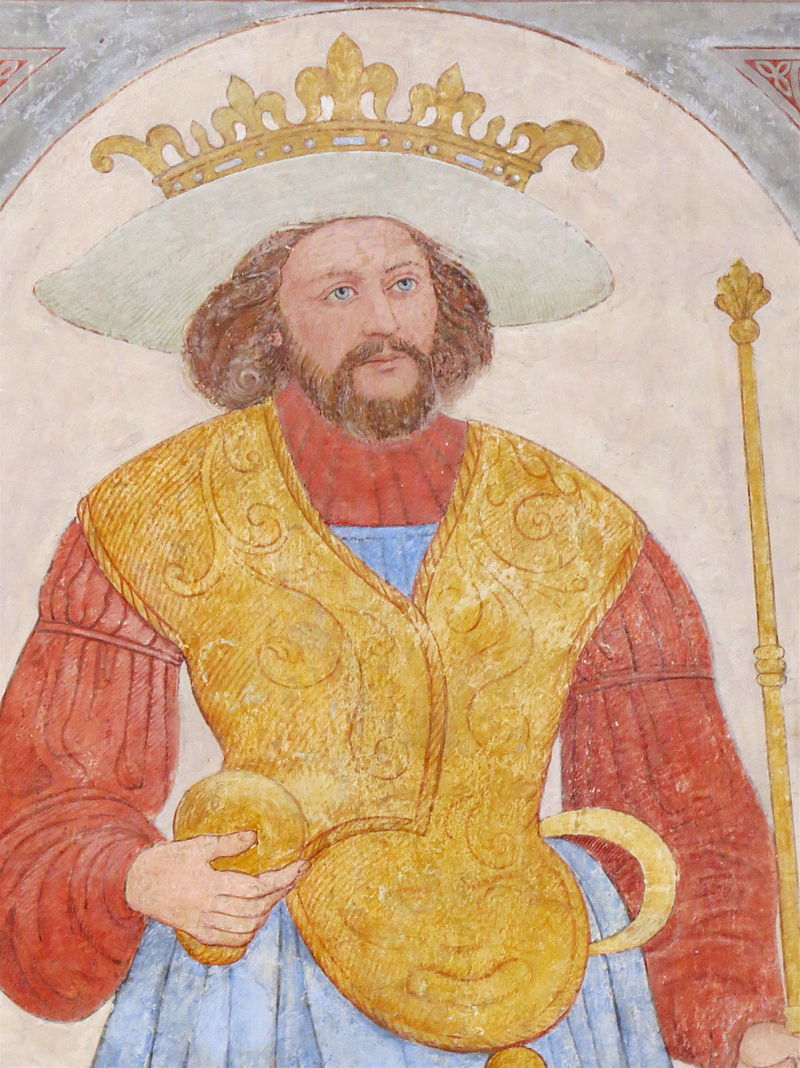
Harald Bluetooth – 16th-century fresco at Roskilde Cathedral, Harald’s burial place; Credit – Wikipedia
In 961, when King Haakon I of Norway was defeated and killed in battle, Harald I Bluetooth, King of Denmark, went to Norway, where he proclaimed himself King of Norway and appointed the Norwegian regional kings as his vassals. Harald II Greycloak of Norway, the leader of the Norwegian vassal kings and also Harald Bluetooth’s nephew (the son of his sister Gunnhild), killed his most important opponents and became increasingly independent of his uncle Harald Bluetooth. In 970, Harald Greycloak was tricked into visiting Denmark and was killed by Haakon Sigurdsson, an ally of his uncle, Harald Bluetooth. Harald Bluetooth regained a strong position as King of Norway and created Haakon Sigurdsson, the Jarl (Earl) of Norway, and made him his vassal king in Norway.
Haakon Sigurdsson had children with several women. He married Tora Skagesdatter (circa 940 – 992) (link in Norwegian), and they had at least four children:
Haakon Sigurdsson had a number of Illegitimate children with various partners. One of his relationships was with Friller, who is mentioned as his wife and his concubine. Some of the children below were probably her children, and some may have been legitimate children. This is probably not a complete list of Haakon Sigurdsson’s illegitimate children.
- Eirik Haakonsson, Earl of Lade, Governor of Norway and Earl of Northumbria (960s – 1020s), co-ruled Norway with his half-brother Sweyn
- Sigurd Haakonsson, a son mentioned by some sources
- Erland Haakonsson (circa 964 – 995), killed fighting Olav Tryggvason
- Erling Haakonsson, sacrificed as a child by his father to the Norse god Torgerd Holgebrud during the Battle of Hjørungavåg
- Ragnhild Haakonsdatter, married Skopte Skagason
- Aud Haakonsdatter (circa 955 – ?)
- Svend Grant (birth circa 966 – 984), married Imgcharge, Princess of Sweden,
- Hackon Håkonsen (birth circa 966 – 984), Helena, daughter of the Earl of Daly
- Peter Grant (birth circa 966 – 984)
Haakon Sigurdsson was a strong believer in the old Norse gods. When Harald Bluetooth attempted to force Christianity upon Norway around 975, Haakon Sigurdsson broke his allegiance with Denmark. In 986, a Danish invasion fleet led by the Jomsvikings, Viking mercenaries of the 10th and 11th centuries, was defeated by Haakon Sigurdsson at the Battle of Hjörungavágr, an important turning point in Haakon Sigurdsson’s efforts to solidify his rule in Norway.
In 995, a quarrel broke out between Haakon Sigurdsson and the Trønders, the people of Trondheim and the surrounding area. Haakon Sigurdsson had become unpopular with the Norwegian people because he often took daughters of the nobility as concubines, which was his right as ruler. However, he quickly grew tired of the women and sent them home after a week or two. Haakon Sigurdsson’s rejection of the Christian faith caused fighting, which further weakened his position.
Olaf Tryggvason, a Viking chieftain who participated in attacks against England, was the great-grandson of Harald Fairhair, the first King of Norway. He lived for a while in Kievan Rus‘, at the court of Vladimir the Great, Grand Prince of Kiev, and was in battles in the Baltic Sea, Friesland, and the Irish Sea. Sometime between 994 and 996, Olaf Tryggvason went to Norway.
By the time Olaf Tryggvason arrived in Norway, many Norwegians were already in revolt against Haakon Sigurdsson, who was forced to hide with his slave Tormod Kark in a hole dug in a pigsty on a farm called Rimul in Melhus, Norway. When Olaf Tryggvason met the rebels, he was accepted as their king, and together they searched for Haakon Sigurdsson. When they came to the farm where Haakon Sigurdsson and Tormod Kark were hiding, their search was initially unsuccessful.
Olaf Tryggvason gathered all the men together, close to the pig sty, unaware that Haakon Sigurdsson was hiding there, and promised a great reward for the man who killed him. Both Haakon Sigurdsson and Tormod Kark heard what Olaf Tryggvason had said. Haakon Sigurdsson feared that Tormod Kark would kill him for the reward. When Haakon Sigurdsson fell asleep, Tormod Kark decapitated him with a knife. Haakon Sigurdsson was buried with high honors, likely in a great burial mound at Lade, the seat of the Earls of Lade, now in Trondheim, Norway.
The day after he killed Haakon Sigurdsson, Tormod Kark went to Olaf Tryggvason and presented him with Haakon Sigurdsson’s head. However, instead of a reward, Olaf Tryggvason had Tormod Kark decapitated. The heads of Haakon Sigurdsson and Tormod Kark were set on stakes for people to spit at. Olaf Tryggvason was ruler of Norway until he died on September 9, 1000, at the Battle of Svolder in Svolder, Norway.
This article is the intellectual property of Unofficial Royalty and is NOT TO BE COPIED, EDITED, OR POSTED IN ANY FORM ON ANOTHER WEBSITE under any circumstances. It is permissible to use a link that directs to Unofficial Royalty.
Works Cited
- Bidragsytere til Wikimedia-prosjektene. (2004). Jarl i Trøndelag. Wikipedia.org; Wikimedia Foundation, Inc. https://no.wikipedia.org/wiki/H%C3%A5kon_Sigurdsson
- Haakon Sigurdsson. (2025). Geni.com. https://www.geni.com/people/Haakon-II/6000000001200100841
- Haakon Sigurdsson. (2024). Wikipedia. https://en.wikipedia.org/wiki/Haakon_Sigurdsson
- KaerHrafnr. (2011). Saturday, April 9, 2011 – Day of Remembrance for Jarl Haakon Sigurdsson of Norway. Kaerhrafnr. https://kaerhrafnr.wordpress.com/2011/04/01/saturday-april-9-2011-day-of-remembrance-for-jarl-haakon-sigurdsson-of-norway/
- Viking sword found in Norway during construction – The History Blog. (2012). Thehistoryblog.com. https://www.thehistoryblog.com/archives/15197

