


by Susan Flantzer
© Unofficial Royalty 2025

The Palace of Whitehall in London, where the wedding took place; Credit – Wikipedia
On February 14, 1613, Elizabeth Stuart, Princess of England and Scotland, daughter of James I, King of England, who was also James VI, King of Scots, and Anne of Denmark, married Friedrich V, Elector Palatine, in the Chapel Royal at the Palace of Whitehall in London, England, which was destroyed in a fire in 1698. Celebrations included fireworks, masques – small, choreography-based plays – tournaments, and a mock sea battle. The events associated with the wedding were described in contemporary pamphlets and letters.
It was through this marriage that the House of Hanover inherited the British throne after the British House of Stuart failed to produce a Protestant heir to the throne. The first Hanover monarch, King George I of Great Britain, was the grandson of Elizabeth and Friedrich. King George I was born Georg Ludwig of Brunswick-Luneburg, the eldest child of Ernst August, Elector of Hanover, Duke of Brunswick-Lüneburg, and Friedrich and Elizabeth’s daughter, Sophia of the Palatinate, commonly referred to as Electress Sophia of Hanover. Through their daughter Sophia, Friedrich and Elizabeth are the ancestors of the British royal family and most other European royal families, including those of Belgium, Denmark, Luxembourg, the Netherlands, Norway, Spain, and Sweden, as well as the former royal families of Greece, Romania, Prussia, and Russia.
Early Life of Elizabeth Stuart, Princess of England and Scotland

Elizabeth Stuart, Electress Palatine; Credit – Wikipedia
Elizabeth Stuart, the eldest daughter and second child of James VI, King of Scots, later also King James I of England, and Anne of Denmark, was born on August 19, 1596. Sources differ on her birthplace, either Dunfermline Palace or Falkland Palace, both in Scotland. At the time of her birth, Elizabeth’s father, the son of Mary, Queen of Scots, was James VI, King of Scots. As was customary for princesses, Elizabeth was not raised by her parents, but by noble families loyal to the Scottish royal family. In 1603, Elizabeth’s father, James, succeeded to the English throne as King James I of England upon the death of Queen Elizabeth I of England, Elizabeth’s namesake. Elizabeth accompanied her mother and her brother, Henry Frederick, Prince of Wales, to England at the time of her father’s accession to the English throne.
Early Life of Friedrich V, Elector Palatine

Friedrich V, Elector Palatine; Credit – Wikipedia
Friedrich V, Elector Palatine, was born on August 26, 1596, at the hunting lodge in Deinschwang, Palatinate, now Lauterhofen in the German state of Bavaria. He was the eldest of the four sons and the third of the eight children of Friedrich IV, Elector Palatine, and Louise Juliana of Nassau. On September 19, 1610, Friedrich’s father, Friedrich IV, died, aged thirty-six, and fourteen-year-old Friedrich V became the Elector Palatine. The Electorate of Palatinate was a constituent state of the Holy Roman Empire until it was annexed by the Electorate of Baden in 1803. From the end of the 13th century, its ruler was one of the Prince-Electors who elected the Holy Roman Emperor. The territories of the Palatinate were spread out, ranging from the west bank of the Rhine River in the current German state of Rhineland-Palatinate, adjacent parts of the French regions of Alsace and Lorraine, and on the east bank of the Rhine River in the present-day German states of Hesse and Baden-Württemberg.
Reasons for the Marriage
The marriage policy of Friedrich V’s father, Friedrich IV, Elector Palatine, was designed to solidify the Electorate of Palatinate’s position within the Protestant reigning families in Europe. Friedrich V’s sisters were married to leading Protestant princes. In keeping with his father’s policy, Friedrich V sought a marriage to Elizabeth Stuart.
As the daughter of a reigning king, a marriage with Elizabeth was sought after by several suitors besides Friedrich V, including Gustavus Adolphus of Sweden (later King Gustavus II Adolphus of Sweden); Friedrich Ulric, Duke of Brunswick-Wolfenbuttel; Maurits, Prince of Orange; Henry Howard, 1st Earl of Northampton; Theophilus Howard, 2nd Earl of Suffolk; Otto, Hereditary Prince of Hesse-Kassel; and Victor Amadeus, Prince of Piedmont (later Victor Amadeus I, Duke of Savoy). After careful consideration, Friedrich V, Elector Palatine of the Rhine, was chosen. Friedrich and Elizabeth were the same age. Friedrich was a descendant of the Kings of Aragon, the Kings of Sicily, the Landgraves of Hesse, the Dukes of Brabant and Saxony, and the Counts of Nassau and Leuven. He was a senior prince of the Holy Roman Empire and a staunch defender of the Protestant faith.
Pre-Wedding
Friedrich V, Elector Palatine, arrived at the port of Gravesend, England, on the River Thames, 21 miles downriver from London, on October 16, 1612, four months before the wedding. Ludovic Stewart, 2nd Duke of Lennox and 1st Duke of Richmond, a Scottish nobleman and a second cousin of King James I, sailed with Friedrich to the water gate of the Palace of Whitehall, where he met Elizabeth’s brother, Prince Charles, Duke of York, the future King Charles I of England. At Whitehall Palace, Friedrich met with King James I, Queen Anne, and his bride-to-be, Elizabeth. They spoke in French as Friedrich did speak much English, and King James and Elizabeth did not speak much German. Queen Anne had believed that her daughter Elizabeth was marrying below her station, but after meeting Friedrich, she “was much pleased with him.”
Less than a month after Elizabeth’s future husband arrived in England, on November 6, 1612, Elizabeth’s brother, 18-year-old Henry Frederick, Prince of Wales, the heir to the throne, died, probably from typhoid fever. King James I and Queen Anne had seven children. Four died in infancy, and now, with the death of Henry Frederick, only 12-year-old Charles and 16-year-old Elizabeth survived. Charles was a sickly child. At the age of two, he still could not walk or talk. He was very small – his adult height was only 1.5meters/5 feet.
Some courtiers thought Elizabeth should not marry a foreign royal. If her brother Charles died without having children, Elizabeth would be the heir to the throne, and her successor, her child, could be a foreign royal. A Scottish faction at court suggested that Elizabeth marry James Hamilton, 3rd Marquess of Hamilton, later the 1st Duke of Hamilton. After the death of Henry Frederick, Prince of Wales, the Marquess of Hamilton became third in line to the throne of Scotland, after Elizabeth’s brother Charles and Elizabeth. This suggestion came to naught, however, in 1714, when the British House of Stuart failed to produce a Protestant heir to the throne, a foreign royal, born Georg Ludwig of Brunswick-Lüneburg, the grandson of Elizabeth Stuart and Friedrich V, Elector Palatine, became the first monarch of the British House of Hanover, as King George I.
The original wedding date was moved to accommodate a period of mourning after the death of Henry Frederick, Prince of Wales. King James I and the Privy Council decided that the betrothal ceremony would be held on January 6, 1613, and the wedding would be held on February 14, 1613.
After the marriage contract was finalized, a betrothal ceremony was held at the Palace of Whitehall on January 6, 1613. Friedrich, dressed in purple velvet trimmed with gold, and Elizabeth, wearing mourning black satin with silver lace, a cloak of black velvet sprinkled with silver flowers or crosslets trimmed with gold lace, and a plume of white feathers, met in Elizabeth’s bedchamber. Friedrich led her to King James I in the Banqueting Hall, where they knelt and received blessings from King James I and George Abbot, Archbishop of Canterbury. The contracts were read aloud by Thomas Lake, Secretary of State to King James I, but the poor quality of the translations made the guests laugh out loud.
The Wedding

Marriage procession for the wedding of Elizabeth Stuart and Friedrich V, Elector Palatine. At the center, Princess Elizabeth walks with her brother, the future Charles I, King of England; Credit – The Metropolitan Museum of Art, Public Domain
The wedding ceremony took place on Sunday, February 14, 1613, in the Chapel Royal at the Palace of Whitehall. The wedding was a grand occasion that saw more royalty than ever visit the English court. A processional route, a scaffold with a raised walkway, was built around Whitehall Palace, enabling more people to see the wedding procession. After the procession, the wedding party and the guests proceeded to the Chapel Royal.

One of the Raphael Cartoons on display at the wedding – Christ’s Charge to Peter (Matthew 16: 18 – 19 & John 21: 15 – 17); Credit – Victoria and Albert Museum – Raphael Cartoons
The chapel was decorated with a set of seven tapestries, purchased by King Henry VIII in 1542, that represent scenes from the lives of Saint Peter and Saint Paul, called the Raphael Cartoons, as they were designed by Italian Renaissance painter and architect Raphael from 1515 to 1516. They are now on display at the Victoria and Albert Museum in London. See Victoria and Albert Museum: The Raphael Cartoons. Elizabeth wore a crown set with diamonds and pearls. Her white gown was richly embroidered. Sixteen daughters of Earls, eight on each side, carried her train. George Abbot, Archbishop of Canterbury, officiated. Elizabeth was nervous during the ceremony and could not help laughing.
Children
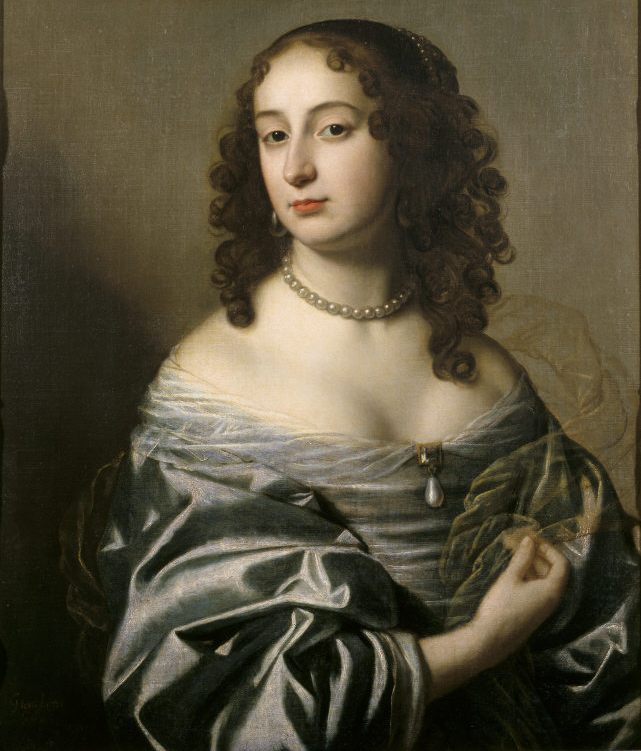
Elizabeth and Friedrich’s daughter, Sophia of the Palatinate, Electress of Hanover in 1650; Credit – Wikipedia
Elizabeth and Friedrich had thirteen children. Through their daughter, Sophia of the Palatinate, Electress of Hanover, whose son succeeded to the British throne as King George I after the Stuarts failed to provide a Protestant heir to the British throne, Elizabeth and Friedrich are the ancestors of the British royal family and most other European royal families, including those of Belgium, Denmark, Luxembourg, the Netherlands, Norway, Spain, and Sweden, as well as the former royal families of Greece, Romania, Prussia, and Russia.
- Heinrich Friedrich, Hereditary Prince of the Palatinate (1614 – 1629), unmarried, drowned
- Karl I Ludwig, Elector Palatine (1617 – 1680), married (1) Charlotte of Hesse-Kassel, had issue including Elizabeth Charlotte, second wife of Philippe, Duke of Orléans, younger brother of King Louis XIV of France; (2) morganatically, Marie Luise von Degenfeld, had issue; (3) morganatically, Elisabeth Hollander von Bernau, had issue
- Elisabeth of the Palatinate (1618 – 1680), unmarried, Princess-Abbess of Herford Abbey
- Rupert, Count Palatine of the Rhine (1619 – 1682), unmarried, had two illegitimate children
- Maurice of the Palatinate (1620 – 1652), unmarried, drowned
- Louise Hollandine of the Palatinate (1622 – 1709), unmarried, converted to Roman Catholicism, nun and then abbess at the Cistercian Maubuisson Abbey
- Ludwig (born and died 1624)
- Edward, Count Palatine of Simmern (1625 – 1663), converted to Roman Catholicism, married Anna Gonzaga, had issue
- Henriette Marie of the Palatinate (1626 – 1651), married Sigismund Rákóczi, no issue
- Johann Philip Friedrich of the Palatinate (1627 – 1650), unmarried, killed in battle
- Charlotte of the Palatinate (1628 – 1631), died in childhood
- Sophia of the Palatinate, Electress of Hanover (1630 – 1714); married Ernst August, Elector of Hanover, had issue, including King George I of Great Britain; the British Act of Settlement 1701 gave the British succession to Sophia and her Protestant heirs
- Gustavus Adolphus of the Palatinate (1632 – 1641), died in childhood
Afterward
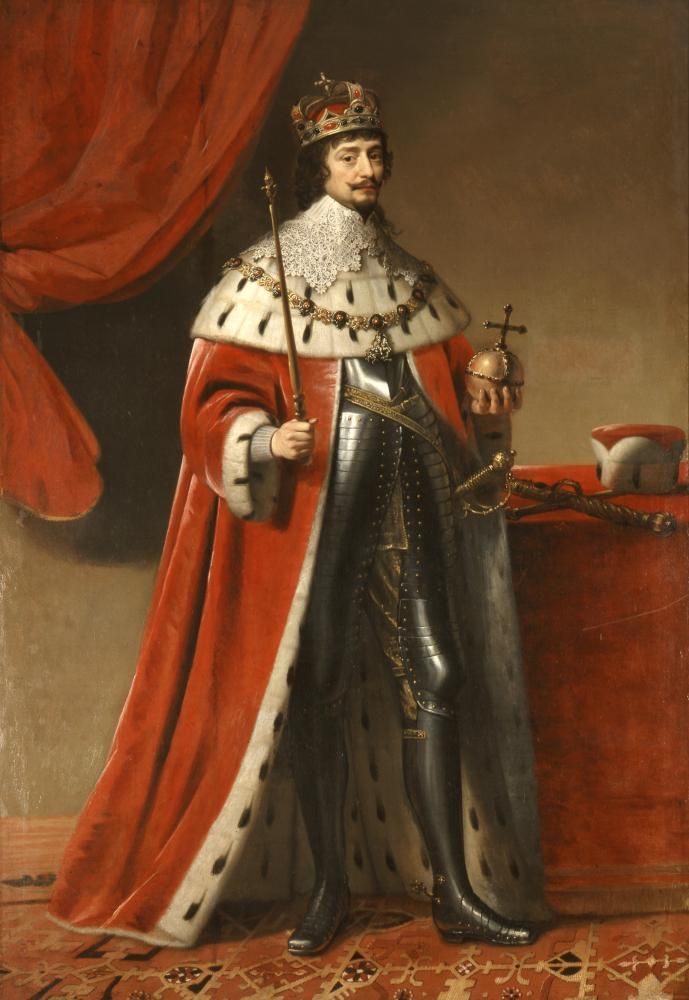
Friedrich as King of Bohemia; Credit – Wikipedia
In August 1619, Friedrich was elected King of Bohemia and was crowned in Prague on November 4, 1619. Elizabeth, who was in late pregnancy with her son Rupert, was crowned at a later date. The crown of Bohemia had been in Habsburg hands for a long time, and the Habsburg heir, Ferdinand II, Holy Roman Emperor, refused to accept Friedrich as King of Bohemia. Friedrich’s reign ended with his defeat by Ferdinand at the Battle of White Mountain, one of the early battles of the Thirty Years’ War, on November 8, 1620. Friedrich and Elizabeth are called the Winter King and the Winter Queen, referring to their short reign as King and Queen of Bohemia.
Elizabeth and Friedrich sought refuge in Berlin but had to leave in January 1621 when Friedrich was forced to give up the Palatinate and was banished from the Holy Roman Empire. Elizabeth, Friedrich, and their family were given refuge in The Hague, now in the Netherlands, by Maurits, Prince of Orange, Stadtholder of all the provinces of the Dutch Republic except for Friesland.

Elizabeth as a widow by Gerard van Honthorst, 1642; Credit – Wikipedia
In January 1632, Friedrich left The Hague to fight alongside King Gustavus Adolphus II of Sweden in the Thirty Years’ War. Elizabeth never saw him again. Beginning in October 1632, Friedrich suffered from an infection that continually worsened. Doctors determined nothing could be done, and Friedrich died in Mainz, then in the Electorate of Mainz, now in the German state of Rhineland-Palatinate, on November 29, 1632, at the age of 36. Friedrich’s internal organs were interred at St. Catherine’s Church in Oppenheim, and his embalmed body was taken to Frankenthal, both towns then in the Electorate of Palatinate. However, the burial site of his body is unknown.
Elizabeth was devastated by Friedrich’s death. Her brother, King Charles I of England, invited her to return to England, but she refused as she felt she had to fight for the rights of her eldest son, Karl Ludwig. She raised a small army on his behalf, and finally, in 1648, the Palatinate was restored to him. Between her husband’s death in 1632 and her death in 1662, Elizabeth suffered the deaths of four of her children and the execution of her brother, King Charles I of England, in 1649. In 1660, the monarchy was restored in England, and Elizabeth’s nephew became King Charles II of England. Elizabeth decided to visit England. She arrived in England on May 26, 1661, and by July, she was determined to remain there. She first lived in Drury House on Wych Street in London. In January 1662, she moved to Leicester House on the north side of present-day Leicester Square. On February 13, 1662, Elizabeth died of bronchitis at the age of 65 and was buried in the Henry VII Chapel at Westminster Abbey near her brother Henry, Prince of Wales.
This article is the intellectual property of Unofficial Royalty and is NOT TO BE COPIED, EDITED, OR POSTED IN ANY FORM ON ANOTHER WEBSITE under any circumstances. It is permissible to use a link that directs to Unofficial Royalty.
Works Cited
- Autoren der Wikimedia-Projekte. (2003). Kurfürst der Pfalz, König von Böhmen (1619–1620). Wikipedia.org; Wikimedia Foundation, Inc. https://de.wikipedia.org/wiki/Friedrich_V._(Pfalz)
- Flantzer, Susan. (2016). Elizabeth Stuart, Electress Palatine of the Rhine. Unofficial Royalty.https://www.unofficialroyalty.com/elizabeth-stuart-electress-palatine/
- Flantzer, Susan. (2025). Friedrich V, Elector Palatine | Unofficial Royalty. Unofficialroyalty.com. https://www.unofficialroyalty.com/friedrich-v-elector-palatine/
- Holmes, Frederick. (2003). The Sickly Stuarts: The Medical Downfall of a Dynasty. Sutton Publishing
- Wikipedia Contributors. (2018). Elizabeth Stuart. Wikipedia; Wikimedia Foundation. https://en.wikipedia.org/wiki/Elizabeth_Stuart
- Frederick V of the Palatinate. (2022). Wikipedia. https://en.wikipedia.org/wiki/Frederick_V_of_the_Palatinate
- Wikipedia Contributors. (2025). Wedding of Frederick V of the Palatinate and Princess Elizabeth. Wikipedia; Wikimedia Foundation. https://en.wikipedia.org/wiki/Wedding_of_Frederick_V_of_the_Palatinate_and_Princess_Elizabeth

