


by Susan Flantzer
© Unofficial Royalty 2025 10/10

Æthelflæd, Lady of the Mercians; Credit – Wikipedia
Born circa 870, Æthelflæd, Lady of the Mercians, the eldest child of Alfred the Great, King of Wessex, King of the Anglo-Saxons, and his wife Ealhswith of Mercia, ruled Mercia, an Anglo-Saxon kingdom, from 911 to 918.
Æthelflæd had five known younger siblings:
- Edward the Elder, King of the Anglo-Saxons (circa 874 – 924), married (1) Ecgwynn, had two children, including Æthelstan, King of the English (2) Ælfflæd, had eight children (3) Eadgifu, had four children, including Edmund I, King of the English and Eadred, King of the English
- Æthelgifu, Abbess of Shaftesbury
- Æthelweard (died circa 922), married and had two children
- Ælfthryth, Countess of Flanders (died 929), married Baldwin II, Count of Flanders, had four children
Æthelflæd married Æthelred, Lord of the Mercians. She is first recorded as Æthelred’s wife in a charter of 887, but the marriage probably took place somewhat earlier. They had one child, a daughter, Ælfwynn, born circa 888. According to William of Malmesbury, the 12th-century English historian, Ælfwynn’s birth was a difficult one, and this led her mother to abstain from further sexual relations.
Some historians believe that during the decade 899 to 909, Æthelred, Lord of Mercia, became ill and his wife Æthelflæd became the de facto ruler of Mercia. Æthelred died in 911 and was buried at Saint Oswald’s Priory in Gloucester, founded by Æthelred and Æthelflæd. After her husband died, Æthelflæd became Lady of the Mercians, the only case of a female ruler of a kingdom in Anglo-Saxon history.
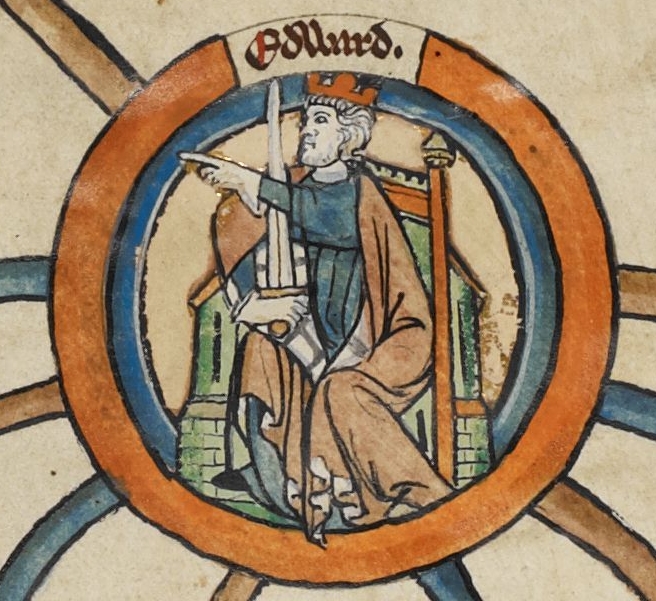
Æthelflæd’s brother, Edward the Elder, King of the Anglo-Saxons; Credit – Wikipedia
When Æthelred died, Æthelflæd’s brother Edward the Elder, King of the Anglo-Saxons, took control of the Mercian towns of London and Oxford and the surrounding areas, which Alfred the Great had put under Mercian control. Æthelflæd probably accepted this loss of territory in return for recognition by her brother of her position in Mercia.
Alfred the Great built a system of fortified towns or forts, known as burhs or burgs, in response to the continued Viking threat. These burhs included former Roman towns where stone walls were repaired and perimeter ditches were added, along with temporary forts and new towns. Edward and Æthelflæd embarked on a program of extending the fortified towns their father had built, consolidating their defenses, and providing bases for attacks on the Vikings.

Ruins of St Oswald’s Priory in Gloucester, where Æthelflæd and her husband Æthelred were buried; Credit – Wikipedia by Philip Halling
On June 12, 918, Æthelflæd, aged about forty-eight, died at Tamworth, the capital of the Kingdom of Mercia. Her body was carried 75 miles (121 km) to Gloucester, where she was buried with her husband at Saint Oswald’s Priory.
After her mother died in 918, Ælfwynn reigned for a few months as Lady of the Mercians until her maternal uncle Edward the Elder, King of the Anglo-Saxons, decided to remove her from power and send her to Wessex in December 918. Ælfwynn never married, and there is no record of her after her removal from power.
This article is the intellectual property of Unofficial Royalty and is NOT TO BE COPIED, EDITED, OR POSTED IN ANY FORM ON ANOTHER WEBSITE under any circumstances. It is permissible to use a link that directs to Unofficial Royalty.
Works Cited
- Flantzer, Susan. (2019). Alfred the Great, King of Wessex, King of the Anglo-Saxons | Unofficial Royalty. Unofficialroyalty.com. https://www.unofficialroyalty.com/alfred-the-great-king-of-wessex-king-of-the-anglo-saxons/
- Venning, Timothy. (2013). The Kings & Queens of Anglo-Saxon England. Amberley Publishing Limited.
- Wikipedia Contributors. (2019). Æthelflæd. Wikipedia; Wikimedia Foundation. https://en.wikipedia.org/wiki/%C3%86thelfl%C3%A6d
- Wikipedia Contributors. (2025). Æthelred. Wikipedia; Wikimedia Foundation.
- Wikipedia Contributors. (2025). Ælfwynn. Wikipedia; Wikimedia Foundation.

