


There are many striking antique Jewels coming up for Auction this month, with Jewels from Emperor Napoleon, the Prussian Royal Family, an Egyptian Princess, the Duchess of Windsor and several Royal and Noble Families are going on Auction in the Sotheby’s ‘Royal & Noble Jewels’ Sale in Geneva tomorrow!
Gold Bracelet | Sapphire and Diamond Demi-Parure | Gold Bracelet | Gold and Diamond Brooch, Bucherer and a Pair of Earclips | Gold and Cultured Pearl Parure | Gübelin Lady’s Gold Wristwatch | Cartier Coral, Emerald and Sapphire Brooch | Gold Longchain | Diamond Ring | Emerald, Enamel and Diamond Pendant | Diamond Brooch | Diamond Earclips/Dress Clips | Emerald and Diamond Ring and a Sapphire and Diamond Ring | Diamond Double-Clip Brooch | Morganite and Diamond Ring | Cultured Pearl and Diamond Earclips | Kutchinsky Diamond Ring | Diamond Necklace | Diamond Ring
Estimate: 5,000 – 7,000 CHF | 3,000 – 5,000 CHF | 3,800 – 4,500 CHF | 1,500 – 2,000 CHF | 3,500 – 4,500 CHF | 800 – 1,200 CHF | 4,000 – 6,000 CHF | 3,000 – 5,000 CHF | 800 – 1,200 CHF | 1,000 – 2,000 CHF | 4,000 – 6,000 CHF | 2,000 – 3,000 CHF | 3,000 – 5,000 CHF | 3,000 – 5,000 CHF | 800 – 1,200 CHF | 2,000 – 3,000 CHF | 3,000 – 5,000 CHF | 6,500 – 10,000 CHF | 11,000 – 14,000 CHF
From a Princess of the Egyptian Royal Family

Pink Diamond Ring
Estimate: 260,000 – 430,000 CHF
Formerly in the collection of Princess Neslişah Sultan, Princess Abdel Moneim of Egypt

A Light Pink Diamond and Diamond Ring, set with an old mine brilliant-cut Light Pink diamond weighing 13.86 carats, the mount embellished with old mine- and rose-cut diamonds, size 541/2; mid-19th century, with the Pink Diamond originating from Empress Catherine I of Russia.

Provenance
Empress Catherine I (1684-1727)
Sultan Ahmed III (1663-1736)
Sultan Abdul Hamid II (1842-1918)
Princess Emina Ilhamy (1858-1931)
Princess Khadija Hanim
Princess Neslişah Sultan (1921-2012)
Thence by descent
Van Cleef & Arpels Sapphire and Diamond Double-Clip Brooch
Estimate: 17,000 – 26,000 CHF
Formerly in the collection of Princess Neslişah Sultan, Princess Abdel Moneim of Egypt

A Van Cleef & Arpels Sapphire and Diamond Double-Clip Brooch of scroll design, set with circular-cut sapphires, accented by circular-cut and baguette diamond.

The stunning Ottoman Princess who married an Egyptian Prince, becoming an accomplished cultural icon as the First Lady of the Court during the short-lived Recency of King Fuad, Princess Neslişah Sultan was a noted Fashion icon, and her illustrious jewels included a spectacular Ottoman Diamond Parure originating from Empress Catherine I of Russia.
This collection of jewels belonged the Ottoman Princess Neslishah Sultan (1921-2012) who was married to Muhammad Abdel Moneim (1899-1979), heir apparent of the Mohammed Ali dynasty whose father Abbas Hilmi II ruled as the last Khedive of Egypt from 1892 to 1914. Neslishah Sultan in many ways embodied the end of an era, both in her native Turkey and in Egypt. Her life was characterised by several periods of exile and many lasts. She faced the difficulties and challenges that life threw at her with unshakable grace and dignity.
When Neslishah was born in Istanbul in 1921, her birth entry was the last made into the palace register of Ottoman dynasty members before the fall of the once-mighty Ottoman Empire in 1922. This also signified that she was the last person to be officially bestowed with the title of ‘Sultan’ or Princess of the Imperial Blood. Her paternal grandfather was the last Ottoman Caliph Abdulmejid II (1868-1944), while her maternal grandfather was the last Ottoman Sultan Mehmed VI Vahideddin (1918-1926). She grew up in exile in France together with her two sisters Hanzade (1923-1998) and Necla (1926-2006). Just before World War II, the family settled in Egypt where their three beautiful young daughters did not fail to make an impression.
In the late 1930s, Egypt was ruled by King Farouk (1920-1965) of the Mohammed Ali dynasty. During the 19th century, the Mohammed Ali dynasty governed Egypt as vassals or Khedive of the Ottoman Empire. The opening of the Suez Canal in 1869 made Egypt a highly strategic economic centre. However, its costly construction was financed by European financial institutions. To save his country from bankruptcy, the Khedive sold Egypt’s controlling shares in the Canal to the British Government. Thus a multi-layered situation occurred where Egypt’s self-governance was hollowed out, nominally by the Ottoman Empire and de facto by the British Empire. In 1914, when Khedive Abbas Hilmi II sided with the Ottomans at the start of World War II, the British immediately established a protectorate, deposed the last Khedive and replaced him with his nephew Hussein Kamel who was given the title of Sultan. Hussein Kamel was in turn succeeded three years later by his brother Fuad who styled himself as King of Egypt in 1922 to underline Egypt’s fragile independence.
In the late 1930s, the Egyptian court was the most dazzling in the world. King Farouk was an avid art collector, while his mother Nazli Sabri (1894-1978) and his four glamorous sisters, the Princesses Fawzia, Faiza, Fathia and Faika, each possessed highly important jewellery collections. In 1939, when Princess Fawzia married the Iranian heir to the throne, Mohammad Reza Pahlavi, her mother placed one of the most illustrious orders in the history of Van Cleef & Arpels: for both the bride and herself she commissioned a sumptuous suite of diamond jewels including a tiara, a bib-style necklace and a pair of pendent earrings. Princess Faiza, moreover, possessed some of the most iconic jewels ever created Van Cleef & Arpels including an emerald drop and diamond necklace and a pair of mystery-set ruby and diamond brooches designed as peonies. During World War II Egypt was a neutral country. Paradoxically, delegates from all over the world congregated in Cairo and Alexandria where they enjoyed many glamorous social functions, while in the desert, only a few kilometres to the West, the armies of Rommel and Montgomery met. Thus in 1940, when Neslishah Sultan married the King’s cousin and heir apparent, Muhammad Abdel Moneim, she found herself in an environment marked both by great luxury as well as great uncertainty.

One week before her wedding, the groom’s aunt, Princess Khadija Hanim, presented the bride with a historical and highly important parure comprising of a necklace, a pair of earrings, a brooch and a ring set with rare and important old mine-cut coloured diamonds which Empress Catherine I, widow of Tsar Peter the Great, had gifted to the Ottoman Sultan Ahmed III during negotiations for the Treaty of the Pruth in 1711. These diamonds remained in the Ottoman treasury for generations until Sultan Abdul Hamid II (1842-1918) gifted them to his cousin Princess Emina Ilhamy (1858-1931), the mother of Khedive Abbas Hilmi II. Neslishah Sultan wore necklace from this suite on her wedding day. During the 1940s and 1950s, she frequently wore the parure at the many glamorous events attended by the Egyptian Royal family. She also wore the necklace as a tiara mounted on a detachable frame. Amongst her wedding gifts featured two brooches, one given by the Queen Mother Nazli Sabri and the other given by King Farouk’s first wife Queen Farida.
King Farouk was overthrown in the Egyptian Revolution of 1952, lead by Gamal Abdel Nasser. As the King went into exile, Neslishah’s husband was appointed as nominal Regent until the official abolition of the monarchy one year later. Thus for a few short months, she served as first lady of Egypt. Sensing the impending danger, Muhammad Abdel Moneim and Neslishah had sent their two children to live with one of her sisters in France. They stayed on in Egypt until 1959, however, under increasingly hostile circumstances. In November 1953, all property of members of the former Egyptian Royal family was confiscated. Neslishah hid her jewellery in her riding clothes and deposited them with a trusted friend under the pretext of going for her habitual morning of horseback riding. Further acquaintances were entrusted with other valuables including jewellery, gold boxes, plate and furs. They all loyally returned them to her in exile a few years later. The couple was eventually allowed to remain in their Cairo residence, but were now charged rent for the rooms they occupied. In 1957, Muhammad Abdel Moneim and Neslishah were placed under house arrest and charged with plotting against the government.
Following two exhausting years of legal proceedings, both were acquitted on all charges and left Egypt for good. At first, they settled in Montreux as Muhammad Abdel Moneim had been educated in Switzerland. Neslishah reluctantly sold the historical coloured diamond parure at Christie’s in London on 22 May 1963. Fortunately, she was able to retain the ring from this suite for her family. In 1964, she and her husband chose to move to Istanbul after the Turkish government had revoked the laws forbidding members of the former Ottoman dynasty to enter the country. In 2012, Neslishah’s funeral became something of national event in Turkey as she had grown into a beloved link to the country’s history, the last Ottoman Princess.
Shell and Turquoise Earclips
Estimate: 4,800 – 8,000 CHF
Formerly in the collection of the Duchess of Windsor

Ruby, Emerald and Diamond Ring
Estimate: 500 – 700 CHF
Formerly in the collection of Albrecht Eugen, Duke Of Württemberg

Gold, Ruby and Diamond Bracelet and an Enamel, Sapphire and Diamond Ring | Cartier Ruby and Diamond Necklace
Estimate: 4,000 – 6,000 CHF | 100,000 – 150,000 CHF
Formerly in the collection of The Princes Thurn Und Taxis


Aquamarine and Diamond Brooch | Koenig Sapphire and Diamond Earclips | Unmounted Emerald |
Estimate: 4,000 – 6,000 CHF | 6,000 – 8,000 CHF | 15,000 – 26,000 CHF
Property of a Lady


Spinel and Diamond Ring | Sapphire and Diamond Ring
Estimate: 25,000 – 45,000 CHF | 15,000 – 26,000 CHF
Property of a Swiss Baroness


JAR Pearl, Sapphire and Diamond Pendent Necklace
Estimate: 30,000 – 50,000 CHF
Property of a distinguished French Aristocratic Family

Gold and Diamond Evening Bag | Sapphire and Emerald Bracelets | Koch Pearl and Diamond Brooch
Estimate: 6,000 – 8,000 CHF | 5,000 – 7,000 CHF | 8,000 – 12,000 CHF
Sold To Benefit Doctors Without Borders


From the Collection of Dr Beatrice Thyssen, Freifrau von Riedel (1920-2025)
Beatrice Freifrau von Riedel was the granddaughter of the Bavarian Minister of Finance Emil Freiherr von Riedel (1832-1906) who served under King Ludwig II and Prince-Regent Luitpold. Her mother’s first husband was Fritz von Bohlen und Halbach whose brother Gustav was married to the steel-heiress Bertha Krupp.
Beatrice was a passionate and well-respected gynaecologist. Her first husband, the neurologist Prof. Dr. Carl Walther Simon, founded the Forschungsinstitut für experimentelle Musikpsychologie in Salzburg which researched the various ways in which music has an impact on the human psyche. Beatrice had a lifelong fondness for classical music and was a frequent guest at the Salzburger Festspiele and Munich concert halls such as the Bavarian State Opera and the Prinzregententheater.
Her second husband Dr. Bodo Thyssen (1918-2004), of the Thyssen industrial family, was likewise a medical doctor who operated a private clinic in Prien near Chiemsee. She divided her time between the Munich Lehel neighbourhood, where she lived on a street near the street named after her grandfather, and her country house on the shores of Lake Chiemsee.
Diamond Bracelet
Estimate: 32,000 – 48,000 CHF
Formerly in the collection of European Noble Family

Pearl and Diamond Tiara
Estimate: 6,000 – 8,000 CHF
From A European Noble Family

Pearl and Diamond Earrings
Estimate: 3,000 – 5,000 CHF
Property Of A European Princely Family

Pearl and Diamond Sautoir | Natural Pearl Sautoir | Pearl and Glass Necklace
Estimate: 32,000 – 48,000 CHF | 28,000 – 35,000 CHF | 24,000 – 40,000 CHF
From The Collection Of A European Ducal House


Pink Sapphire and Diamond Bangle | Ruby and Diamond Ring
Estimate: 12,000 – 20,000 CHF | 10,000 – 30,000 CHF
Formerly in the collection of Duchess Helene in Bavaria, Princess Von Thurn Und Taxis


Cartier Emerald and Diamond Pendent Necklace
Estimate: 300,000 – 500,000 CHF
Formerly in the collection of Albertina Taylor Winthrop

Albertina Taylor Winthrop was a scion of one of New York’s wealthiest and most prominent families of the Gilded Age. Like her contemporaries Consuelo Vanderbilt, Cornelia Martin and Mary Goulet, she was an American ‘Dollar Princess’ who married into the European aristocracy. She spent her happily married life as Dutch Ambassadress in Madrid, Rome and Washington, giving her ample opportunity to represent both her countries of birth and adoption wearing her refined and highly important emerald and diamond necklace by Cartier.
Albertina was the daughter of the American banker Robert Winthrop (1833-1892). In the 1860s, he was one of the founders of the investment firm Drexel, Winthrop & Company, later renamed Robert Winthrop & Company, one of the most important banking enterprises during America’s Gilded Age which remained family owned until the 1970s. It was eventually absorbed into Credit Suisse. Albertina’s mother, Kate Wilson Taylor (1839–1925), was in turn the daughter of Moses Taylor (1806 – 1882), one of America’s wealthiest financiers of the 19th century who built his fortune through the budding railroad business and a controlling interest in the National City Bank, today known as Citibank.
In 1904, Albertina married the Dutch nobleman and diplomat Herman van Roijen (1871-1933) whose family had a longstanding tradition in the diplomatic corps. From 1905 to 1908, van Roijen served as chargé d’affaires at the Dutch Embassy in London. From 1908 to 1913, he was appointed Dutch ambassador to the United States, a mission in which he was greatly aided by his well-connected American wife. He would complete a second term as ambassador in the United States from 1927 to 1933. In between these appointments, he served as Dutch ambassador in Madrid and Rome. Together the couple had two sons: Herman van Roijen (1905-1991), who followed his father in the diplomatic service, and Robert Dudley van Roijen (1907–1981).
The stones in this necklace were most likely given to Albertina Winthrop around the time of her wedding in 1904 and were remounted by Cartier in 1932, in a manner that recalls the softer styles of the Gilded Age, rather than the contemporary art deco style of the 1930s.
Imperial Topaz and Diamond Brooch | Turquoise and Diamond Demi-Parure | Turquoise and Diamond Parure
Estimate: 5,000 – 8,000 CHF | 6,000 – 8,000 CHF | 20,000 – 50,000 CHF
Property Of A Noble Family


Diamond Tiara | Emerald and Diamond Brooch | Van Cleef & Arpels Gold and Diamond Bracelet |
Estimate: 20,000 – 30,000 CHF | 5,000 – 7,000 CHF | 20,000 – 30,000 CHF
Property Of A European Princely Family


Sapphire, Ruby and Diamond Brooch | Diamond Bracelet | Diamond Necklace | Diamond Devant-de-Corsage | Diamond Necklace
Estimate: 5,500 – 8,500 CHF | 7,000 – 15,000 CHF | 15,000 – 20,000 CHF | 14,000 – 26,000 CHF | 22,000 – 35,000 CHF
Jewels from a Royal Family in Asia


Boucheron Diamond Tiara/Bracelet | Sapphire and Diamond Demi-Parure
Estimate: 20,000 – 30,000 CHF | 10,000 – 15,000 CHF
From the estate of the Countess of Faber-Castell


This diamond tiara/bracelet combination, though unsigned, features a laurel wreath motif that is often associated with Boucheron.
The famous Parisian maison created several jewels incorporating this very theme in the late 19th century. The most famous of these was a necklace composed of two laurel wreaths presented to Princess Margaret of Connaught (1882-1920) as a wedding gift when she married the future King Gustaf VI Adolf of Sweden in 1905. The necklace was a gift from the groom’s grandmother Queen Sofia of Sweden (1836-1913) and was inherited by Margaret’s son Prince Bertil of Sweden, Duke of Halland (1912-1997). It was subsequently worn as a tiara by his Welsh-born wife Lillian Davies (1915-2013) for many decades. The latter bequeathed the Boucheron tiara to her great-niece Crown Princess Victoria of Sweden who now frequently wears it at glittering state occasions.

Numerous other jewels of this type were created by Boucheron including versions further enhanced with pearls. The fashionable French lyric soprano Geneviève Vix (1879-1939) was also photographed wearing a bandeau of similar design.
The case accompanying the present lot is stamped with Boucheron’s address at Palais-Royal where the jeweller was located prior to 1893 when its premises were moved to Place Vendôme, becoming the first major jeweller to establish a presence on the famous square.
Chaumet Diamond Brooch/Devant-de-Corsage
Estimate: 60,000 – 110,000 CHF
Formerly in the collection of A British Noble Family

This devant-de-corsage was commissioned from Chaumet in 1931 by a distinguished British noble family. Chaumet’s archival records reveal that this commission was completed between 31 March and 30 June 1931, using stones provided by the jeweller. A photograph, dated to 26 May 1931, records the layout of the stones on wax, whereas a photograph, dated 30 June 1931, features the brooch in its original configuration. In the 1950s, the client requested that several pieces from her collection including a tiara, a necklace and several diamond brooches be modernised. The baguette diamond lines on the brooch were re-used to create a pair of earrings and the two outer sections of the fringe were removed, giving it its current more streamlined appearance.

Formerly in the Collection of a British Noble Family
Magnificent Jewels, Sotheby’s Geneva, 16 and 17 November 1993, lot 715.
Private Collection
Diamond Tiara
Estimate: 25,000 – 45,000 CHF
Formerly in the collection of Baroness Barracco

Baroness Barracco (1860-1941)
Thence by descent
The aristocrat Signora Balbi Seranega (1860-1941) was born as the daughter of Marques Francesco Maria Piovera, a Genovese patrician who served as a senator after the Unification of Italy in 1861. Her mother Maria Maddalena was born into the ancient Genovese Pallavicini family.

Ms Balbi Seranega married Baron Roberto Barracco (1836-1917) who was likewise an Italian senator and patrician of Cosenza. Together the couple had four children: Maria, Francesco, Luigi and Chiara. The Barracco family is a noble house with roots in Southern Italy which in the early 19th century was part of the Kingdom of the Two Sicilies ruled by the Bourbon dynasty. The family was among Italy’s richest landowners with extensive estates in Calabria and historical residences in Naples, Crotone and Rome.
Roberto’s brother Giovanni (1829-1914) was likewise a senator. Giovanni’s passion for collecting ancient Roman and Near-Eastern artefacts lead to his founding the Museo di Scultura Antica which he gifted to the city of Rome in 1904. Today it still houses his collection. Giovanni was furthermore a close acquaintance of Queen Margherita of Italy (1851-1926), while the Baroness held the function of lady-in-waiting to the Queen.
Ruby and Diamond Necklace
Estimate: 40,000 – 60,000 CHF
Formerly in the collection of Christian, Lady Hesketh

A Ruby and Diamond Necklace centring oval and cushion-shaped rubies within old cushion-shaped diamond borders.Formerly in the Collection of Christian, Lady Hesketh, it was sold in the Noble Jewels Sale at Sotheby’s Geneva, 17 May 2007, lot 329.
Christian Mary McEwen, The Dowager Lady Hesketh, universally known as Kisty Hesketh, was the only daughter of Sir John McEwan of Marchmont and Bardrochat and his wife Brigid Lindley, daughter of the Ambassador, Sir Francis Lindley. She was brought up in the Scottish Lowlands surrounded by six brothers in whose company she became a fine sportswoman and a passionate Scot. In 1949 she married the second Lord Hesketh at the age of 20, leaving the Adamesque splendours of Marchmount for the baroque exuberance of Easton Neston House. During this period her home was shared with her reclusive American mother-in-law, who occupied an apartment on the first floor attended by three nurses, who refused to meet strangers including her new daughter-in-law, demanding that the whole of Easton Neston be kept quiet. It was only after her husband’s death in 1955, that Lady Hesjeth approached her mother-in-law for the first time, aged just 25. When the old Lady Heketh died the following year, Easton Neston finally became the home to Kisty and her three young sons.
Under the new Lady Hesketh’s management Easton Neston was decorated and a new library installed by David Hicks, all celebrated in The Connoisseur, Country Life and Architectural Digest. The house was reawakened, and during the 1960s and 70s became famous for its eclectic mix of guests. It was during this period that Kisty involved herself in politics, becoming and ardent Tory, following her father who had been a conservative M.P for Berwickshire. Even personal tragedies such as the loss of four of her six brothers and a car crash that resulted in the loss of an eye when she was only 33 did not diminish her zest for life. In the late 1970s, following the death of her eldest son she finally left the great house and moved to the dower house Pomfret Lodge where she continued her energetic life, writing books and articles and containing a lively social life, until the last year of her life when she moved to London.
Important and Highly Significant Diamond Brooch/Pendant
Estimate: 120,000 – 200,000 CHF
Formerly in the collection of Emperor Napoleon and the House of Hohenzollern

Two Historically Significant Napoleonic Jewels from the Hohenzollern Treasury
The historical and important diamond brooch/pendant and unmounted green beryl were heirlooms of the Prussian Royal House of Hohenzollern for over two centuries, both having a connection to Emperor Napoleon I. The former can conclusively be identified as a hat ornament left behind by Napoleon in his carriage when retreating from the battlefield at Waterloo. The beryl would have been worn by Napoleon at his coronation in 1804 according to tradition. Both jewels possess an extraordinary historical significance through their provenance of the illustrious House of Hohenzollern.
Napoleon’s Hat Ornament and the Booty of Waterloo
There are several records of the belongings left behind by Emperor Napoleon I following the Battle of Waterloo when he fled in haste from the combined forces of the British army led by the Duke of Wellington and the Prussian army led by Field Marshal von Blücher. As the French retreated, their carriages got held up on the muddy roads near the village of Genappe. During the retreat, the Prussian army captured and seized at least two carriages carrying the personal belongings of the Emperor including medals, weapons, silverware, a hat and a jewellery box containing 22 solitaires and 121 small diamonds. In fact, Napoleon is recorded as having travelled to Waterloo with diamond jewels given to him by his brother Joseph, the former King of Spain, the night before his departure from Paris. Moreover, Napoleon also travelled with a diamond necklace valued at 300,000 Francs given to him by his sister Pauline, Princess Borghese, when he was first exiled to Elba. In his hour of need, Pauline proved to be his most loyal sibling giving her brother this valuable necklace as a sign of her unwavering support.
Field Marshal von Blücher recorded that he sent Napoleon’s captured hat and sword to the Prussian King Friedrich Wilhelm III because of their symbolic value. As it was custom the jewels and valuable were considered as booty for the troops. In the days after Waterloo, confusion arose regarding the status of these abandoned goods and several Prussian officers took diamonds and valuables as loot which they considered their personal property. One of the abandoned carriages was later seized by Major von Keller and transferred to London to be exhibited. Furthermore, von Keller also sold some of the diamonds in the British capital.
Lieutenant von Pless, another of the men participating in the looting, presented the King of Prussia with this diamond jewel in Hanau on 21 June 1815, only three days after the battle of Waterloo. Von Pless explained his gift to the King as follows: ‘I herewith humbly present, in the name of the 15th Regiment and particularly the Fusilier Battalion under my command, a brilliant ornament that we captured in pursuit during the glorious battle. This ornament is so rare that it should rightfully belong only to the Crown of Prussia and our revered King.’
In 1819, the Brothers Jourdan, the Royal Prussian court jewellers, described the jewels given to King Friedrich Wilhelm III from the looting at Waterloo as ‘a hat ornament consisting of a button set with a large solitaire within a surround’. Two further items were also listed, namely ‘twenty solitaires mounted in collets’ and ‘a bow set at the centre with a large solitaire’. The latter corresponds to another recorded looted jewel which Major von Keller had given to the Prussian King. At the time Major von Keller was in litigation with the army concerning the ownership of his loot at Waterloo and wished to be compensated for the items he felt he was forced to present to the Prussian Crown. The hat ornament, alternately referred to as brooch or a button in records, remained in the Prussian Royal collection for generations. At some point during the 19th century, the original hat pin fitting was exchanged for the present fastener, and a pendant loop was added.
In 1913, the Hohenzollern family jewels were photographed, described and extensively researched in Dr. Paul Seidel’s entry into the Hohenzollern Jahrbuch titled ‘Die Insignien und Juwelen der preussischen Krone’. The Hohenzollern Jahrbuch was an annual publication compiling research articles on different historical and art historical topics pertaining to the Prussian Royal family. There the hat ornament is illustrated as part of a suite of jewels related to the diamonds found in Napoleon’s abandoned carriage at Genappe near Waterloo. These include the bow-shaped brooch mentioned above and a necklace which presumably was set with the twenty collet-set diamonds recorded in 1819, together with a pair of earring surmounts, seemingly missing their pendants.
Though the Hohenzollern family jewels are sometimes referred to as the crown jewels, they did not belong to the Prussian state but to the Hohenzollern family fideicommis, a trust-like structure based on Roman law that ensures the undivided transmission of wealth across generations. Following World War I when the German monarchies were abolished in 1919, the property division between the Hohenzollern family and the German Republic was settled only in 1926. This settlement had as its main object the family’s real estate holdings in Berlin, Potsdam and extensive estates in Silesia. The jewels, on the other hand, were considered private property and as such were passed down from Emperor Wilhelm II to his son Crown Prince Wilhelm and his grandson Prince Louis Ferdinand.

Napoleon and the Myth of the Hohenzollern Family
The Napoleonic Wars had an important impact on the development of Europe’s nation states. Especially for Prussia the events of the Napoleonic wars were instrumental in shaping its future. In the late 18th century, the country was a rising regional power in Central Europe whose standing had been greatly elevated by Frederick the Great’s military successes. The Napoleonic Wars saw Prussia being almost entirely run over by la Grande Armée which ignited an urgent sense of unity amongst the population through a common fight for survival. The end of the Napoleonic wars brought about Prussia’s ascent as one of Europe’s leading Powers, on a par with Great Britain, Russia and the Austrian Empire thanks to its significant military contributions. Over the ensuing decades, Prussia instrumentalised both its international standing and strong newfound sense of national identity to unify the German speaking states into the Second German Empire (1871-1918). All through the 19th and 20th centuries, the memories of heroic battles and the brave German people fighting together in the face of a foreign enemy, remained a key pillar of the German national myth.
The Hohenzollern dynasty personified the Prussian state, both in its suffering at the hand of Napoleon, its defiance against the foreign enemy and its eventual glorious victory. No Royal personage embodied this narrative more poignantly than the beautiful and brave Queen Louise. Louise of Mecklenburg-Strelitz (1776-1810) was hailed as the most beautiful Princess in Europe whose angelic features perfectly suited the neoclassical dress styles of the 1790s and early 1800s. She married the future King Friedrich Wilhelm III of Prussia (1770-1840) in 1793. The couple had a blissfully harmonious marriage and were blessed with nine children. When Napoleon invaded Prussia and occupied Berlin, the Royal family fled to Memel on the kingdom’s Eastern borders. Following disastrous losses during the War of the Fourth Coalition (1806-1807), Prussia’s negotiation position at the Peace Treaty of Tilsit was very weak. Queen Louise’s presence at the negotiations was instrumental in averting concessions that would have annihilated the Prussian state. Napoleon was quoted as calling the Queen ‘the only real man in Prussia’. Queen Louise’s bravery, determination and defiance of Napoleon at the Treaty of Tilsit gained her much admiration, which combined with her tragic death at the age of thirty-four, helped cement her image as a national symbol.
Due to the importance of the Napoleonic period in the Hohenzollern legacy, the very fact of owning jewels that were taken from Napoleon following his final defeat takes on an almost talismanic, symbolic connotation, underlining the dynasty’s central role in history.
An Appreciation by Vincent Meylan
During more than 200 years that round piece of diamond jewellery has been kept in the ‘Schatzkammer’ or treasure room of the Kings of Prussia of the Hohenzollern dynasty. And during those two centuries it has always been identified as ‘Emperor Napoleon’s hat button’. It used to be worn as a pendant or a brooch, but the fact that four small holes can still be seen at the back of the setting suggests that there was an ancient mechanism to wear the piece on a hat. In 1815, King Friedrich Wilhelm III of Prussia was gifted the diamond button a few days after the battle of Waterloo and in a letter of thanks he wrote that he would keep it ‘as a curiosity and a permanent souvenir with the crown jewels’.
Napoleon’s extraordinary military career ended on the evening of June the 18th on the battlefield of Waterloo. After ruling most of Europe during almost 20 years, the French Emperor lost his last battle. He had to escape in a hurry on horseback in order not to be made a prisoner by the Prussian army. He left everything behind him and he was travelling in style. He had two coaches, a big one ‘the dormeuse’ where he could work and sleep and a smaller one ‘a landau in berline’ in which he could travel in speed. The smaller still exists. It was seized by the Prussian and offered to Field Marshall Blücher, commander of the Prussian armies. One of his descendants gave it to the Museum of Malmaison near Paris in 1973. The ‘dormeuse’ which was a really big coach was seized by Major von Keller who sold it in England almost immediately. It was destroyed in a fire about a hundred years ago.
The ‘dormeuse’ was full of the Emperor’s personal possessions: his silverware, some of his clothes, his numerous decorations and quite a large amount of jewellery. The decoration and military orders were given to the king of Prussia Friedrich Wilhelm III. They were exhibited at the Berlin national armory as soon as 1816. After World War II, they were seized by the Russian armies who took them to Moscow where they have remained to this day. The silverware and clothes were given to officers and soldiers of the Prussian army. Some have been kept by their descendants, others have been sold. By all accounts there were also numerous diamonds in the coach. Some of them mounted and others unmounted. Actually, Napoleon was used to travel with diamonds. He was always giving presents and diamonds were the most appreciated. His court costume which he did not wear often was embroidered with a lot of diamonds. The famous comtesse de Boigne describes it in her memoires: ‘A jacket, a pair of trousers in white satin, white shoes with gold rosettes, a red velvet overcoat inspired from King François I completely embroidered in gold, the sword shinning with diamonds over the costume, military orders and decorations all with diamonds and a hat with feathers and a ganse of diamonds’.

It is not surprising that Napoleon would have a diamond hat button in his coach to wear on his hat if victory required it. In his last will and testament written on the island of Sainte Hélène, the ex-Emperor mentions 600 000 gold francs worth of personal diamonds which had been taken from him or kept in the imperial treasury which were his personal property. In his book about the history of the French crown jewels published in 1889, Germain Bapst who is very often quoted and never mentioned officially wrote on page 581: ‘In 1805, Napoléon placed many orders (of jewellery) for his personal use. The main one was a ganse and a hat button. The total price was 362 060 francs. The biggest stone on these objects was a diamond of 25 carats. It was paid 180 000 francs. All these jewels were bought at Marguerite’. Many historians have made a simple translation of these words ‘a ganse and a hat button’ as if the button was always part of the ganse. But it could be worn and indeed sold separately. The fact that Napoleon would carry a diamond button in his travelling coach seems highly possible.
The name of Marguerite mentioned by Bapst is also very interesting, especially in the context of imperial jewellery. In 1804, Bernard Marguerite took over the jewellery business of his father-in-law Edme-Marie Foncier (1760-1826). Foncier had always been the personal jeweller of the Beauharnais family including the future Empress Josephine. He is the one who created the diamond sword mentioned by Madame de Boigne and Empress Josephine’s diamond belt for her coronation. In 1804, Foncier and Marguerite had been entrusted by the French government to estimate some pearl jewels included in the national treasury that Josephine wanted to keep for herself. They gave an estimate of 256 000 francs which Napoleon, who was not Emperor at the time, paid directly to the treasury. The relationship between Josephine and Napoleon and the Foncier and Marguerite families were rather intimate. In 1811, Bernard Marguerite was officially declared ‘Jeweller to the crown’. He kept this title until 1815 when the Bourbon Dynasty came back to power and the new king decided to give it back to Paul Nicolas Menières who had already been in charge between 1788 and 1792. It is very possible that this decision was decisive in the collapse of the Foncier Marguerite firm. Unfortunately, their archives have never been found. They definitely included records of many personal transactions between them and Emperor Napoleon I, but they are still to be discovered.
Emperor Napoleon I (1769-1821)
King Friedrich Wilhelm III of Prussia (1770-1840), presented by Lieutenant von Pless
Hohenzollern Family Jewels
Private Collection
Historical and Important Unmounted Green Beryl
Estimate: 32,000 – 48,000 CHF
Formerly in the collection of the House of Hohenzollern

Two Historically Significant Napoleonic Jewels from the Hohenzollern Treasury
The historical and important diamond brooch/pendant and unmounted green beryl were heirlooms of the Prussian Royal House of Hohenzollern for over two centuries, both having a connection to Emperor Napoleon I. The former can conclusively be identified as a hat ornament left behind by Napoleon in his carriage when retreating from the battlefield at Waterloo. The beryl would have been worn by Napoleon at his coronation in 1804 according to tradition. Both jewels possess an extraordinary historical significance through their provenance of the illustrious House of Hohenzollern.

The Hohenzollern Napoleonic Green Beryl
According to family tradition, the green beryl weighing 132.66 carats was worn by Emperor Napoleon I at his coronation in 1804. However, the first written record of the beryl can be found in the inventory included in the last will and testament of Elisabeth Ludovika of Bavaria, Queen of Prussia (1801–1873). It is listed as ‘an aquamarine mounted in a diamond border worn by Napoleon at his coronation‘. The dowager Queen bequeathed this item to the crown jewels, together with her important collection of pearls, her extensive ruby and diamond and sapphire, pearl and diamond parures, a carved emerald demi-parure and a yellow diamond. She also made provisions for Victoria, the Princess Royal and Crown Princess of Prussia (1840-1901), to enjoy the use of these jewels even in the case her husband never succeeded to the Prussian throne. It is noteworthy that all these jewels were her personal property. Therefore, the beryl and diamond brooch only entered the Hohenzollern treasury following the Queen’s death in 1873.
Queen Elisabeth Ludovika’s Family Connections
A possible link between Elisabeth Ludovika’s jewellery collection and Napoleon can be found in her family relations. She was the daughter of the first Bavarian King Maximilian I Joseph (1756 – 1825) and his second wife Caroline of Baden (1776 – 1841). Maximilian I Joseph succeeded in elevating Bavaria to the rank of Kingdom with Napoleon’s support. The first Bavarian King famously commissioned his regalia from Napoleon’s crown jeweller Nitot, precursor to Chaumet. In 1806, Elisabeth Ludovika’s half-sister, Princess Auguste of Bavaria (1788-1851), married Napoleon’s adopted stepson Eugène de Beauharnais, Vice-Roy of Italy and Duke of Leuchtenberg (1781 – 1824). Auguste of Bavaria acquired an extensive jewellery collection during Napoleon’s reign, while her husband Eugène inherited a portion of the jewels of his mother Empress Joséphine. It is not excluded that the green beryl may have passed from the Bonaparte family to Elisabeth Ludovika through her half-sister.

Later Remounting of the Green Beryl
Records from the Hohenzollern family archive reveal that Empress Auguste Viktoria, the wife of Wilhelm II, occasionally wore the aquamarine and diamond brooch. At this time the brooch could be used as the centre of a diamond tiara. Unfortunately, there are no photographic records of her wearing the piece. The beryl retained its mid-19th century mount until 1950, when it was remodeled as the centrepiece of a small clover leaf tiara by the jeweller Koch of Frankfurt and Baden-Baden at the behest of Prince Louis Ferdinand, then the Head of the House of Hohenzollern, and his wife Grand-Duchess Kira Kirillovna of Russia. This small tiara was made using elements from an imposing diamond coronet created for Empress Auguste Viktoria by Koch at the turn of the century.
Some jewels carry the history that the family has given to them. The Hohenzollern family passed down this heirloom for generations, preciously keeping alive its link to Emperor Napoleon I. It was a preponderant part of their collection given the Imperial connotations given to this jewel and underlined the dynasty’s legacy.
By tradition worn by Emperor Napoleon I at his coronation
Princess Elisabeth Ludovika of Bavaria, Queen of Prussia (1801–1873)
Bequeathed to the Hohenzollern Family Jewels
Worn by Victoria, the Princess Royal of Great Britain, Empress of Germany and Queen of Prussia (1840-1901) and Auguste Viktoria of Schleswig-Holstein-Sonderburg-Augustenburg, Empress of Germany and Queen of Prussia (1858-1921)
Remounted for Grand-Duchess Kira Kirillovna of Russia, Princess of Prussia (1909-1967)
Private Collection
Diamond Tiara
Estimate: 110,000 – 160,000 CHF
From the collection of The Barons Gisborough


A Diamond Tiara designed as a graduated series of flowerheads set with old mine-cut and pear-shaped diamonds, partially in closed back settings, to a base set with old mine-cut diamonds, together with a detachable drop set with an old mine cut diamond suspending an old pear-shaped diamond with old cushion-shaped foliate motif, detachable for wear as a bracelet, brooch fitting; the tiara formed in the 19th century from 18th-19th century floral motifs, the large central flowerhead originally an 18th century dress ornament.
The current Gisborough baronetcy was created in 1917 for Richard Chaloner (1856-1938), a distinguished officer in the British army and Member of Parliament. The Chaloner family had already held the baronial rank in the seventeenth century when the baronetcy had been bestowed on Sir William Chaloner (1587–1641), but the title became extinct upon his death.

Richard Chaloner was in fact born as the second son of the Wiltshire-based landowner and politician Richard Penruddocke Long. His older brother Walter became the first Viscount Long in 1921. Richard inherited the Gisborough estate in North Yorkshire from his maternal great-uncle Admiral Thomas Chaloner (1815-1884). In accordance with Admiral Chaloner’s will, Richard Long assumed the Chaloner surname by royal licence in 1888.
In 1558, the Chaloner family had acquired Gisborough Priory following the Dissolution of the monasteries. Gisborough Priory had been founded as an Augustinian monastery in 1119 by the Norman lord Robert de Bruce. In the 13th century, it was rebuilt in the Gothic style. For centuries the Priory flourished as one of the wealthiest monasteries in Yorkshire. When Sir Thomas Chaloner (1521-1565) acquired Gisborough Priory, demolition of the monastic buildings was already underway, therefore he built a manor house, Old Gisborough Hall, which featured one remaining Gothic arch on its grounds. The old Hall was in turn demolished in the early 19th century. When Admiral Thomas Chaloner inherited the estate in 1842, he constructed the current neo-Jacobean Gisborough Hall, where the Chaloner family continued to have its seat until World War II.
Pearl and Diamond Jewel and a Brooch
Estimate: 340,000 – 500,000 CHF
Property of a European Noble Family

A Rare and Historically Important Natural Pearl and Diamond Jewel and a Brooch comprising: a transformable jewel designed as a graduated garland of vines set throughout with old cushion-shaped diamonds, accented by rose-cut diamonds, suspending a series of drop-shaped and slightly baroque drop-shaped natural pearls each element detachable, various fittings including links connecting the detachable elements, two brooch fittings, six hairpin fittings and two tiara fittings, one pearl pendant deficient, nine small diamonds deficient; and a brooch of ribbon design set with old cushion-shaped diamonds, centring a button-shaped natural pearl.

This rare and historically important jewel was created around 1840 as a face-framing hair ornament adapted to the fashionable hairstyles of the romantic period. It stands as perhaps the last known surviving example of this extravagant, but short-lived style of bejewelled hair ornament. Thanks to later alterations and the use of fittings, it is transformable for wear as a necklace, devant-de-corsage, tiara and as a set of hairpins. According to family tradition, the important collection of natural pearls suspended from the jewel and its accompanying brooch belonged to Kunigunde of Saxony, Marchesa di Montoro (1774-1820).Thence by descent
In 1951, the jewel was worn by the wife of a descendant of Kunigunde of Saxony, herself born a Princess Odescalchi, at a ball held in honour of Princess Elizabeth, who would become Queen Elizabeth II the following year. In 1980, during another state visit of Elizabeth II the jewel was worn again. On both occasions the Queen expressed words of admiration for the jewel.

Kunigunde of Saxony (1774-1820) was the daughter of Prince Franz Xaver of Saxony (1730-1806). He in turn was the second son of Elector Frederick Augustus II of Saxony (1896-1763), who simultaneously held the elective Polish crown as King Augustus III, and Archduchess Maria Josepha of Austria (1699-1757).
Franz Xaver’s grandfather Augustus the Strong (1670-1733) had greatly expanded the influence of the ancient Saxon Wettin dynasty by becoming King of Poland. He was well aware that representation was crucial at the baroque courts of the early 18th century and thus set out to make his court at Dresden one of the most magnificent in Europe, on a par with Versailles. Augustus the Strong and his son Frederick Augustus II assembled one of the most significant art collections of their day, including Raphael’s Sistine Madonna, Vermeer’s The Procuress and Jean-Étienne Liotard’s The Chocolate Girl. Today, Dresden’s Grünes Gewölbe museum, the former Royal Schatzkammer, still houses the Electors’ superlative collection of jewels, including the epaulette set with the world-famous Dresden Green Diamond.
Prince Franz Xaver grew up surrounded by the grandeur and culture of the Dresden court at its height. The prestige enjoyed by the Wettins at this point in time, brought them to the forefront of European Royal dynastic relations. Franz Xaver’s sisters Marie Josèphe (1731-1767), Maria Amalia (1724-1760) and Maria Anna (1728-1797) were married to the French Dauphin, the King of Naples and the Elector of Bavaria respectively, while his brother Albert Casimir, Duke of Teschen (1738-1822) was the husband of Archduchess Maria Christina of Austria, the favourite daughter of Empress Maria Theresa. This Golden Age for Saxony came to a crashing halt with the Seven Years War (1756-1763) that saw Prussia invade and occupy their neighbour, which subsequently never regained its place amongst Europe’s major players.
In 1763, Franz Xaver’s brother Frederick Christian passed away after a reign of only 73 days. Therefore, Franz Xaver fulfilled the role of regent during the minority of his nephew Elector Frederick Augustus III (1750-1827). In 1765, he secretely married the Italian Countess Maria Chiara Spinucci (1741–1792), a lady-in-waiting to his sister-in-law, the Electress. As she was not of Royal birth, the marriage was considered morganatic, meaning that the couple’s offspring was considered legitimate, but forfeited its place in the line of succession.
Following the conclusion of his regency in 1768, Franz Xaver moved his family to France where he lived discretely under the title Graf von der Lausitz. His daughter Kunigunde was born at Chaumot in France in 1774, during the reign of his ill-fated nephew King Louis XVI, the son of his sister Marie Josèphe. When the French Revolution broke out, the family relocated to Rome. There Kunigunde married the Marchese Montoro in 1795. She passed way in the eternal city in 1828. Her descendants created this magnificent jewel, with accompanying brooch, during the 1840s using pearls that originally belonged to her.
This rare and historically important jewel is perhaps the last known surviving example of an elaborate type of hair ornament that saw a very brief flowering of popularity during the 1840s. The hairstyles of the late 1830s to the 1850s consisted of swoops of hair covering each ear, combined with a middle part and smooth crown, tied into an elaborate bun at the back. For formal events, floral decorations, either natural or silk flowers, were used as decoration. This period was the height of the romantic movement which fostered a deep-rooted fascination for nature, folkloric myths and the supernatural. In jewellery these themes were translated into highly articulated floral and foliate sprays that gave women the air of sylphs when gliding through a candle- or gas-lit ballroom.

The high point of this style was found in elaborate floral and foliate hair ornaments or coiffures, intended to be worn across the crown of the head and draping over the ears. They were supreme showcases for the jeweller’s virtuosity and created a mesmerizingly ethereal, yet dramatic effect when worn. Vever’s perennial standard work La Bijouterie Française du XIX siècle features several illustrations of variations on this type of jewel. The archives of the former Viennese court jeweller Köchert also contain a number of sketches for intricate examples of the style, which did not survive long past 1850.
Such extravagant jewels were usually remounted when they went out of fashion. This example, however, survived because it was rendered transformable with ingenious alterations and the use of numerous fittings. Together with its accompanying brooch, the jewel is a truly rare and magnificent artifact that recalls the beauty and splendour of a bygone era.
Diamond Tiara
Estimate: 100,000 – 170,000 CHF
Jewels from a Royal Family in Asia


A Diamond Tiara designed as a garland of wild roses, each flowerhead centring a stamen set en tremblant with an old mine-cut diamond framed by rose-cut diamond pistils, the petals, leaves and rose buds pavé-set with similarly shaped diamonds, each element detachable, five brooch fittings, two pairs of later added ear clip fittings, additional later added tiara frame; circa 1840.


Originates from Henrietta Scott, Duchess of Portland (1774 – 1844). Thence by descent to the great-granddaughter Margaret Greenhalgh,Countess of Norbury before being sold at Christies’ London, 14 December 1953

Diana Scarisbrick, Ancestral Jewels, London, 1989, pp. 169 and 170 and plate 248, for this tiara which was sold by the Countess of Norbury who had inherited it from her great-grandmother Henrietta Scott (1774 – 1844) who married the fourth Duke of Portland in 1795. The tiara was sold at Christie’s London on 14 December 1953.
The Tiara later sold at Auction at the Magnificent Jewels Sale, Sotheby’s St. Moritz, 21 and 22 February 1996, lot 566.
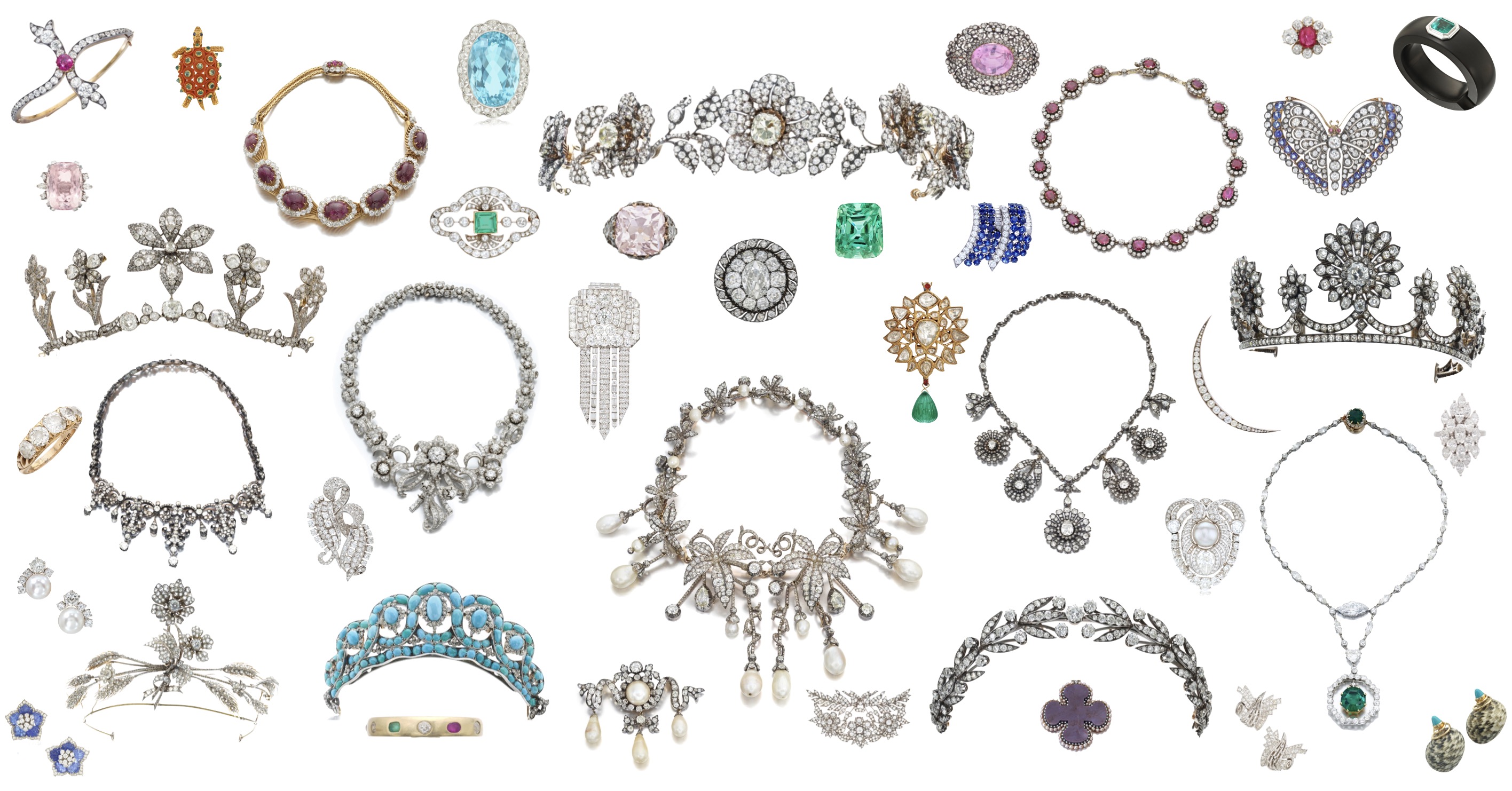


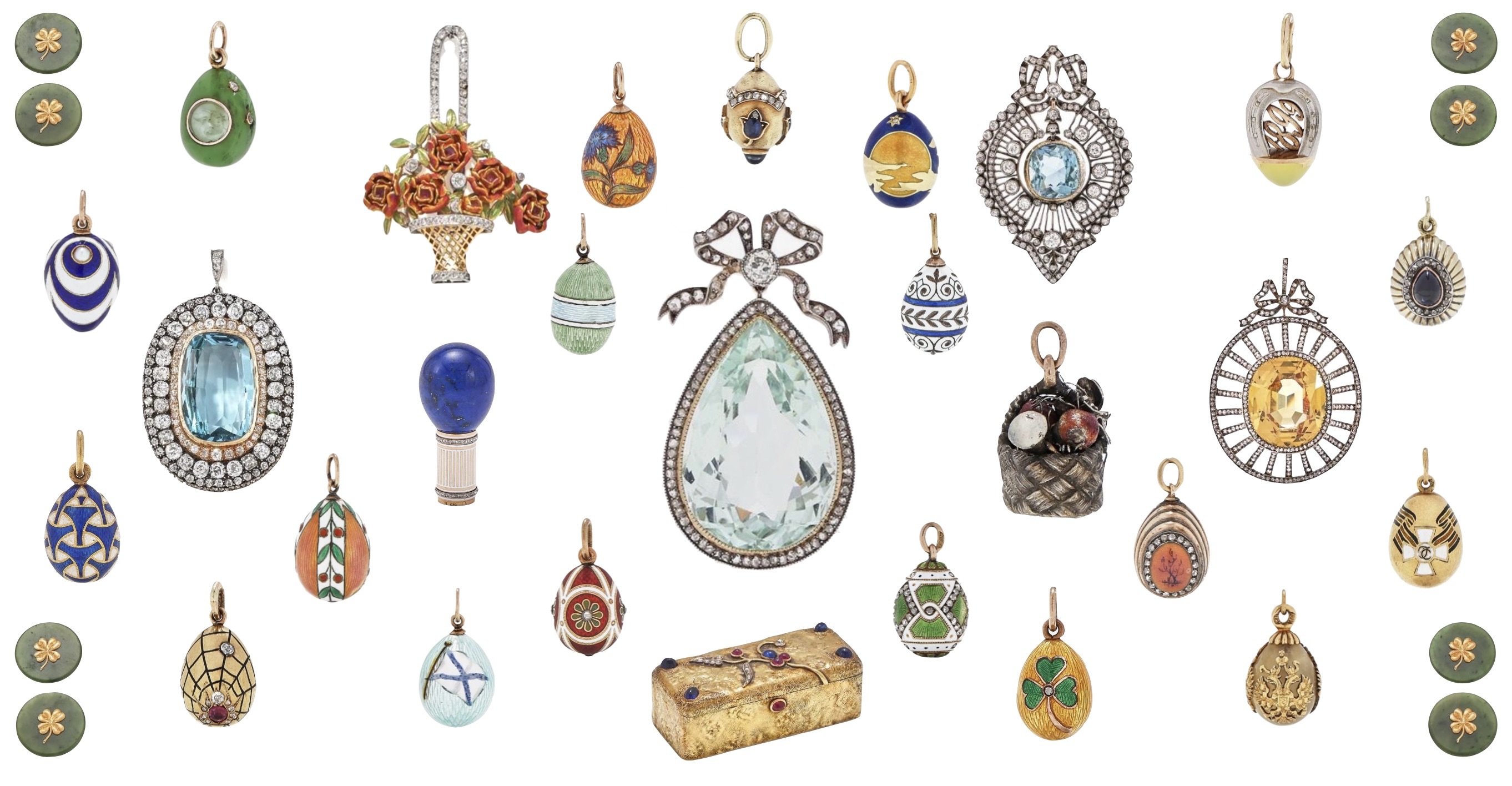
Sotheby’s Noble & Private Collections | 5 December 2024

Phillips Geneva Jewels | 11 November 2024
Christie’s Magnificent Jewels | 12 November 2024
Sotheby’s Royal & Noble Jewels | 13 November 2024
Sotheby’s Important Jewels | 16 November 2024
Christie’s Jewels | 20 November 2024
Girls of Great Britain and Ireland Tiara
Vladimir Tiara

Queen Alexandra’s Kokoshnik Tiara
Belgian Sapphire Tiara
Burmese Ruby Tiara
Brazilian Aquamarine Tiara
Queen Mary’s Fringe Tiara
Queen Mary’s Lover’s Knot Tiara
Queen Victoria’s Oriental Circlet Tiara

