


The portrait of a beautiful queen loomed large over King Felipe
today. The royal in question was his great grandmother, Victoria
Eugenia, who had to leave Spain when her husband, King Alfonso
XIII, was forced into exile. She only returned when Felipe was born
to act as his godmother. Now, her story is being told in a huge new
exhibition in Madrid and it’s quite a tale. In fact, it’s hard to
believe it’s not more widely known for Victoria Eugenie was almost
killed on her wedding day.
She began life as a princess, the youngest granddaughter of
Queen Victoria, and she spent a lot of her early years in the
solitude of Balmoral. But Ena, as she was known, perhaps realized
the turbulence ahead of her just minutes after her wedding. She
walked into the Royal Monastery of San Jeronimo in Madrid on May
21st 1906 as a princess and left as a queen having said
‘I do’ to King Alfonso XIII of Spain. But as the newlyweds
travelled back to the reception their procession was attacked by an
anarchist, Mateu Morral, who threw a bomb at the coaches. Alfonso
and Ena escaped injury but many others were killed and hurt.
It was hardly an auspicious start and married life proved
just as traumatic.
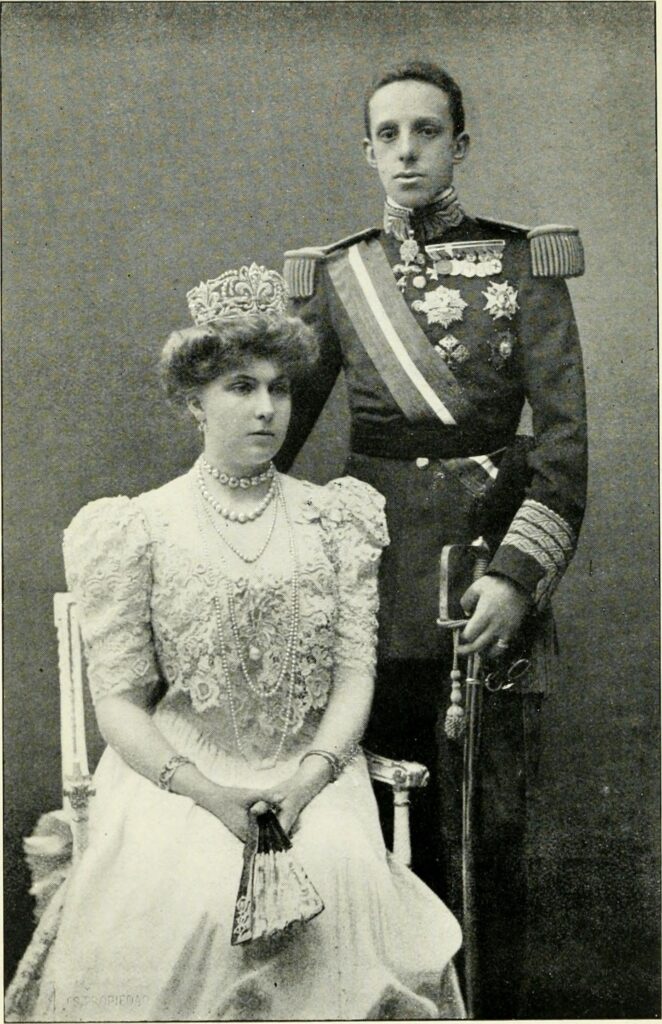
Commons
Ena’s life before her marriage could hardly have been more
different. It was quiet and restrained to the point of suffocation
and her childhood was spent at the beck and call of ‘grandmamma’ as
she and her parents lived with Queen Victoria. She was born at
Balmoral on October 24th 1887, the only daughter of
Victoria’s youngest girl, Princess Beatrice and her husband, Prince
Henry of Battenberg and christened Victoria Eugenie Julia
Ena. Her last name was a mistake – it was meant to be Eua but
was written down incorrectly. No matter, she came to be known
by that name for most of her life.
But the troubles that can come with a crown already coloured
Ena’s life at this early stage. The name Eugenie had been
given in honour of one of her godparents, the exiled Empress of
France who now lived in England. It is striking that this little
girl who would grow up into a queen forced to flee her husband’s
kingdom began life in the arms of a woman who had already endured
that same fate.

Osborne in her youth, a world away from the Madrid court she would
one day rule
Young Ena may well have encountered her godmother as she grew up
for Eugenie spent a lot of time with the British royals. And Ena
spent a lot of time with Queen Victoria for her mother had promised
to be granny’s lifetime companion. The queen had wanted her
youngest child to remain unmarried but Beatrice had other ideas.
The compromise reached was that once wed she and her husband would
remain at Victoria’s side. And that meant their children were
raised with granny.
Ena grew up in the cloistered world of Victoria’s later years,
spending her days at Windsor or at Osborne or wherever her
grandmamma chose to go. She had three brothers – one older and two
younger – but her reliance on female relatives only increased when,
in 1896, her father died. Henry had persuaded Victoria to let him
leave the family briefly to go to modern day Ghana to serve in the
Ashanti wars. He died there after catching malaria.
Henry’s desperation to get to west Africa perhaps indicates the
stifling surroundings in which he and his family lived. And that
craving for something new can be seen in his only daughter’s
actions almost a decade after his death when, against a healthy
dose of opposition, she decided to accept the proposal of the King
of Spain.
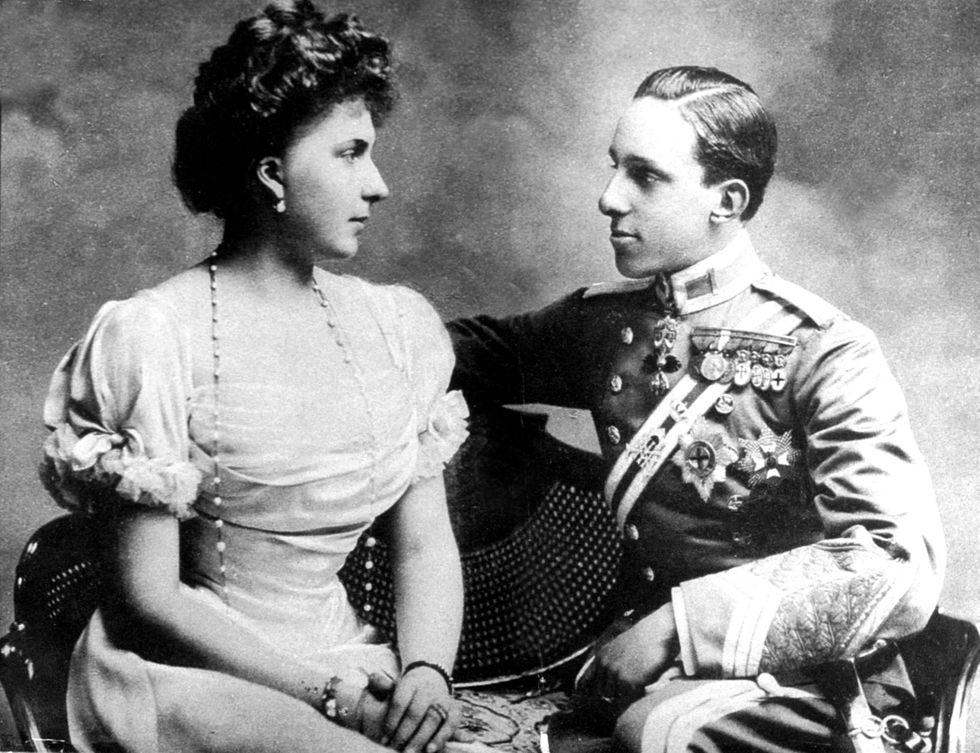
hopelessly in love with one another – and with the idea of love
(Public Domain, Wiki Commons)
Queen Victoria was, of course, dead by then. Following her
passing and funeral Princess Beatrice had begun to dedicate her
life to editing her mother’s journals while Ena’s older brother
joined the Navy and her younger brothers persued their educations.
When she met the dashing and rather keen Spanish monarch, Ena was
swept off her feet.
Alfonso XIII had been Spain’s king since the day of his birth,
his father having died six months before the arrival of his only
son. In 1905, now aged 19, Alfonso decided he needed a
wife and on a visit to Britain he met several of King Edward
VII’s nieces. He was particularly struck by Patricia of Connaught
but she was even more struck by the instability besetting Spain at
the time and made it clear this princess did not want to be
pursued. Alfonso then began to woo Ena and after a dull lifetime in
grandmamma’s house, she was smitten with his attentions and the
prospect of a new life far away.
But others weren’t so keen on the match. Alfonso’s mother, Maria
Cristina, wanted her son to marry into the Hapsburg family. One of
her main reasons for that was religion – Alfonso needed a Catholic
wife and Ena was very definitely a Protestant. Those issues had
been raised in England as well with Princess Beatrice writing to
the Archbishop of Canterbury about a possible wedding only to be
told that he was against any link with this Catholic monarchy. But
uncle Edward did give his backing, raising Ena to the status of Her
Royal Highness, and in early 1906 she went to Spain where she
converted to Catholicism and wed her king.

illness that several of their children inherited
(Public Domain, Wiki Commons)
There had been one other issue much discussed before their
marriage but prior to saying ‘I do’ Alfonso seemed to have
reconciled himself to it. Ena, as a descendant of Queen Victoria,
had a chance of carrying the gene for haemophilia, the condition
which causes uncontrollable bleeding in male bearers. The couple
had concluded it was only a possibility that Ena might pass this
hereditary condition on to any male children and they put it to one
side. But not long after the birth of their first son, Alfonso,
just a year after their marriage it became clear that Ena did carry
the gene. The new Prince of Asturias had haemophilia and his father
blamed his mother completely. The affection between the king and
queen disintergrated.
They went on to have another six children but of their three
other sons who survived to adulthood another, Gonzalo, also had
haemophilia while the second born of their boys, Jaime, suffered
ongoing health problems. And Ena raised her children in an
increasingly fragile and fractious political situation as her
husband gave his support to unpopular wars to retain Spanish
possessions in Africa. In 1923 an army general, Miguel Primo de
Rivera, seized power and established a dictatorship with the
support of King Alfonso. After the fall of de Rivera, in
1930, the king became even more unpopular and when republican
parties won elections in April 1931 he left Spain.

Spain
(Public Domain, Wiki Commons)
He and his family went into exile. He and Ena fell apart and
they lived largely separate lives in exile with the queen spending
her time in the UK and Switzerland. In 1934 their youngest son,
Gonzalo, died of a haemorrhage following what had appeared to be a
minor car crash. Four years later, Ena lost her eldest son in
similar circumstances. The relationship between her and her husband
was largely non existent by the time he died in 1941 and Ena spent
the following decades on her own.
But despite her exile, in later life her royal connections only
continued to grow. When Grace Kelly married Prince Rainier III of
Monaco in 1956 it was Queen Ena who offered support and advice to
the new royal and helped her as she made a new life as a princess.
Several photos from Ena’s later life show her holding hands with
Grace and the Princess of Monaco thought so highly of her friend
that she asked her to be godmother to her son, Albert, in 1958.
He’s not the only head of state in Europe today to count this
youngest granddaughter of Queen Victoria among his sponsors.
Victoria Eugenie, then the last queen of Spain, returned to her
adopted country just once after exile. She touched down in Madrid
in February 1968 and soon afterwards acted as godmother to her new
great grandson, a boy called Felipe. At the time there wasn’t even
a monarchy in Spain for him to inherit but in a famous photo of his
baptism he lies in Queen Ena’s arms. Seven years later the
monarchy was restored on the death of Franco and Felipe became
Spain’s king on June 19th 2014 on the abdication of King
Juan Carlos.
But Ena never saw the troublesome crown which had been such a
large part of her life restored. She passed away on April
15th 1969, the 38th anniversary of her flight
from Spain. Her funeral was held in Lausanne and she was buried
there. But Ena’s story wasn’t done yet. Six years after her death,
the monarchy in Spain was restored and in 1985 her grandson, Juan
Carlos I, had her remains moved to the royal burial vault at El
Escorial just outside Madrid. She was interred next to her husband
and the three sons who died before her. Eight years later her other
son, Juan, was buried there too with all the rights due to a King
of Spain.
Victoria Eugenie, a quiet princess from Scotland and last of the
granddaughters of the great queen empress, had worn a crown of her
own but her life was very far from the stability her grandmother
cherished so dearly. Ena was Spain’s queen for twenty five years
but spent far longer in exile and the personal sadnesses of her
life were at times almost unbearable. For the baby of the family
life was very far from a royal fairytale.
Now that life is at the heart of a brand new exhibition at the
Royal Palace in Madrid which runs until early 2026. Queen Ena
returned to its corridors after a bomb attack on her wedding day.
Now, the baby she held in her arms is king of the country she came
to love so dearly but which almost cost her her life.
Lydia Starbuck is a pen name of June Woolerton who has
written extensively on royal history. Her book, A History of Royal Jubilees, is
available now. She is also the author of a popular cosy mystery,
All Manne

