


by Susan Flantzer
© Unofficial Royalty 2025
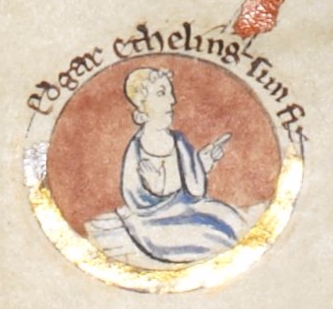
Edgar the Ætheling; Credit – Wikipedia
Edgar the Ætheling was elected King of England by the Witenagemot in 1066, after the Battle of Hastings. He was never crowned and submitted to William the Conqueror, who then reigned as King William I of England. Ætheling was used in Anglo-Saxon England to designate princes of the royal dynasty who were eligible for the kingship.
Edgar the Ætheling was the second of the three children and the only son of Edward the Exile and his wife Agatha. He was probably born circa 1052 in Hungary, where his father, Edward the Exile, the son of Edmund II Ironside, King of the English, had found refuge after Edmund II’s death and the 1016 conquest of England by Cnut the Great, King of Denmark and Norway, who also then became King of England.

Edgar the Ætheling’s sister, Saint Margaret of Scotland, stained glass window at St. Margaret’s Chapel at Edinburgh Castle; Credit – Wikipedia
Edgar the Ætheling had two sisters:
In 1057, Edward the Confessor, the childless King of England, discovered that his nephew Edward the Exile was still alive and summoned him to England as a potential successor. Edward the Exile arrived in England with his wife and children, but died within a few days, on April 19, 1057, without meeting King Edward the Confessor. The cause of his death has never been determined. Murder is a possibility, as he had many powerful enemies.
After Edward the Exile’s death, his son Edgar the Ætheling had the best hereditary claim to the English throne. Edmund Ironside’s three children were then raised in the court of King Edward the Confessor, who died in January 1066. However, Edgar the Ætheling was considered too young to be king, and the Witenagemot elected Harold Godwinson King of England mainly because it was thought he could defend England against foreign claimants to the English throne.
On October 14, 1066, King Harold of England was killed at the Battle of Hastings by the invading Normans led by William II, Duke of Normandy, later King William I of England, also known as William the Conqueror. Some of the Anglo-Saxon leaders decided to back Edgar the Ætheling’s claim to the throne. Two leading Anglo-Saxon nobles, Edwin, Earl of Mercia, and his brother Morcar, Earl of Northumbria, promised their military support. As William of Normandy’s position grew stronger, it became evident to those in power that Edgar the Ætheling should be abandoned and that they should submit to William, who then reigned as King William I of England, the first English monarch of the House of Normandy. Edgar the Ætheling was among the English leaders who submitted to William.
In 1069, with Danish support, Edgar the Ætheling tried to resume the fight against King William I but was defeated and fled to Scotland, where his sister Margaret had married Malcolm III, King of Scots. After King William I died in 1087, Edgar supported King William I’s first son, Robert III Curthose, Duke of Normandy, against his second son, William Rufus, in the dispute over his succession. However, William Rufus ultimately became king and reigned as King William II Rufus of England, causing Edgar the Ætheling to flee again to Scotland. In 1097, in Scotland, Edgar the Ætheling helped his nephew Edgar of Scotland, the son of his sister Margaret, overthrow his uncle King Donald III and Donald’s half-brother King Edmund, who jointly reigned in Scotland, and Edgar became King of Scots.
Around 1098, Edgar the Ætheling left for Constantinople and probably served in the Varangian Guard, a military unit of Vikings and Anglo-Saxons of the Byzantine Empire. That same year, he was given command of a Byzantine fleet with provisions and reinforcements for the Crusaders during the Siege of Antioch.

Battle of Tinchebray; Credoit – Wikipedia
Back in Europe, Edgar the Ætheling fought on the side of Robert II, Duke of Normandy, at the Battle of Tinchebray in the Duchy of Normandy, now in France, against King Henry I of England in 1106 and was captured. He reconciled with King Henry I and received an estate in Hertfordshire, England, where he retired. Edith of Scotland, also known as Matilda, the daughter of Edgar the Ætheling’s sister Margaret, married King Henry I of England in 1100, uniting the Anglo-Saxon and Norman lines in her descendants.
Edgar the Ætheling was still alive in 1125, according to 12th-century chronicler William of Malmesbury, who wrote at the time that Edgar “now grows old in the country in privacy and quiet”. Edgar the Ætheling died sometime after this contemporary reference, but the exact date of his death and burial site are unknown.
This article is the intellectual property of Unofficial Royalty and is NOT TO BE COPIED, EDITED, OR POSTED IN ANY FORM ON ANOTHER WEBSITE under any circumstances. It is permissible to use a link that directs to Unofficial Royalty.
Works Cited
- Autoren der Wikimedia-Projekte. (2005). Angelsächsischer Thronanwärter. Wikipedia.org; Wikimedia Foundation, Inc. https://de.wikipedia.org/wiki/Edgar_%C3%86theling
- Flantzer, Susan. (2025). Edward the Exile, son of Edmund II Ironside, King of the English [Review of Edward the Exile, son of Edmund II Ironside, King of the English]. Unofficial Royalty. https://www.unofficialroyalty.com/edward-the-exile-son-of-edmund-ii-ironside-king-of-the-english/
- Wikipedia Contributors. (2024). Edgar Ætheling. Wikipedia; Wikimedia Foundation. https://en.wikipedia.org/wiki/Edgar_%C3%86theling

