


Powerlifting is one of the most effective training systems for building raw strength, muscle density, and overall athletic power. Whether you’re a beginner or an experienced lifter, a 45-minute powerlifting workout plan can help you maximize your training results without spending endless hours in the gym. In this guide, we’ll break down everything you need — from warm-ups and compound lifts to accessory work and recovery tips — to build a strong, lean, and powerful physique.
What Is Powerlifting?
Powerlifting focuses on three main compound movements: the squat, bench press, and deadlift. Each lift challenges multiple muscle groups and tests your total-body strength under heavy loads. The goal isn’t just aesthetics — it’s about improving your max strength (1RM) while developing coordination, stability, and explosive power.
Unlike bodybuilding, which prioritizes muscle isolation and symmetry, powerlifting emphasizes performance over appearance. However, with consistent training and proper nutrition, you’ll still build thick, muscular size — especially in your legs, chest, back, and core.
Benefits of a 45-Minute Powerlifting Workout Plan
Many lifters assume they need two-hour sessions to make serious progress, but time efficiency doesn’t mean sacrificing results. A focused 45-minute powerlifting workout is enough to hit all major lifts, accessory movements, and conditioning work — if you manage your rest and intensity correctly.
1. Time Efficiency
Perfect for busy schedules, you can get in, lift heavy, and leave — all under an hour while maintaining top performance.
2. Strength and Muscle Density
By focusing on heavy compound lifts, you stimulate the most muscle fibers and release higher levels of growth hormone and testosterone naturally.
3. Functional Fitness
Powerlifting builds real-world strength that translates to better athletic performance, improved posture, and reduced injury risk.
4. Progressive Overload Mastery
You’ll learn how to push your limits gradually, adding weight, volume, or intensity week after week for continuous gains.
Structure of a 45-Minute Powerlifting Workout Plan
A well-rounded powerlifting session should include:
- 5-10 minutes of dynamic warm-up and mobility drills
- 30 minutes of compound lifts (main and secondary)
- 5-10 minutes of accessory or assistance work
- 5 minutes of cool-down and stretching
To make the most of every session, you’ll rotate focus across the three main lifts over the week, allowing adequate rest for recovery.
Weekly Powerlifting Workout Plan Training Split Example
Here’s how your 45-minute powerlifting routine might look across a typical 5-day training week:
| Day | Focus | Main Lift | Accessory Work |
|---|---|---|---|
| Monday | Squat Day | Back Squat | Lunges, Leg Press, Core |
| Tuesday | Bench Day | Barbell Bench Press | Triceps, Shoulders |
| Wednesday | Rest or Mobility | — | Active recovery, stretching |
| Thursday | Deadlift Day | Conventional Deadlift | Hamstrings, Back, Grip |
| Friday | Overhead Strength | Standing Overhead Press | Upper back, traps |
| Saturday | Optional Conditioning | Sled Push, Rowing, HIIT | Cardio + mobility |
| Sunday | Rest | — | — |
45-Minute Powerlifting Workout Plan
Below is your detailed 45-minute powerlifting workout plan, designed to hit strength, hypertrophy, and performance goals.
Warm-Up (5-10 Minutes)
A proper warm-up is critical for powerlifting — it primes your muscles and nervous system for heavy lifting.
Dynamic Warm-Up Routine:
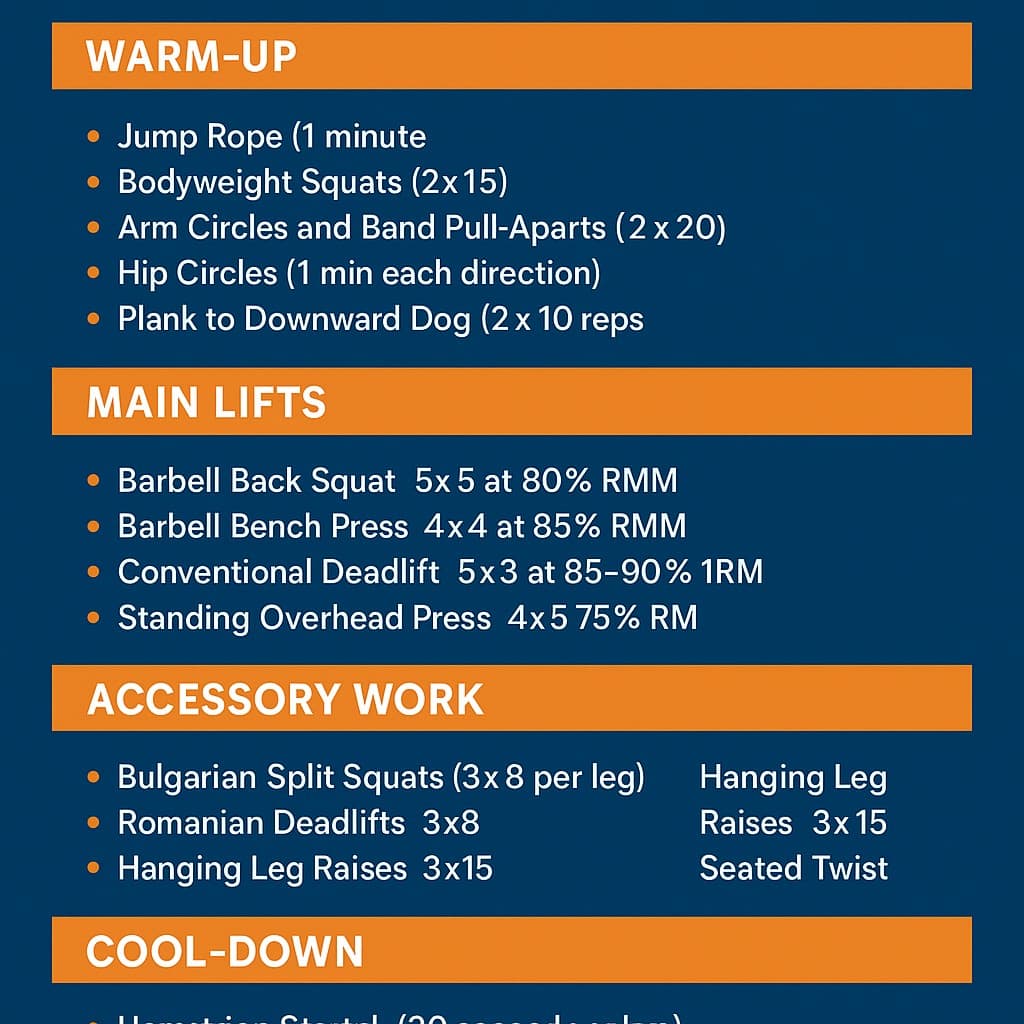
- Jump Rope – 1 minute
- Bodyweight Squats – 2 sets of 15
- Arm Circles and Band Pull-Aparts – 2 sets of 20
- Hip Circles – 1 minute each direction
- Plank to Downward Dog – 2 sets of 10 reps
This combination increases circulation, improves flexibility, and reduces injury risk before heavy work begins.
Main Lifts (30 Minutes)
Your main lifts are the heart of the workout. Stick to 3–5 sets of 3–6 reps at 75–90% of your one-rep max (1RM) for optimal strength gains.
Day 1: Squat Focus Powerlifting Workout Plan
Main Lift: Barbell Back Squat
- 5 sets x 5 reps at 80% 1RM
- Rest: 2 minutes between sets
Accessory Work:
Tips:
Keep your torso upright, drive through your heels, and engage your core for stability. Aim for consistent depth (hips below parallel).
Day 2: Bench Press Focus
Main Lift: Barbell Bench Press
- 4 sets x 4 reps at 85% 1RM
- Rest: 90 seconds between sets
Accessory Work:
- Incline Dumbbell Press – 3 sets x 8
- Close-Grip Bench Press – 3 sets x 6
- Face Pulls – 3 sets x 15
Tips:
Tuck your elbows slightly, maintain a strong arch, and focus on controlled lowering and explosive upward drive.
Day 3: Deadlift Focus Powerlifting Workout Plan
Main Lift: Conventional Deadlift
- 5 sets x 3 reps at 85–90% 1RM
- Rest: 2–3 minutes between sets
Accessory Work:
- Barbell Rows – 3 sets x 8
- Hamstring Curls – 3 sets x 12
- Farmer’s Carry – 3 sets x 40 seconds
Tips:
Engage your lats, keep the bar close to your body, and avoid jerking the weight — lift smoothly and with purpose.
Day 4: Overhead Power and Stability
Main Lift: Standing Overhead Press
- 4 sets x 5 reps at 75% 1RM
- Rest: 90 seconds
Accessory Work:
- Push Press – 3 sets x 6
- Lateral Raises – 3 sets x 12
- Dumbbell Shrugs – 3 sets x 15
Tips:
Brace your core, avoid leaning back, and maintain strict control during the press.
Day 5: Speed and Conditioning (Optional) Powerlifting Workout Plan
Explosive/Accessory Conditioning:
- Sled Push – 4 sets x 20 meters
- Kettlebell Swings – 3 sets x 15
- Rowing Machine Sprints – 4 rounds of 30 seconds on / 30 seconds off
Goal:
Build power endurance and maintain cardiovascular fitness without compromising strength recovery.
Cool-Down and Stretching (5 Minutes)
Finish with light stretches to improve flexibility and reduce soreness:
- Hamstring Stretch – 30 seconds each leg
- Chest Opener Against Wall – 30 seconds each side
- Hip Flexor Stretch – 30 seconds each leg
- Seated Twist – 30 seconds
- Deep Breathing – 1 minute
Progressive Overload and Periodization
To make continuous strength gains, you must apply progressive overload — gradually increasing the challenge placed on your muscles. That can mean adding weight, volume, or reducing rest periods.
Linear Progression
Increase load by 2.5–5% weekly until you can no longer complete the desired rep range with good form.
Deload Weeks
Every 4–6 weeks, take a lighter week (60–70% intensity) to allow full recovery and avoid burnout.
Periodization Example
- Weeks 1–4: Strength Phase (3–5 reps, 80–85%)
- Weeks 5–8: Power Phase (2–3 reps, 85–90%)
- Weeks 9–12: Volume Phase (5–8 reps, 70–75%)
Nutrition for a Powerlifting Workout Plan
Lifting heavy is only half the battle — nutrition fuels your performance and recovery.
1. Caloric Surplus for Strength Gains
If your goal is to increase strength and muscle, aim for a small caloric surplus (around 300–500 calories above maintenance).
2. Protein Intake
Consume 1.0–1.2 grams of protein per pound of bodyweight daily from sources like chicken, eggs, fish, beef, and whey protein.
3. Carbohydrates for Energy
Powerlifters rely heavily on glycogen. Include complex carbs (rice, oats, potatoes, fruits) to fuel performance.
4. Healthy Fats
Don’t skip fats — they support hormone balance. Focus on avocados, nuts, olive oil, and fatty fish.
5. Hydration
Dehydration kills strength. Drink at least 3–4 liters of water per day, especially around training sessions.
Recovery Tips for Powerlifting Workout Plan
Heavy training demands serious recovery. Here’s how to bounce back faster:
Sleep
Aim for 7–9 hours of quality sleep each night to maximize testosterone and muscle repair.
Active Recovery
Incorporate light mobility work, yoga, or walking on rest days to increase circulation and reduce stiffness.
Foam Rolling and Massage
Target sore areas like your hamstrings, glutes, and lats to improve tissue recovery.
Supplements
Consider:
- Creatine Monohydrate: Boosts power output
- Whey Protein: Enhances post-workout muscle repair
- Omega-3s: Reduces inflammation
- Magnesium + Zinc: Supports sleep and hormone balance
Form, Technique, and Safety
Powerlifting requires strict attention to technique. Poor form not only limits your progress but also risks injury.
Key Tips:
- Always warm up with lighter sets before hitting heavy loads.
- Keep a neutral spine during squats and deadlifts.
- Engage your core and glutes for stability.
- Don’t ego lift — perfect form beats heavy weight with bad mechanics.
- Consider filming your lifts to analyze technique.
Sample 45-Minute Powerlifting Workout Plan Session
Here’s an example of a single day in the gym:
Day 1: Squat + Accessory
| Segment | Exercise | Sets x Reps | Time |
|---|---|---|---|
| Warm-Up | Dynamic Mobility | — | 5 min |
| Main Lift | Back Squat | 5 x 5 | 25 min |
| Accessory | Romanian Deadlift | 3 x 8 | 8 min |
| Core | Hanging Leg Raise | 3 x 15 | 5 min |
| Cool-Down | Stretching | — | 2 min |
Total Time: 45 minutes
Common Powerlifting Workout Plan Mistakes in Powerlifting Workouts
1. Skipping Warm-Ups
Cold muscles increase injury risk and reduce power output.
2. Ignoring Accessory Work
Smaller lifts (like rows and triceps extensions) improve balance and stability.
3. Poor Recovery Habits
Overtraining without proper rest can stall progress and lead to burnout.
4. Inconsistent Tracking
Always log weights, reps, and perceived effort to monitor progress.
5. Bad Nutrition
Neglecting your diet will limit your strength potential.
Powerlifting Workout Plan Mindset: Train for Progress, Not Perfection
Powerlifting is a marathon, not a sprint. You won’t add 100 pounds to your squat overnight, but with consistency, smart programming, and proper recovery, you’ll see dramatic strength and physique changes within months.
Stay patient, stay disciplined, and celebrate every small victory — whether it’s a cleaner lift, better depth, or adding just 5 pounds to the bar.
A 45-minute powerlifting workout plan is all you need to build a stronger, more muscular body — even with a busy schedule. The combination of heavy compound lifts, targeted accessory work, and smart recovery keeps your sessions efficient and your progress consistent.
Commit to this plan for 8–12 weeks, track your lifts, eat for performance, and you’ll be amazed by how much stronger and more powerful you become.

