


Kettlebell training has exploded in popularity—and for good reason. With one compact piece of equipment, you can build strength, increase endurance, improve mobility, and torch calories in a short amount of time. If you’re looking for a fast, efficient, and highly effective session, this 30-minute full body kettlebell workout delivers everything you need.
This routine hits all major muscle groups in a balanced format, pairing strength-building movements with explosive conditioning exercises to elevate your heart rate and maximize fat burning. Whether you’re training at home, in the gym, or while traveling, this kettlebell-based session is perfect for beginners, intermediate lifters, and experienced athletes alike.
In this article, you’ll learn the benefits of kettlebell training, how to warm up, the full 30-minute workout breakdown, exercise descriptions, technique tips, and progressions to help you get stronger over time. Get ready to challenge your entire body and finish your workout feeling powerful and energized.
Benefits of a 30-Minute Full Body Kettlebell Workout
Before diving into the training itself, it’s helpful to understand why kettlebells are so effective. This workout style brings together functional movement, strength development, and metabolic conditioning in one powerful session.
1. Full Body Strength and Conditioning in One Tool
Kettlebells allow you to move through a wide range of dynamic and compound exercises. Movements such as swings, cleans, and presses target multiple muscle groups at once, producing a demanding full-body experience that builds both strength and conditioning.
2. Huge Calorie Burn in a Short Time
Because kettlebell exercises often involve continuous movement patterns, they create a high-intensity training stimulus. Paired with minimal rest periods, this leads to an elevated heart rate and increased calorie burn, even after your workout is over.
3. Improved Mobility and Stability
The offset kettlebell design forces your core and stabilizer muscles to work harder. Rotational muscles, hip stabilizers, and shoulder stabilizers all get activated, resulting in improved posture, better joint stability, and stronger movement patterns.
4. Functional Movement for Real-Life Strength
Kettlebell exercises mimic how your body naturally moves—lifting, hinging, pushing, and pulling. This helps improve functional strength, making everyday tasks easier while reducing the risk of injury.
5. Train Anywhere With Minimal Space
A 30-minute kettlebell session requires only a single kettlebell and a small open floor. It’s ideal for home workouts or compact gym spaces, giving you a convenient full-body solution anytime.
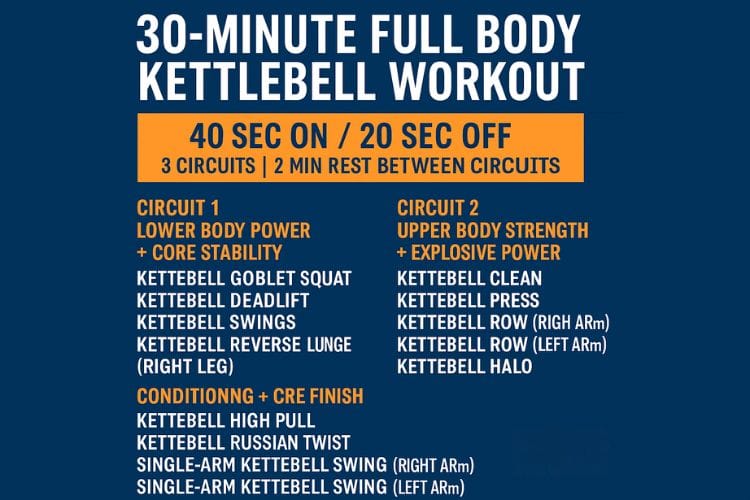
How This 30-Minute Full Body Kettlebell Workout Works
This workout is designed to target every major muscle group while keeping your heart rate elevated for maximum fat-burning and endurance-building benefits.
Structure
- Duration: 30 minutes
- Format: 3 circuits
- Time per circuit: 8 minutes of work + 2 minutes rest
- Equipment: One kettlebell (moderate weight)
- Training style: Strength + HIIT hybrid
Each circuit includes 5 exercises, performed in timed intervals:
- 40 seconds work
- 20 seconds rest
You will complete all 5 exercises back-to-back for one round. After each full 5-exercise circuit, rest for 2 minutes before moving on.
Warm-Up Before Your Workout (3 Minutes)
A powerful kettlebell workout requires your muscles and joints to be primed for movement. A short but effective warm-up prepares your hips, core, and shoulders for the dynamic movements ahead.
Warm-Up Routine
Perform each movement for 30 seconds:
- Arm Circles
- Hip Hinge to Reach
- Bodyweight Squats
- Torso Rotations
- High Knees
- Cat-Cow / Spine Mobilization
By the end of the warmup, you should feel loose, warm, and ready to move explosively.
Circuit 1: Lower Body Power + Core Stability
This first section builds strength through the legs and glutes while engaging the core through dynamic and functional movements.
Exercise 1: Kettlebell Goblet Squat Full Body Workout
Muscles Worked: Quads, glutes, hamstrings, core
Hold the kettlebell at your chest and lower into a deep squat. Drive through the heels to return to standing. Maintain a tall chest and tight core. Goblet squats help build lower-body power while reinforcing proper squat mechanics.
Exercise 2: Kettlebell Deadlift
Muscles Worked: Hamstrings, glutes, lower back
Using a hip hinge pattern, lower the kettlebell to the floor while keeping your spine neutral. The deadlift is a foundational movement that strengthens the posterior chain, improves hip power, and protects the lower back.
Exercise 3: Kettlebell Swings Full Body Workout
Muscles Worked: Glutes, hamstrings, lower back, shoulders, core
Swings are explosive and elevate your heart rate quickly. Drive the kettlebell forward using your hips—not your arms—to build powerful posterior chain strength and endurance.
Exercise 4: Kettlebell Reverse Lunge (Right Leg)
Step back into a lunge while holding the kettlebell in a goblet position. This develops unilateral leg strength and improves balance.
Exercise 5: Kettlebell Reverse Lunge (Left Leg)
Repeat on the opposite leg to balance muscular development and improve lower-body stability.
Circuit 2: Upper Body Strength + Explosive Power
This circuit targets the back, shoulders, arms, and core while introducing more dynamic kettlebell movements.
Exercise 1: Kettlebell Clean
Muscles Worked: Shoulders, back, traps, core
Use a hip-driven swing to bring the kettlebell smoothly to rack position. This movement teaches power transfer and coordination. Avoid letting the kettlebell crash into your wrist—guide it smoothly.
Exercise 2: Kettlebell Press Full Body Workout
Muscles Worked: Shoulders, triceps, core
From rack position, press the kettlebell overhead with full lockout. This strengthens shoulder stability, improves pressing strength, and engages your deep core muscles.
Exercise 3: Kettlebell Row (Right Arm)
Muscles Worked: Lats, mid-back, biceps
Perform a bent-over row while keeping the core tight and spine neutral. This builds pulling strength and improves posture.
Exercise 4: Kettlebell Row (Left Arm)
Repeat on the left side to support balanced back development and symmetry.
Exercise 5: Kettlebell Halo Full Body Workout
Muscles Worked: Shoulders, arms, core
Hold the kettlebell upside down and rotate it around your head in a controlled motion. Halos help strengthen the shoulders, stabilize the core, and improve overhead mobility.
Circuit 3: Conditioning + Core Finish
This final circuit keeps your heart rate high while targeting core muscles and improving explosive endurance.
Exercise 1: Kettlebell High Pull Full Body Workout
Muscles Worked: Back, shoulders, traps, core
Drive the kettlebell up from your hips, pulling it toward chest level. This movement increases power and conditioning while demanding core control.
Exercise 2: Kettlebell Russian Twist
Muscles Worked: Abs, obliques
Seated on the ground, rotate the kettlebell side to side. Keep your core braced and avoid rounding the lower back. This move blasts the obliques.
Exercise 3: Kettlebell Thruster Full Body Workout
Muscles Worked: Quads, glutes, shoulders, core
Squat down while holding the kettlebell at your chest, then explode upward into an overhead press. This full-body movement combines lower-body power and upper-body strength into a demanding conditioning exercise.
Exercise 4: Single-Arm Kettlebell Swing (Right Arm)
A unilateral version of the swing, this challenges grip strength, core stability, and muscular coordination.
Exercise 5: Single-Arm Kettlebell Swing (Left Arm)
Complete the sequence by switching arms. Stay in control and avoid rotating the torso.
Cool Down and Recovery (3 Minutes)
Finish your workout with a slow, controlled cooldown to restore your heart rate and reduce muscle tension.
Cool Down Routine
Hold each stretch for 20–30 seconds:
- Forward Fold Stretch
- Hamstring Stretch
- Hip Flexor Stretch
- Shoulder Stretch
- Child’s Pose / Back Stretch
Deep breathing brings your body back to a relaxed state and helps jumpstart recovery.
Technique Tips for Better Full Body Kettlebell Workout Performance
To get the most out of your training, focus on form and body alignment. These principles help you lift safer and more effectively.
1. Master the Hip Hinge
Most kettlebell movements—especially swings, cleans, and deadlifts—are driven by the hips. Push your hips back, keep the core tight, and avoid rounding your spine.
2. Keep Your Core Tight
Engaging your core stabilizes your spine and increases power transfer. Imagine someone tapping your stomach—you should feel braced and firm.
3. Choose the Right Weight
Beginners should focus on mastering technique before increasing weight. A moderate kettlebell is ideal for 30-minute sessions that combine strength and conditioning.
4. Breathe With Intention
Use sharp exhales on explosive movements to drive power. Controlled breathing improves performance and prevents fatigue.
5. Avoid Over-Gripping
Let the kettlebell handle move naturally in your hand during dynamic movements to reduce forearm fatigue.
How to Progress This Full Body Kettlebell Workout Over Time
As you get stronger, you can continue challenging yourself with progressions that elevate intensity and build muscle.
Increase Weight
Once you can perform each circuit comfortably, move to a heavier kettlebell to overload the muscles.
Add More Rounds
Extend the session by adding an additional round of your favorite circuit.
Reduce Rest Time
Shorter rest periods increase cardiovascular intensity and calorie burn.
Advance to More Complex Movements
Once you’ve mastered the basics, integrate:
- Kettlebell snatches
- Windmills
- Turkish get-ups
- Double kettlebell variations
Who Should Use This 30-Minute Full Body Kettlebell Workout?
This routine is fantastic for:
- Men wanting a full-body strength and conditioning workout
- Busy individuals seeking fast, effective training
- Home gym athletes with minimal equipment
- Beginners looking to build foundational kettlebell skills
- Intermediate and advanced lifters needing a conditioning day
- Anyone wanting to burn fat while building functional strength
Whether you’re chasing muscle definition, fat loss, improved endurance, or overall fitness, kettlebell training delivers results.
This 30-minute full body kettlebell workout is a powerful, time-efficient training system that hits every muscle group while boosting your heart rate and improving functional strength. With consistent practice, you’ll build stronger movement patterns, burn calories, enhance mobility, and develop total-body conditioning.
Grab your kettlebell, set your timer, and commit to pushing hard for 30 minutes. You’ll finish sweaty, challenged, and energized—ready to take on anything.

