


You’re pushing for better performance—training harder, dialing in your recovery, and optimizing everything.
But what if the key to unlocking your full potential starts with your tongue?
Most athletes focus on their training, diet, and recovery techniques to improve performance. While these are undoubtedly important, people rarely consider how their tongue posture can affect their health and overall life.
This small but mighty muscle has a larger influence than you might realize. In fact, it could be the missing piece when it comes to your posture, sports performance, and even your sleep.
In this article, I’ll help you discover why tongue posture is the hidden driver of breathing efficiency, posture, and recovery. You’ll also get to dig into why quick fixes like mouth taping often fall short, how poor tongue position rewires your nervous system, and the surprising link between tongue placement, athletic output, and sleep quality.
Key Takeaways
- Mouth taping doesn’t solve the root of the problem: Mouth taping may stop snoring, but it doesn’t retrain the brain or correct low tongue posture, leaving the airway and nervous system under stress.
- Tongue posture may set the foundations for optimal posture and performance: Pressing the tongue to the roof of the mouth stabilizes the hyoid bone and cervical spine, improving head position, reflexive core tension, and overall movement efficiency.
- Correct tongue posture can improve both strength and recovery: Research shows holding the tongue against the palate can increase strength output by up to 30%, while also activating the parasympathetic nervous system for better rest and focus.
- Habits formed early shape lifelong health: Children who mouth breathe develop structural and neurological patterns that affect breathing, focus, and behavior well into adulthood.
- Retraining your tongue posture, however, is possible at any age: Daily awareness, swallowing retraining, posture correction, and special devices like those you’ll discover in this article provide the feedback your nervous system needs to rewire itself and sustain proper tongue position.
Why Is Mouth Taping Not Enough?
Under normal conditions, you’re meant to breathe through the nose.
During nasal breathing, the tongue rests naturally against the roof of the mouth (the palate), providing upward pressure that shapes the maxilla (upper jaw) and supports a wide, U-shaped dental arch. In turn, the tongue counters the inward pressure from the cheeks, helping to guide proper facial development, jaw alignment, and airway space, which leads to proper head posture.
Mouth taping has gained popularity as a quick fix to stop mouth breathing during sleep. This involves using tape to keep the mouth shut at night, encouraging nasal breathing.

For some, this can result in short-term benefits like less snoring, a reduction in dry mouth, or even slightly improved sleep quality.
However, these changes are surface-level—and while they can result in small improvements in sleep performance, especially in chronic mouth breathers or those with mild sleep apnea, the changes induced by mouth breathing do nothing to address the neurological programming and structural compensation patterns that drive mouth breathing in the first place.
So, what does this mean exactly? Let’s rewind for a second.
The tongue, jaw, and neck are part of a continuous network of fascia, muscles, and neural inputs known as the deep front line. This fascial chain runs from the tongue and hyoid bone through the diaphragm and psoas, all the way down to the inner thighs and the feet.
This fascial chain informs the brain of the body’s position in space, as well as helps regulate muscle tone from head to toe.
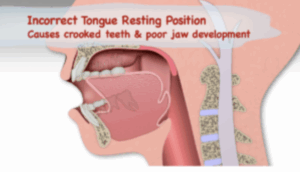
When nasal breathing becomes compromised, the body compensates with mouth breathing. This causes your jaw to drop, your tongue to fall from the roof of your mouth, and your airway to narrow.
Over time, this drives neurological adaptation: the brain rewires itself around this dysfunctional pattern. The fascial tissues adapt, the muscles shorten or become overactive, and the compensations become locked in, especially at night when the body is supposed to be in a state of restoration.
The problem with mouth taping is that it covers up the symptom—an open mouth—without fixing the sensory-motor loop that caused it.
You can tape the lips shut, but if the tongue is still sitting low in the mouth, the airway is still compromised. And the brain still perceives a threat, leading to shallow breathing, disrupted sleep cycles, and chronic tension in the jaw, neck, and spine.
In fact, forcing the mouth closed without addressing tongue posture or jaw alignment can increase stress in the craniofacial system.
The body may respond by pushing the head forward or clenching the jaw in an attempt to maintain airway patency, compensations that feed directly into the development of forward head posture, temporomandibular joint (TMJ) dysfunction, and even thoracic and lumbar misalignment.
Why Your Tongue Might Be the Root of Your Fatigue, Misalignment, and Poor Recovery
All of this may sound subtle, but this slight shift creates a ripple effect that impacts posture, stamina, concentration, and recovery.
For athletes and fitness enthusiasts, it could even be the physical performance edge you didn’t know you needed.
Proper tongue positioning enhances cognitive performance by optimizing oxygen delivery to your brain. Better oxygenation means sharper focus, faster reaction times, and improved decision-making under pressure.
The parasympathetic activation also reduces cortisol, eliminating brain fog and improving memory consolidation.
Combined with deeper REM sleep from improved airway patency, correct tongue posture creates the mental clarity and sustained focus that separates good athletes from elite performers.
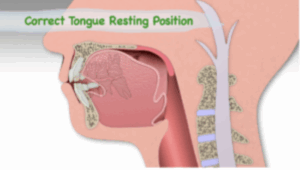
Research shows that proper tongue positioning also supports better airway patency, which means it helps deliver oxygen more efficiently to muscles and tissues.
For instance, one published scientific review highlighted how the muscles responsible for tongue posture, like the genioglossus, help maintain an open upper airway, allowing for optimal airflow and gas exchange.
Another study found that when the tongue is held against the upper palate during muscle activity, strength increases by approximately 30%.
When the tongue is pressed against the roof of the mouth, it activates the parasympathetic cranial nerves, which can have a calming effect on the body.
The parasympathetic branch, also known as the “rest-and-digest” nervous system, helps reduce feelings of stress or anxiety. In turn, this can further fuel optimal performance and concentration.
But that’s not all…
Pressing your tongue to the roof of the mouth also supports good overall body posture by activating the muscles in the throat and neck—and, consequently, placing the body in a position where it’s under the least amount of stress or strain.
In fact, the position of your tongue influences your ability to breathe through your nose, as well as impacts your sinuses, your eyes, your head, your neck, and your shoulders.
And here’s another twist: missing teeth can also impact tongue position.
When you’re missing a tooth, the tongue automatically fills this hole to prevent drooling. Yet, this creates dysfunction all on its own, interfering with the natural tongue position against the roof of the mouth.
If you think mouth taping at night may fix all of this… think again.
It can still lead to wakeups or drops in oxygen levels—both of which disrupt REM sleep and hurt recovery.
Instead of Chasing Symptoms, Tackle the Root Cause
When your tongue naturally rests on the roof of your mouth, it helps keep your airway open without effort, letting oxygen flow freely and supporting deep rest and vagus nerve activation all night long.
Unlike mouth taping, which attempts to block symptoms, correct tongue posture works upstream—training the brain to maintain airway tone through proprioceptive and cranial nerve input.
Rather than seeing tongue posture as a minor detail, it’s time to recognize it for what it truly is: a primary input that informs the brain’s control over the body.
When the tongue is where it should be, the nervous system gets clear, consistent data.
And when the nervous system has accurate input, it creates optimal output—better breathing, better movement, better recovery, and ultimately, better performance.
In short, correct tongue posture helps you breathe better, sleep better, look better, and feel better.
And at the end of the day, optimal performance doesn’t start in the gym; it starts in the brain. This is a neurological advantage rooted in improved oxygenation, vagal regulation, and spinal stabilization.
The Earlier the Habit, the Deeper the Impact
When it comes to childhood development, tongue posture is far more than an orthodontic concern—it’s a critical piece of the sensory input that shapes how a child breathes, stands, and even thinks.
Children who mouth breathe—often due to allergies or enlarged tonsils—shift their tongue low in the mouth, disrupting airway function and facial development.
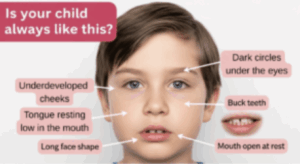
But what’s often overlooked is how this also rewires the nervous system…
Reduced nasal breathing lowers oxygen delivery to the brain and activates the stress-driven sympathetic system. Over time, this can affect focus, emotional regulation, and even behavior—often misdiagnosed as hyperactivity or anxiety.
Because tongue posture is linked to brainstem input and midline stability, these patterns become neurological defaults. By the time a child reaches adolescence, the brain has adapted around this dysfunction—compensating with poor posture, inefficient breathing, and sensory imbalance.
For parents, this means that early intervention is key.
Encouraging nasal breathing, resolving airway obstructions, and teaching proper tongue posture may be the most powerful step you can take—not just for your child’s teeth or jaw, but for their brain, their posture, and their long-term health.
How to Correct Your Tongue Posture Naturally
As an adult, it’s entirely possible to correct your tongue posture.
Yes, it will take conscious effort and consistency, but your brain can rewire itself through consistent, targeted feedback, even if you’ve spent years defaulting to low tongue posture or mouth breathing.
With that in mind, here are tips on how to improve your tongue posture—and, in turn, your overall health, body posture, and physical performance.
1. Build Awareness Throughout the Day
Behavioral change begins with awareness. Start by checking your tongue posture during routine activities—while walking, working, or even waiting at a red light.
Ask yourself: “Is my tongue resting against the roof of my mouth, or is it sitting low in my mouth?” “Are my lips closed?” “Am I breathing through my nose?”
Pairing posture awareness with daily cues—like checking your phone or sipping water—can also help shift this from a conscious act to a default setting over time.
2. Reintroduce the Brain to the Correct Tongue Position
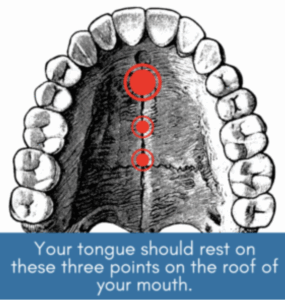
Find the correct spot for your tongue to rest by making a clucking sound with your tongue against the roof of your mouth.
The spot where your tongue naturally hits is approximately where it should rest—just behind the front teeth, not touching them.
Keep your lips closed, teeth gently apart, and the tongue lightly suctioned to the palate. Doing so helps create clear, consistent input to reprogram your postural reflexes.
3. Retrain Swallowing Patterns
Improper swallowing often reinforces poor tongue posture and jaw tension.
Instead of pressing the tongue against your teeth when you swallow, retrain it to move in a wave-like motion against the roof of your mouth.
To practice:
- Place the tongue against the hard palate.
- Swallow without clenching the jaw.
- Repeat slowly 5 times per day.
This may feel awkward at first, but over time, it teaches your nervous system to associate swallowing with correct midline engagement and helps normalize the tongue’s resting state.
4. Address Forward Head Posture as a Parallel Habit
Low tongue posture and forward head posture are often two sides of the same compensatory pattern. When the tongue drops, the head shifts forward to open the airway.
But the opposite is also true: When your head shifts forward, it changes the tension in the muscles and fascia of your neck and jaw, making it mechanically more difficult to maintain proper tongue position.
According to research, forward head posture can compress the carotid arteries, potentially reducing blood flow to the brain and creating a cascade of negative effects, including disturbed sleep, increased anxiety, and mental fatigue.
By practicing proper tongue posture throughout the day—keeping it gently pressed against the roof of your mouth—you provide natural support for your head and neck.
This small change can be the first step in correcting forward head posture, which, in turn, makes maintaining proper tongue position even easier.
5. Use a Functional Activator to Reinforce Neurological Change
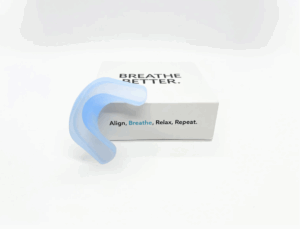
While conscious awareness and exercises are essential for retraining tongue posture, they rely on your attention and effort.
But lasting change happens when the nervous system is exposed to consistent, passive input—especially during rest and sleep. This is where the Functional Activator (save 15% off here with code BEN15) becomes invaluable.
Unlike traditional mouthguards, the Functional Activator isn’t designed to protect teeth—it’s engineered to provide a physical guide that trains the tongue to rest against the palate, even when you’re not thinking about it.
Think of it as a sensory template: It helps the brain relearn where the tongue belongs and creates the kind of repetitive feedback that drives neuroplasticity.
Here’s how to use it:
- Begin with 15-minute sessions during quiet activities, allowing your mouth to adapt.
- Gradually increase wear time, working up to overnight use.
- Use consistently over 10–12 months to encourage permanent changes in tongue posture, jaw alignment, and airway function.
By supporting proper tongue placement, the Functional Activator also helps align the jaw and decompress the craniofacial system.
This alignment positively influences posture across the entire body via the deep front line—reducing tension in the neck, shoulders, and spine.
If you struggle to maintain tongue posture consistently, especially during sleep, this tool can act as a neuro-sensory bridge—helping you retrain your tongue, recalibrate your nervous system, and restore full-body balance more efficiently.
As a result, this creates a positive feedback loop the brain can lock onto—an internal reference point for posture that doesn’t rely on effort or reminders once it’s neurologically embedded.
✅ Exclusive Offer: Save 15% with code BEN15
👉 bengreenfieldlife.com/posturepro
Ready to Level Up? You Can Start With Your Tongue
Unlocking better performance, posture, and long-term health may be simpler than you realize—and it starts with one of the most overlooked sensory systems in the body: the tongue.
By making the conscious effort to correct your tongue posture, you set in motion a positive cascade of changes that can transform your breathing, alignment, sleep quality, and athletic performance.
Ultimately, you change the input your brain receives every second of the day. This input regulates how your body aligns, how your muscles fire, how your nervous system recovers, and even how you breathe while you sleep.
Whether you’re an athlete chasing better performance or someone looking to resolve chronic tension, fatigue, or breathing issues, don’t overlook the power of this small, neurologically rich muscle.
Correct tongue posture is more than a technique—it’s a sensory upgrade for your entire system.
I’ve also explored this topic in depth through my work with Dr. Neel Bulchandani, who specializes in tongue and fascia integration (you can check out our podcast on tongue exercise here). His innovative methods connect the dots between oral posture, fascial tension, and nervous system regulation—showing how the tongue serves as a key anchor for full-body alignment and performance.
These principles aren’t just theoretical—they translate directly into tangible changes in how you move, breathe, and perform.
And the best part?
Change starts the moment you close your mouth, breathe through your nose, and reconnect your tongue to the roof of your mouth. From there, everything else begins to realign and improve.
For more information on improving your tongue posture, you can check out these additional resources:
Have questions, comments, feedback, or your own tips to add for tongue posture? Leave them below. I read them all!

