


 Benjamin Franklin, in a 1789 letter to Jean-Baptiste Le Roy, remarked that “in this world nothing can be said to be certain, except death and taxes.”
There is, however, a third certainty that is often cited. That is, change.
Change, of course, can be for the better. But it can also be for the worse.
With the prospect of change, there also comes fear. Humans, particularly those lacking in spiritual guidance, can have an intense fear of the unknown.
The swift conquest of Artificial Intelligence is currently threatening a scope and scale of change unlike anything in living memory – if ever. The complete overhaul of modern employment, and the mass loss of livelihoods, is inciting mass fear across the general population.
But what if it’s all for the best?
Today we turn to Joel Bowman, and his Notes From the End of the World, for unique perspective and insights you won’t hear anywhere else. After giving it a read, please head over to his website and subscribe to his newsletter so you can stay abreast of all his latest deliberations.
Enjoy!
MN Gordon
P.S. We have no financial arrangement with Bowman and do not profit from publishing his work. We merely find his observations and writing to be valuable and believe that you will too.
—
Spoon-Fed Labor
Plus Musk, A.I. and the curse of man’s crab pot mentality…

“Why not use spoons?”
~ Milton Friedman’s response when told by government officials that it was better to dig ditches with shovels than bulldozers because more jobs were created that way.
Joel Bowman with today’s Note From the End of the World: Buenos Aires, Argentina…
We awoke yesterday morning (do not ask us at what time, dear reader), to the familiar clashing and clanging of pots and pans.
Known in these parts as a cacerolazo, the casserole cacophony is a peaceful form of protest whereby people take to their balconies and give voice to their discontent by conducting a discordant symphony of kitchen utensils and baking trays.
Folks abroad will recognize this as either noble “civil disobedience” or good ol’ fashioned “throwing one’s toys out of the stroller,” depending on their sympathy with the causa del dia. And the cause for this particular concerto? Hard to say, though a few amigos offered some guesses…
“[Dog-owning President] Milei was found to have 1,000 cloned dogs in the Casa Rosada, kept in horrible conditions. Animal fanatics are apoplectic!” joked one.
“Protesting a proposed tax on bovine flatulence,” chimed another (linking to an actual story about imposing a tax on gassy cows out on the Pampas. No joke.)
“No one would wake up to bang a pot,” ventured another, a porteña. “Probably just drunk people.”
Deeper Cuts
Being spontaneous in nature, it is difficult to say what inspired the latest outburst… but if we had to guess, we would say it was the announcement by the Milei government that it will deepen its chainsaw cuts to the public sector. The latest, from La Derecha Diario:
“Milei’s government is moving toward a new reduction of the state workforce in 2026
“The libertarian administration seeks to dismiss ‘ñoquis’ and militant employees in order to continue lowering taxes
“Javier Milei’s government is working on a new stage of the state reduction plan, aiming to further reduce the state structure during 2026, and thus continue lowering taxes.
“Although the government avoided specifying how many public employees could be involved in this new phase, they let it be known that the reduction would cover “another 10%,” which would imply a large-scale cut to the current workforce.”
“Ñoquis,” for the uninitiated, refers to the potato-based pasta traditionally served here on the 28th of every month… when, in times of few, family financial ends stretch to meet. Locals use the term to describe notoriously indolent public functionaries, who likewise show up once a month… and then only to collect their paycheck.
Public sector pink slips has, thus far, been something of a hallmark of the Milei administration, having handed out close to 60,000 of them (representing about 17% of the total ‘ñoquis’) during its first two years.
Here’s the latest graph, published on X yesterday by Fede Sturzenegger, head of the Ministry for Deregulation, along with the unambiguous caption:
“CHAINSAW. Less public spending = less taxes. VLLC!”
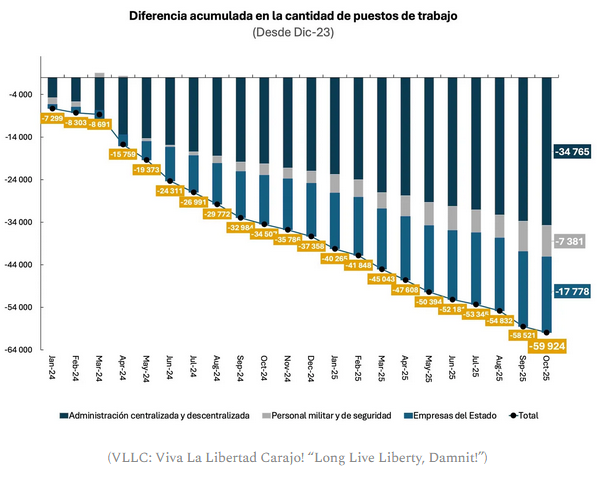
As predicted in this space, the migration from public lethargy to private innovation, from tax-funded coercion to voluntary cooperation, from ossified statism to dynamic free markets, has been an enormous boon for the Argentine economy, to say nothing of its long-enduring people.
But it also raises an interesting philosophical question regarding the very nature of “work” itself. When we left you last week, we dared ask: Who wants a job, anyway?
Today, we take up the task…
Optional Labor
The subject and nature of “labor” is, of course, as old as mankind itself. Indeed, we would not be here today, tapping away on our laptop computer, were it not for the convenient fact that enough of our forebears managed to dodge the cosmic unemployment lines such that the species itself could carry on.
Smith, Marx, Ricardo, Menger, and plenty of other bright and shiny minds besides, waxed and waned on the topic, advancing various theories to suit their time and circumstances. Today, the question is brought into higher and higher relief by accelerating advances in bright and shiny technologies, Artificial Intelligence (A.I.) and humanoid robotics in particular.
And what of those catalyzing twin phenomena, approaching a doe-eyed workforce at the infinite speed of distributed information?
Speaking at a recent investment summit in The Kingdom of Saud, the world’s most controversial envy magnet, Elon Musk, had this to say on the matter:
“In the long term, where will things end up? My prediction, for the next ten to twenty years… is that work will become optional. It will be like playing sports, or a video game. Something like that.”
Ah, but our dear reader has already foreseen the predictable reaction…
Almost as the words were falling from Mr. Musk’s monied maw, Pavlovian pooches in the comments section were decrying the fact that the “greedy capitalist” was depriving them of their beloved leg irons.
“Work being ‘optional’ is CEO-speak for workers being terminated,” cried one card-carrying comrade, evidently unable to tear himself from the drool-soaked security blanket that is his own lack of imagination.
“Why do I suspect it is we, people, who will become optional and irrelevant?” chimed another, apparently unable to differentiate his value as a human being from his temporary job title.
Setting aside the absurd implication that anyone is somehow owed a job by anyone else, much less from someone they openly resent, the notion that humans are best employed at the absolute lowest threshold that technology allows is fundamentally an anti-human attitude, one that ignores Browning’s aspirational line:
A man’s reach should exceed his grasp,
Or what’s a heaven for?
Universal Basic Poverty
Typically, humans do not so much want jobs, per se, as much as they desire the spoils of the job having been done… either by their own two hands or, so far as they harbor collectivist tendencies, by those belonging to someone (anyone) else.
And here we arrive at the crux of the matter… a crab pot mentality that, because it is unable to imagine a future unlike the past, remains hostile to any intelligent life form capable of doing so, decrying anyone whose reach dares “exceed his grasp.”
Politically speaking, this infantile convulsion is best expressed as the doctrine of socialism: the lurking suspicion that someone, somewhere is getting ahead… and that something must be done about it!
Doubtless there are those among us who wish to see humans eternally bound to their menial tasks, yoked to history’s ever-grinding millstone, lest one poppy dare grow taller than the rest. For the terminally, gleefully myopic, the only goal worth aiming at is one every layabout, every mental defective, every slacker, halfwit and ne’er-do-well can achieve… which is to say, absolute and unrelenting equality… of poverty.
And here a solution presents itself, obvious and wrong, in the form of endless drudgery as befits the lowest common denominator. After all, nothing could be easier than “accomplishing” full employment, as long as we actively retard all efficiency and technological progress along the way.
In precisely this manner the Soviets (in)famously achieved “Full Employment.” They even contrived a sassy slogan, an anthem for the ultimate boondoggle era:
“We pretend to work; they pretend to pay us.”
Taking a leaf from the Luddite’s playbook, why search for a complex solution when an elementary one is staring us in the face? Why learn to adapt, strive and aspire… when we could stifle, whine and impede?
Let us begin, then, by banning simple machines. That is to say, screw the screw, hang the pulley, and counter the lever! Imagine the swelling employment rolls, if only society could find within its overfed ranks the resolve to ax the wheel and axle!
And why halt the regression there? Perhaps we could set up a Ministry of Inefficiency, to see that no process is trimmed of its necessary lard, or a Ministry of Equality, to ensure that no single human inches ahead by way of his ideas, actions or cooperation with other such ambitious co-conspirators.
Finally, after all the fire and spark is extinguished, after the drive and ambition is snuffed out, we could all get jobs in the Argentine government.
Just don’t expect them to pay.
Stay tuned for more on the nature of man’s Works and Days in future Notes From the End of the World…
Cheers,
Joel Bowman
founder of Notes from the End of the World
P.S. For all of Bowman’s latest musings head over to his website. While you’re there, subscribe to his newsletter for all his latest analysis and insights as they’re reported in real time.

