


By J.D. ALT
The
theme and illustrations of this essay are from the new book “Paying Ourselves to Save the
Planet.”
It
might seem, as we observe the U.S. government “instantly” generating $2
trillion new dollars for direct payments and grants to people and businesses,
that the coronavirus pandemic has shed a new light on the authenticity (and
necessity) of modern money theory (MMT). But that light, if it is being shed at
all, is illuminating instead the dramatic limitations of the “standard money
theory” we insist on applying to the exigencies of an unfolding modern society
(including, but not limited to, how to deal with pandemics).
What
do I mean by “standard money theory”? I mean a very simple assumption
implicitly built into our mental models of how money works: namely, that the
only money available to sovereign governments for their spending purposes are
dollars (or euros, or yen etc.) that have been earned in private
enterprise. According to the standard theory, the government (in order to
spend) must claim a share of that privately earned money through taxation—and
if that is not adequate to meet its spending needs, it must borrow a further share
by issuing treasury bonds (government debt) which, themselves, can only be redeemed
by the collection of future taxes on private earnings. Thus, government spending to
buy the goods and services of public enterprise—those things which
profit-seeking private enterprise is unwilling or unable to provide but which
collective society requires for its vital functioning—that government spending is
literally “feeding” on the fruits of personal labor and entrepreneurship.
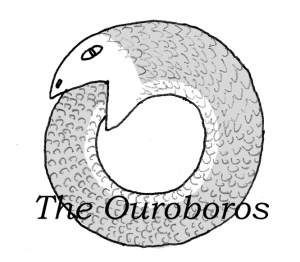
This view of the sovereign
government as the Ouroboros—the mythical snake eating its own tail—permeates our
mental models and government policies about money, taxes, and “private” versus
“public” enterprise. The snake can eat only so much of its tail before the
unimaginable happens!
This
perspective leads inexorably and inescapably to two overarching positions in
the national economic and fiscal policy debate: First, the snake must be given
free rein and nourishment to grow (to stay ahead of the consuming mouth
of public enterprise);second, public enterprise’s voracious mouth must
be forcefully held in check, lest it get ahead of the snake’s growth, and
gobble itself toward the unimaginable oblivion. The tension between these
positions has become paralyzing in today’s modern society—as is now evident in our
confrontation with the coronavirus. (It will become more evident—and more
tense—as the global climate crises unfolds.)
A
case in point is a recent news article in the Washington Post about the efforts, within the last
decade, by the federal government (spurred by the SARS epidemic) to establish a
national preparedness for the next pandemic. A study group identified one of
the weakest links to be the availability of protective respirator masks for
medical personnel. These masks, unlike other medical components, cannot be
produced ahead of time and stock-piled because they have a relatively short
shelf-life, with no way of predicting how many years they’d have to sit on
their shelves before a pandemic arrived. The federal government awarded a $5M contract
to a private medical company to design a high-speed machine that could
manufacture the protective masks—as needed—after a pandemic occurred.
The design was completed and submitted to the government in 2018—along with a
request for the next stage of funding for the more expensive task of building
and testing a prototype. This, apparently, was one “bite” too far to allow the
Ouroboros: The project was abandoned by the Trump administration— (the same
year, it should be noted, that the Ouroboros was fed a gargantuan,
growth-seeking meal of tax-cuts).
In
hindsight it was obviously a bad decision—but a decision that even political
progressives, strapped with the perspective of the Ouroboros, are virtually
helpless to counteract. Even president Obama admitted the government was
“broke,” and spent a lot of golfing hours with John Boehner negotiating a “grand
bargain” to restrain the snake’s out-of-control appetite.
But
it was only one of many relevant bad decisions driven and informed by the
standard money theory. We read about the 1980’s when, during the SARS epidemic,
big-pharma saw great potential for profit-making in the development of a
vaccine—and made significant strides in developing one, only to abandon the
effort (just closing in on the brink of achievement!) when the SARS virus
suddenly subsided: The “market” disappeared!—so what purpose (from the
perspective of a profit-oriented and profit financed business) was there in
continuing with the effort? It’s now clear that vaccine, had the final efforts
been made to develop and test it, could well have proved fateful against the
coronavirus we now confront. So, great “profit” could have resulted, but
not in the kind of “profit timeline” that profit-demanding private enterprise
requires.
So
now private enterprise starts again from scratch. Are its fingers crossed that,
this time, the pandemic will last long enough to provide a profit-making
“market”? Or has another reality taken hold? The realization that without the health
and prosperity of collective society private enterprise itself is threatened?
Does the Ouroboros now need to be given bigger, trillion dollar tax bites?
What
needs to be made clear—shouted from the media rooftops—is that another
perspective of the Ouroboros is possible—a perspective in which the tensions of
self-consumption disappear, and public enterprise is freed to pursue what is
necessary for collective society to meet its challenges and prosper. This other
perspective, of course, is modern money theory, or MMT.
MMT
views the same phenomena—the collection of taxes by the sovereign government,
the issuance of treasury bonds—but sees a completely different structure than
what the standard theory insists upon. MMT sees that taxes are spent for public
enterprise—but the purpose of taxes is not to fund public enterprise.
The purpose of taxes is to infuse the sovereign fiat money with authoritative
value. MMT sees that treasury bonds are issued when taxes fall short of the
spending needs of public enterprise—but the act of issuing treasury bonds is not
the act of “borrowing” money from the private earnings of people and
businesses. It is, instead, the act of issuing new sovereign fiat money which
subsequently lands in the spending account of public enterprise.
“Deficit
spending” is merely an accounting calculation of the difference between taxes
collected and treasury bonds issued. What the standard theory so ominously
refers to as the “national debt” is not something that ever has to be repaid to
anybody for the simple reason that they’ve already been paid (with the
treasury bonds themselves which can be exchanged/traded at any moment of the
day for sovereign fiat money).
From
the perspective of MMT, then, the Ouroboros appears as a completely different
animal!
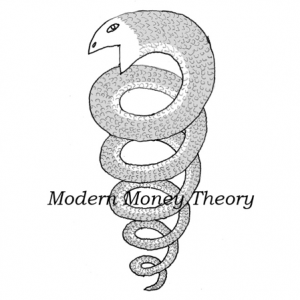
The
snake is not eating its tail at all! One might ask what, then, is the
snake feeding on if it’s not taxes and private earnings? The answer is it is
feeding on the real resources—labor, inventiveness, and materiel—which are
available to be put to work in the pursuit of public enterprise. Its feeding
has nothing to do with the availability of money but rather the opposite: the
availability of money matches the availability of the real resources which
public enterprise can marshal to accomplish its goals.
Which
brings us, of course, full circle back to what we should be seeing and
understanding in the federal government’s response to the pandemic: We are not
talking about (and shouldn’t be fretting about) collecting $2.2 trillion in new
taxes—now, or ever. Just as we won’t be talking about collecting $100
trillion in new taxes when we get serious about confronting the climate crisis.
What we’re talking about, instead, is employing trillions of dollars’ worth
of real resources—labor, inventiveness, and materiel—to accomplish the things
that private enterprise and finance cannot find a profit in doing, but which
need to be done, nevertheless.

