


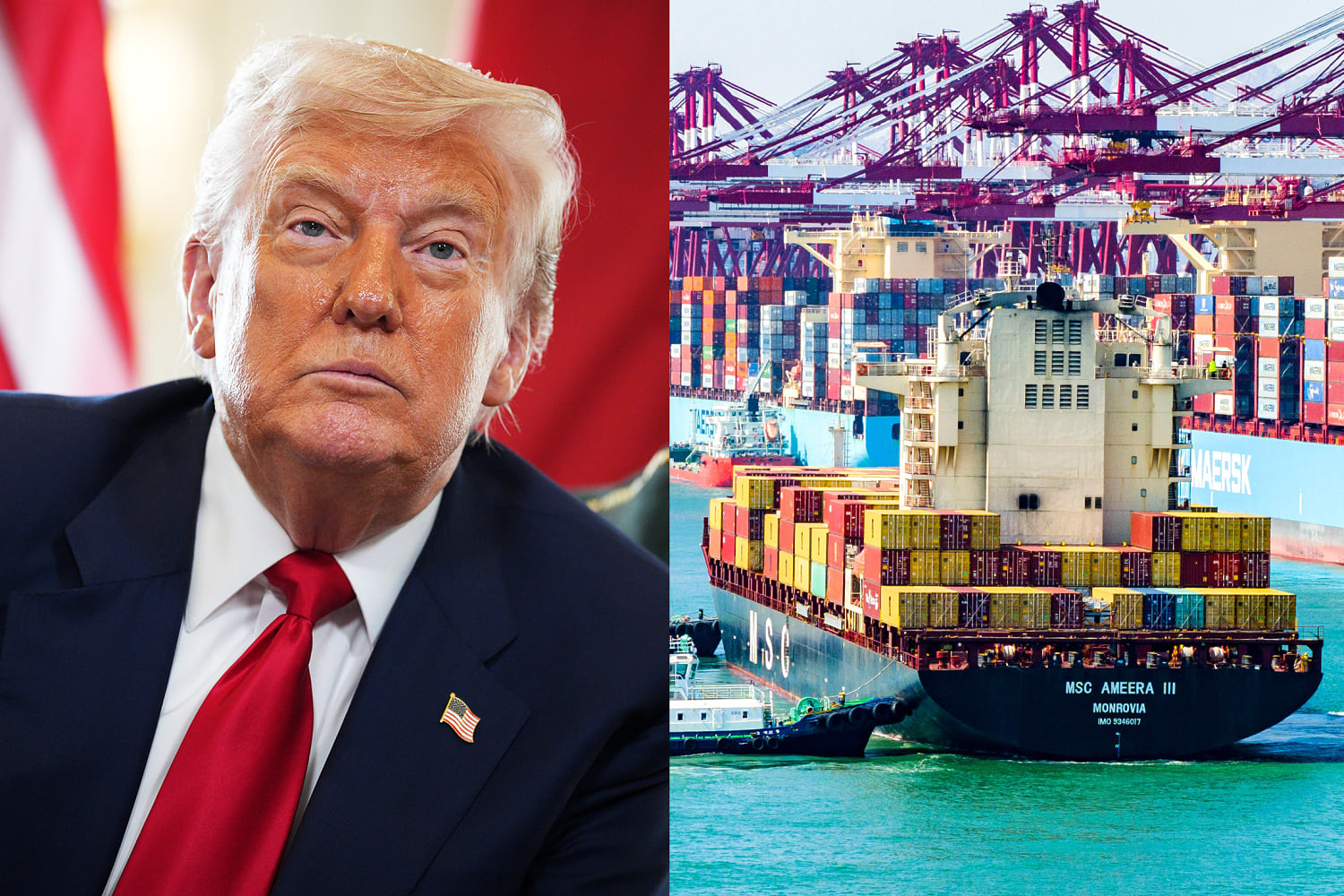
A federal appeals court said Friday that President Donald Trump had misused his authority in imposing an array of tariffs under an emergency-powers statute, ruling that only Congress has the power to apply such sweeping measures.
However, the judges said the tariffs can stay in place as the case proceeds.
“The core Congressional power to impose taxes such as tariffs is vested exclusively in the legislative branch by the Constitution,” a ruling signed by seven judges with the federal circuit court of appeals said.
“Tariffs are a core Congressional power,” it said.
The administration is expected to appeal quickly to the United States Supreme Court, which is currently composed of six conservative members and just three liberal justices. Three of the six conservatives were nominated by Trump.
In a post on Truth Social Friday evening, Trump highlighted that the tariffs would remain in effect while claiming “a Highly Partisan Appeals Court incorrectly said that our Tariffs should be removed.”
“But they know the United States of America will win in the end,” he said. “If these Tariffs ever went away, it would be a total disaster for the Country. It would make us financially weak, and we have to be strong.”
“President Trump lawfully exercised the tariff powers granted to him by Congress to defend our national and economic security from foreign threats,” White House spokesman Kush Desai said in a statement. “The President’s tariffs remain in effect, and we look forward to ultimate victory on this matter.”
Uncertainty due to the tariff-policy rollout has roiled stock markets, businesses and consumers alike for the better part of five months. The appeal court’s ruling will likely cause even more.
It affects two sets of tariffs Trump has sought to impose. The first are the country-by-country or “reciprocal” tariffs, which now range in scope from 34% for China to a 10% baseline for the rest of the world. It also affects the 25% tariff Trump imposed on some goods from Canada, China and Mexico for what the Trump administration said was a failure on the part of those countries to curb fentanyl flows.
Friday’s ruling does not impact tariffs implemented under other laws, such as 50% steel and aluminum tariffs on all other worldwide trading partners. Those tariffs were implemented under various sections of the Trade Act of 1974 and the Trade Expansion Act of 1962.
Many businesses have said tariffs have caused confusion and uncertainty and have made it extremely difficult to plan. “Retailers typically plan their inventories six to nine months in advance to meet seasonal demand. However, unpredictable and rapidly changing tariff policies are making it nearly impossible to forecast costs, place orders and manage supply chains effectively,” the National Retail Federation said in June.
V.O.S. Selections Inc., a wine and spirits importer, and Plastic Services and Products, a pipe and fittings company, sued Trump over his use of the International Emergency Economic Powers Act (IEEPA) of 1977, saying he has “no authority to issue across-the-board worldwide tariffs without congressional approval.”
The Court of International Trade initially blocked the tariffs in late May. It found that the import duties lacked “any identifiable limits” and that the law Trump cited in many of his executive orders did not “delegate an unbounded tariff authority to the President.” It also said the tariffs did not meet the test of an “unusual and extraordinary” risk to the country.
All of Trump’s tariffs on major trading partners, such as Canada, Mexico, China, the European Union, Japan, India, Brazil and a handful of other countries, have been deployed using the law.
The tariffs are a major reset of the world’s trading relations, which the president says is designed to benefit the United States.
Trump believes the taxes on imported goods will erase trade deficits and bring back manufacturing to the United States. He has touted at least $125 billion in revenue his already-existent import taxes have brought in, with hundreds of billions more pledged by a handful of countries in the form of investments. However, economists say tariffs appear to be slowing economic growth and inflation has started to tick up in recent months.
Even though use of the IEEPA law has been blocked, the administration has a number of other ways to impose import taxes if the Supreme Court also blocks its use.
For example, Trump could instruct the commerce secretary and the U.S. trade representative to launch investigations under Section 301 of the 1974 U.S. Trade Act against various trading partners, which would allow tariffs to be implemented after an investigation runs its course. He could also use Section 232 of the 1962 trade law, which he is already using for steel and aluminum duties.
There is also a never-before-used trade law, Section 338 of the Trade Act of 1930, which allows the president to impose tariffs of up to 50% on imports from countries.
Trump could also negotiate and agree to formal trade deals. So far, though, most of what he and his administration have called deals are not full-fledged pacts. Instead, they are framework agreements light on details announced on social media followed by slim executive orders.
However, formal trade deals typically take years to reach because of the highly complex nature of the U.S. and global economies. The United States alone has more than 12,000 possible tariff categories among 200 trading partners, according to the financial services firm UBS.

