


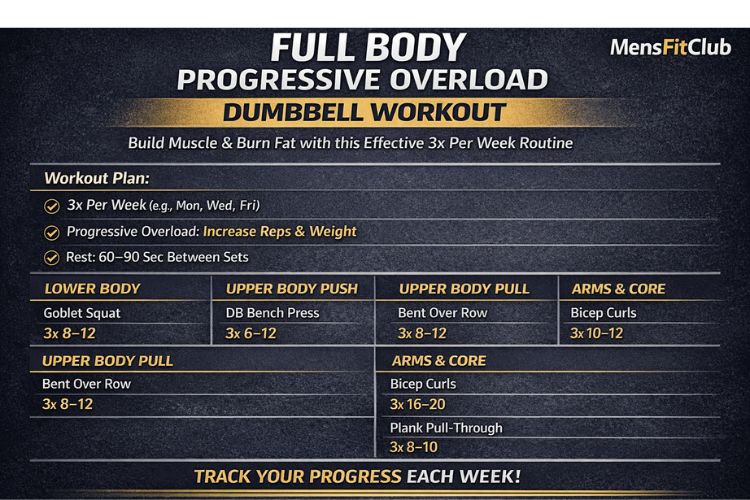
Building muscle, increasing strength, and burning fat doesn’t require a fully stocked gym. With the right plan, a pair of dumbbells can deliver exceptional full-body results. A full body progressive overload dumbbell workout is one of the most effective and sustainable training methods for men who want long-term gains without complicated programming.
Progressive overload is the foundation of muscle growth. When paired with full body dumbbell training, it creates a flexible, joint-friendly, and highly efficient workout system that works for beginners, intermediates, and advanced lifters alike. This guide breaks down exactly how to structure a full body dumbbell routine using progressive overload so you can train smarter, build lean muscle, and continuously improve.
What Is Progressive Overload Training?
Progressive overload is the gradual increase of stress placed on the body during exercise. To grow muscle and strength, your body must be challenged beyond its current capacity. When that challenge increases over time, your muscles adapt by becoming stronger, larger, and more resilient.
How Progressive Overload Works
Progressive overload can be applied in several ways:
- Increasing dumbbell weight
- Performing more repetitions with the same weight
- Adding extra sets
- Slowing down tempo for more time under tension
- Reducing rest periods
- Improving exercise technique and range of motion
When applied consistently, progressive overload prevents plateaus and ensures continuous progress.
Why Choose a Full Body Dumbbell Workout?
Full body workouts train all major muscle groups in a single session. When combined with dumbbells, this approach offers unmatched versatility and balance.
Benefits of Full Body Dumbbell Training
- Trains multiple muscle groups efficiently
- Enhances coordination and functional strength
- Allows frequent muscle stimulation throughout the week
- Reduces joint strain compared to heavy barbells
- Ideal for home workouts or busy schedules
- Supports fat loss and muscle gain simultaneously
Full body dumbbell workouts are especially effective for men who want maximum results without overtraining.
How Progressive Overload Fits Into Full Body Dumbbell Workouts
Progressive overload is easier to apply in a full body structure because each muscle group is trained multiple times per week. Instead of waiting a full week to increase stimulus, you can progress faster while managing recovery.
Weekly Progression Strategy
A full body dumbbell workout is typically performed 3–4 times per week. Each session targets:
- Legs
- Chest
- Back
- Shoulders
- Arms
- Core
By rotating rep ranges and gradually increasing volume or load, you create steady progress without burnout.
Full Body Progressive Overload Dumbbell Workout Structure
This workout is designed to be repeated weekly while applying progressive overload over time.
Recommended Frequency
- 3 workouts per week (e.g., Monday, Wednesday, Friday)
- Rest or active recovery on off days
Equipment Needed
- Adjustable dumbbells or fixed dumbbells
- Flat or adjustable bench (optional)
- Floor space
Warm-Up for Full Body Dumbbell Training
A proper warm-up prepares the joints, increases blood flow, and improves workout performance.
Dynamic Warm-Up (5–8 Minutes)
- Arm circles
- Bodyweight squats
- Hip hinges
- Shoulder rolls
- Light dumbbell presses and rows
Focus on mobility and controlled movement before loading weight.
Full Body Progressive Overload Dumbbell Workout Plan
Lower Body Exercises
Dumbbell Goblet Squat
The goblet squat targets quads, glutes, and core while reinforcing proper squat mechanics.
- Sets: 3–4
- Reps: 8–12
- Progressive overload: Increase reps first, then weight
Dumbbell Romanian Deadlift
This hinge movement builds the hamstrings, glutes, and lower back.
- Sets: 3
- Reps: 8–10
- Focus on slow eccentric control
Upper Body Push Exercises
Dumbbell Bench Press
A fundamental chest-building exercise that also trains shoulders and triceps.
- Sets: 3–4
- Reps: 6–12
- Progressive overload: Add weight once top reps are achieved
Dumbbell Shoulder Press
Builds shoulder strength and stability while engaging the core.
- Sets: 3
- Reps: 8–10
- Perform standing or seated
Upper Body Pull Exercises
Dumbbell Bent-Over Row
Targets the lats, upper back, and biceps.
- Sets: 3–4
- Reps: 8–12
- Maintain a neutral spine throughout
Dumbbell Reverse Fly
Strengthens the rear delts and improves posture.
- Sets: 3
- Reps: 12–15
- Use lighter weights with strict form
Arm Isolation Exercises
Dumbbell Bicep Curl
Isolates the biceps for arm size and strength.
- Sets: 3
- Reps: 10–12
- Control the lowering phase
Dumbbell Tricep Overhead Extension
Targets the long head of the triceps.
- Sets: 3
- Reps: 10–12
- Keep elbows tucked
Core Training Progressive Overload Dumbbell Workout
Dumbbell Russian Twist
Engages obliques and deep core muscles.
- Sets: 3
- Reps: 16–20 total
- Use controlled rotation
Dumbbell Plank Pull-Through
Builds core stability and anti-rotation strength.
- Sets: 3
- Reps: 8–10 per side
How to Apply Progressive Overload Dumbbell Workout Week to Week
Week 1: Establish Baseline
Choose weights that allow you to complete all reps with proper form.
Week 2: Increase Reps
Add 1–2 reps per set while keeping the same weight.
Week 3: Increase Weight
Once you hit the upper rep range, increase dumbbell weight slightly.
Week 4: Increase Volume or Tempo
Add an extra set or slow the eccentric phase to increase intensity.
This progression method ensures continuous improvement without overtraining.
Rest Periods for Progressive Overload Dumbbell Workout
Shorter rest periods increase workout density and metabolic demand.
Nutrition to Support Progressive Overload Dumbbell Workout
Training hard without proper nutrition limits results.
Key Nutrition Guidelines
- Consume adequate protein (0.7–1g per pound of bodyweight)
- Eat complex carbohydrates for workout fuel
- Include healthy fats for hormone balance
- Stay hydrated throughout the day
Fueling your body correctly enhances recovery and muscle growth.
Recovery and Rest Days
Muscle growth occurs during recovery, not training.
Recovery Tips
- Sleep 7–9 hours per night
- Stretch after workouts
- Use light cardio on rest days
- Avoid training to failure every session
Smart recovery allows progressive overload to work long term.
Common Mistakes in Progressive Overload Dumbbell Workout Training
Adding Weight Too Fast
Increasing weight without mastering form leads to injury and stalled progress.
Ignoring Rep Progression
Progressive overload isn’t only about heavier dumbbells—reps matter.
Skipping Warm-Ups
Cold muscles are more prone to injury and reduced performance.
Training Without Tracking
Progressive overload requires consistency and tracking workouts.
Who Should Use This Progressive Overload Dumbbell Workout?
This workout is ideal for:
- Beginners building foundational strength
- Intermediate lifters breaking plateaus
- Men training at home
- Busy professionals needing efficient workouts
- Anyone seeking lean muscle and fat loss
How Long Should You Follow This Progressive Overload Dumbbell Workout Program?
You can follow this full body progressive overload dumbbell workout for 8–12 weeks. As long as progression continues, the program remains effective.
When progress slows, deload for one week or switch rep ranges before restarting.
Full Body Progressive Overload Dumbbell Workout Training
A full body progressive overload dumbbell workout is one of the most practical and effective ways to build muscle, strength, and athletic performance. It combines simplicity with scientific training principles that stand the test of time.
By focusing on gradual progression, consistent effort, and proper recovery, you create a sustainable system for long-term fitness success. Whether your goal is muscle growth, fat loss, or overall strength, this training approach delivers real results without unnecessary complexity.
Train with intent. Track your progress. Increase the challenge over time. And let progressive overload do the rest.

